
National News
INS Mahe Commissioned In Mumbai: Indian Navy Inducts 1st Anti-Submarine Warfare Vessel; All You Need To Know

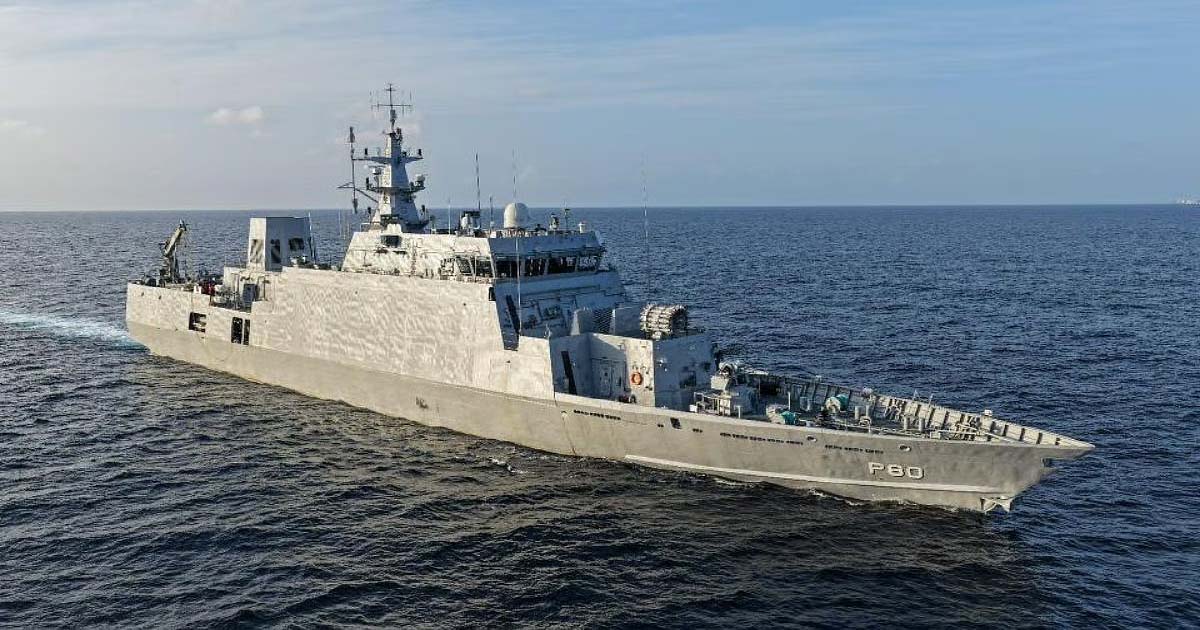
Mumbai: A major boost to India’s coastal defence capability came on Monday as the Indian Navy commissioned INS Mahe, the first vessel in the Mahe-class series of Anti-Submarine Warfare Shallow Water Craft (ASW-SWC). The ceremony, held at the Naval Dockyard in Mumbai, was hosted by Vice Admiral Krishna Swaminathan, Flag Officer Commanding-in-Chief, Western Naval Command and presided over by Army Chief General Upendra Dwivedi.
The commissioning marks the arrival of a new generation of indigenous shallow-water combatants, compact, highly manoeuvrable and designed specifically for India’s littoral warfare requirements. Built by Cochin Shipyard Limited (CSL), INS Mahe reflects the strength of the Aatmanirbhar Bharat initiative, with over 80 per cent indigenous content in its design, construction and integration. Navy officials described the vessel as ‘sleek, swift and resolutely Indian.’
INS Mahe’s primary role is anti-submarine warfare in shallow waters, an area where conventional deep-water ships face limitations. With a blend of stealth, firepower and agility, the ship will undertake submarine hunting, coastal patrol and surveillance duties, strengthening security along critical maritime approaches.
Its name pays tribute to Mahe, the historic coastal enclave on India’s Malabar Coast. The ship’s crest features the Urumi, the flexible sword of Kalaripayattu, symbolising agility, precision and lethal grace, qualities reflected in the vessel’s mission profile.
Navy officials emphasised that INS Mahe is a multi-purpose warship, capable of being deployed across a wide spectrum of operations:
Anti-submarine warfare
Coastal defence and maritime security
Underwater surveillance
Search and rescue
Mine-laying
High-precision missions in shallow waters
Its compact 78-metre frame, 2.7-metre draft, 896–1,100-ton displacement and robust water-jet propulsion enable rapid manoeuvring even in tight maritime zones, an increasingly crucial requirement in modern coastal defence.
INS Mahe is powered by a modern diesel-engine and water-jet propulsion system, allowing a top speed of 25 knots and a range of 1,800 nautical miles at cruising speed. It carries 57 crew members including seven officers and is equipped with two RHIBs for rapid response.
With an extremely low acoustic signature, the vessel is engineered to remain undetected while tracking enemy submarines. This stealth advantage is reinforced by advanced sonar systems, making it highly effective in both shallow and variable-depth waters.
The ship’s surveillance backbone is built around two state-of-the-art sonar systems:
1. DRDO Abhay Hull-Mounted Sonar
Continuously monitors underwater surroundings
Detects submarine signatures, mines and artificial objects
Optimised for shallow-water operations
2. Low Frequency Variable Depth Sonar (LFVDS)
Deployed through a cable for deep-water detection
Effective in areas where hull-mounted sonar faces limitations
Long-range, low-frequency scanning for high accuracy
Together, the systems offer round-the-clock underwater surveillance and precise target identification.
INS Mahe is armed with a range of modern weapons, making it a formidable platform for anti-submarine warfare:
12-barrel IRL Anti-Submarine Rocket Launcher
30 mm Naval Surface Gun for defence against small craft and aerial threats
Two triple lightweight torpedo launchers (six ALWT torpedoes)
Anti-submarine mines deployable via mine-laying rails
Two 12.7 mm Stabilised Remote-Controlled Guns for coastal and anti-piracy operations
The combination enables detection, tracking and elimination of hostile submarines and maritime threats across a variety of operational scenarios.
With INS Mahe joining the fleet, the Indian Navy majorly enhances its littoral warfare capability. The vessel will play a vital role in protecting India’s coastal zones, monitoring suspicious submarine activity and contributing to mission-critical operations on the Western Seaboard.
INS Mahe stands as both a strategic asset and a milestone in India’s indigenous defence manufacturing journey, further strengthening maritime security and pushing India closer to naval self-reliance.


Mumbai Press Exclusive News
Navneet Rana meets Sunitra Pawar… Is BJP preparing to send Navneet to Rajya Sabha from NCP quota, NCP senior leaders are angry

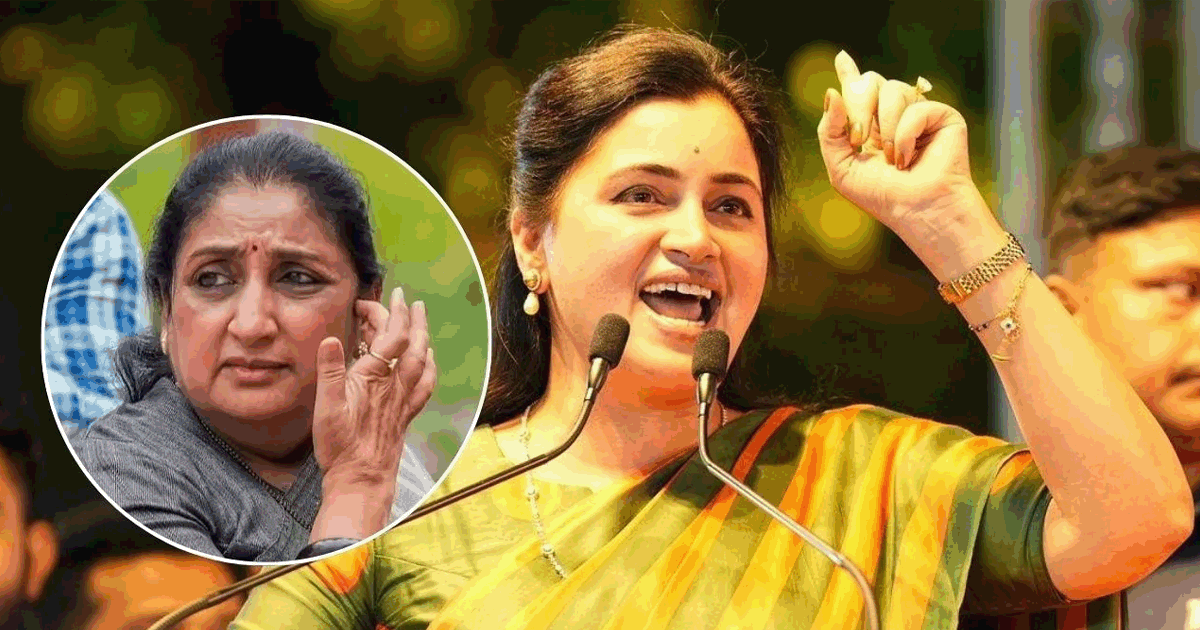
Mumbai : BJP leader Naveen Rana’s meeting with Nationalist Congress Party president Sunitra Pawar has sparked fresh debate in political circles. There are speculations that the meeting was held to deliberate on the Rajya Sabha seat that fell vacant after Sunitra Pawar resigned as an MP. After Vikram Kakde, who is outside the party, was nominated for the Pune Local Authority constituency of the Legislative Council, preparations are being made to send Naveen Rana, who has now joined the BJP, to the Rajya Sabha, a debate that has angered several senior leaders in the NCP.
Rajya Sabha seat: Chhagan Bhujbal is interested Senior party leader Chhagan Bhujbal is interested in this Rajya Sabha seat. However, after the discussion of Navneet Rana’s name started, an open discussion has started that the influence of MP Partha Pawar’s group on the decision-making process in the party has increased. It is also being said that Praful Patel is not very active in the party after his name was removed from the post of National Executive President. It is also being said that Sunil Tatkre is also angry and the number of angry leaders in the party is increasing. The last date for filing nominations for this Rajya Sabha seat is June 8, so various leaders in the party have started lobbying for this seat and efforts to get nomination are going on rapidly. After all, the focus of political circles is on who will give the party a candidate.
Navneet Rana, who was elected as an independent candidate with the support of the Nationalist Congress Party in the 2019 Lok Sabha elections, joined the BJP in 2024. However, there are talks about her political revival after her defeat in the Lok Sabha elections. It is also said that she has recently contacted some senior BJP leaders. However, it is known that she was advised to contact them because the vacant Rajya Sabha seat is in the NCP quota. It is believed that she met Sunita Pawar only after that.
Elections have been announced for 24 vacant Rajya Sabha seats and by-elections. This includes 4-4 from Andhra Pradesh, Gujarat and Karnataka, 3-3 from Rajasthan and Madhya Pradesh, 2 from Jharkhand and one each from Manipur, Meghalaya, Arunachal Pradesh and Mizoram. Apart from this, by-elections for one seat each from Maharashtra and Tamil Nadu will also be held on the same day. Voting will be held on June 18 and the results will be announced on the same day. Meanwhile, there is an important development. It is being told that former MP Naveen Rana is trying to get the Rajya Sabha nomination. The Rajya Sabha nomination from the Nationalist Congress Party quota will be announced soon. For this, Naveen Rana met Sunita Pawar and Partha Pawar on Wednesday. Yesterday, Naveen Rana and Ravi Rana also met Chief Minister Devendra Fadnavis. Therefore, it is being said that an attempt is being made to nominate Navneet Rana on the NCP quota seat. However, will Navneet Rana give up his quota seat for the NCP? This is also a question. So, will this meeting result in Navneet Rana being nominated in place of Sunitra Pawar? This will become clear in the coming days.
Rajya Sabha Seat: Amul Matkari’s social media post is under discussion, Amul Matkari has posted in this regard and said that the vacant Rajya Sabha seat of Smt. Sunitra Vahini belongs only to NCP! No one else should claim this and put up a front. The name of the NCP party is “Ajit Dada”. Therefore, the decision taken by Smt. will be final. This party is a party that is under the sway of Ajit Dada. That’s all for now.
Chandigarh, June 5: A Special CBI Court in Mohali, Punjab, has convicted and sentenced Samir Dua, a partner of M/s G.D. Ispat Udyog, Mandi Gobindgarh, to three years of rigorous imprisonment (RI) along with a fine of Rs 15,000 in connection with a multi-crore bank fraud case, an official statement said on Friday.
The sentence was pronounced on June 4, following the conclusion of trial proceedings in the case investigated by the Central Bureau of Investigation (CBI).
According to the CBI, the case was registered against Dalip Dua and Samir Dua, partners of M/s G.D. Ispat Udyog, along with other accused, for allegedly entering into a criminal conspiracy to defraud Indian Overseas Bank’s Mandi Gobindgarh branch in Punjab.
The investigation revealed that the accused had fraudulently secured a cash credit limit of Rs 4 crore from the bank by submitting false and fabricated information and documents.
The loan facility was allegedly obtained through misrepresentation, causing a wrongful loss to the bank and corresponding unlawful gain to the accused, the agency said.
Following a detailed investigation, the CBI filed a charge sheet against the accused persons before the competent court. During the trial, the prosecution presented evidence establishing the fraudulent nature of the transactions and the conspiracy behind obtaining the credit facility.
After examining the evidence and hearing the arguments, the Special CBI Court found Samir Dua guilty and sentenced him to three years of rigorous imprisonment. The court also imposed a monetary penalty of Rs 15,000.
Proceedings against co-accused Dalip Dua were abated due to his death during the pendency of the case.
The conviction marks the culmination of the CBI’s investigation into the bank fraud, underscoring the agency’s efforts to prosecute financial crimes and hold those responsible for defrauding public sector banks accountable.
National News
Rahul Gandhi, Kharge condole loss of lives in Malviya Nagar blaze; ask Cong workers to extend help
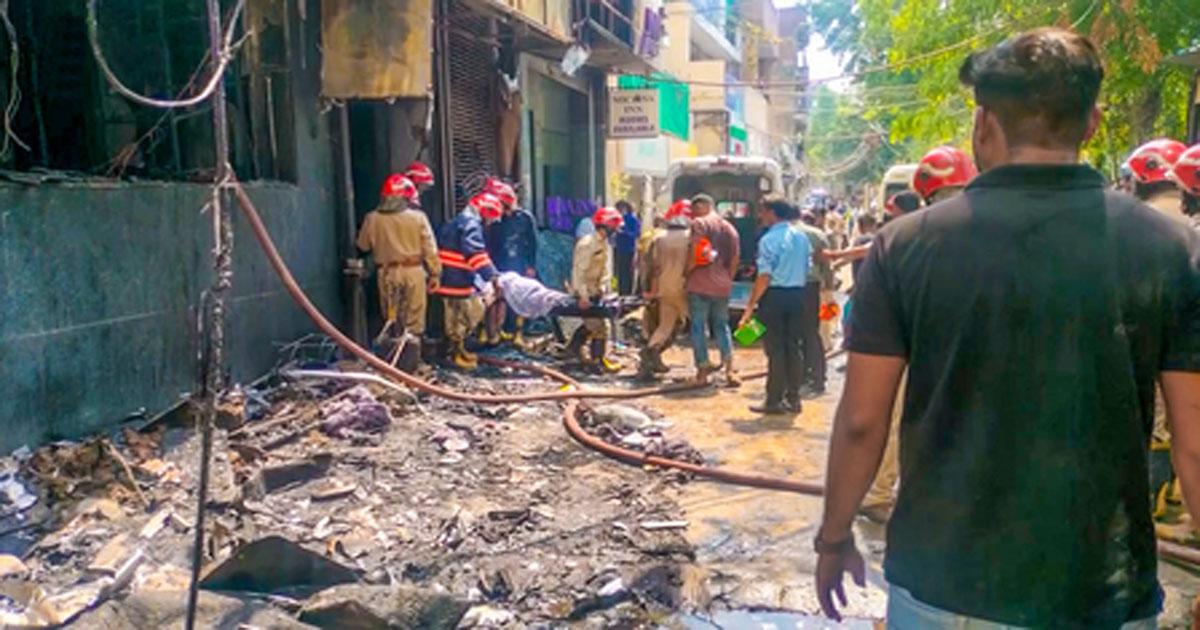
New Delhi, June 3: Congress leaders, including party President Mallikarjun Kharge, Lok Sabha Leader of Opposition (LoP) Rahul Gandhi and party MP Priyanka Gandhi Vadra, on Wednesday, expressed grief over the 20 lives lost in the tragic Delhi fire, calling the tragedy “extremely heartbreaking”. They also appealed to Congress leaders and workers to extend every possible help and support to the victims injured in the blaze and the families of the deceased.
At least 20 people were killed, and dozens were injured after a massive fire broke out at the multi-storied Lemon Green Restaurant in Malviya Nagar on Wednesday morning, officials said.
So far, 37 people were rescued and taken to the hospital, while a search for others is underway, officials added.
Congress President Mallikarjun Kharge said he was “deeply saddened” by the news.
“My heartfelt condolences to the families who lost their loved ones and prayers for the speedy recovery of the injured,” he said in a post on X.
He urged the Delhi government and authorities to provide adequate and timely compensation, “including prompt medical care to the victims”.
“I urge Congress workers to extend every possible help and support to the victims in this difficult time,” he added.
LoP Rahul Gandhi called the incident “extremely heartbreaking.”
Taking to X, he said: “I express my deepest condolences to all the bereaved families. I urge all Congress workers to contribute in every possible way to the relief and rescue operations.”
“I hope for the swift recovery of the injured,” Rahul Gandhi mentioned.
Congress MP Priyanka Gandhi Vadra echoed: “The news of the deaths of a large number of people and injuries to nearly three dozen or more due to a fire in a hotel in Malviya Nagar, Delhi, is extremely heartbreaking.”
“May God grant peace to the departed souls. My deepest condolences to the bereaved families. I pray for the swift recovery of the injured,” she wrote in a post on X.
She, too, appealed to Congress leaders and workers to extend their support to the affected people as much as possible.
Senior officials from Delhi Police, Delhi Fire Services and rescue services are present at the scene of the tragedy and were monitoring the situation.
Upon receiving information, ten fire tenders were immediately dispatched to the scene. The fire was soon brought under control. However, the damage was extensive.

Navneet Rana meets Sunitra Pawar… Is BJP preparing to send Navneet to Rajya Sabha from NCP quota, NCP senior leaders are angry

PMK urges TN govt to support paddy cultivation amid Mettur water uncertainty

Actor Salim Kumar under expert medical supervision in Kochi hospital

Islamabad records 432 sexual assault, kidnapping cases so far this year : Report

Focus where the power is, victory will be ours…In the elections, Member of Parliament Dr. Shrikant Shinde gave the workers a mantra of victory

The Municipal Corporation and the Railway Administration should work together to make Mumbai flood-free, directs Standing Committee Chairman Prabhakar Shinde

Mumbai: Strict action directed against prominent Marathi placards in shops and institutions, warning of action in Shiv Sena style: Deputy Mayor Sanjay Ghadi

Virar Citizens Protest Demolition Drive In Arnala; Police Block Lal Bawta March, Sit-in Held On Road

Dangerous Love Triangle In Mira-Bhayandar: Youth Kidnapped, Brutally Beaten, & Burned With Cigarettes Over Affair With Same Girl

Israel captures strategic Beaufort Castle in southern Lebanon
-

 Crime4 years ago
Class 10 student jumps to death in Jaipur
-

 Maharashtra2 years ago
Mumbai Local Train Update: Central Railway’s New Timetable Comes Into Effect; Check Full List Of Revised Timings & Stations
-

 Maharashtra2 years ago
Mumbai To Go Toll-Free Tonight! Maharashtra Govt Announces Complete Toll Waiver For Light Motor Vehicles At All 5 Entry Points Of City
-

 Maharashtra2 years ago
False photo of Imtiaz Jaleel’s rally, exposing the fooling conspiracy
-

 National News2 years ago
Ministry of Railways rolls out Special Drive 4.0 with focus on digitisation, cleanliness, inclusiveness and grievance redressal
-

 Maharashtra2 years ago
Maharashtra Elections 2024: Mumbai Metro & BEST Services Extended Till Midnight On Voting Day
-

 National News2 years ago
J&K: 4 Jawans Killed, 28 Injured After Bus Carrying BSF Personnel For Poll Duty Falls Into Gorge In Budgam; Terrifying Visuals Surface
-

 Crime2 years ago
Baba Siddique Murder: Mumbai Police Unable To Get Lawrence Bishnoi Custody Due To Home Ministry Order, Says Report