
Business
India’s CPI inflation recorded at 1.33 pc for Dec, food inflation stays in negative zone


New Delhi, Jan 12: India’s inflation rate, based on the Consumer Price Index (CPI), was estimated at 1.33 per cent for December 2025, which is marginally higher than the corresponding figure of 0.71 per cent for November.
Food inflation remained in the negative zone during December at (-) 2.71 per cent, as prices of food goods fell compared to the same month of the previous year. Food inflation has now stayed negative for the seventh month in a row, easing the burden on household budgets. However, the figure for December was a tad higher than the (-) 3.91 per cent recorded for November.
The increase in headline inflation and food inflation during December 2025 is mainly attributed to an increase in inflation of personal care and effects, vegetables, meat and fish, egg, spices, and pulses, according to an official statement.
However, the overall outlook for inflation remains benign. The RBI’s monetary policy committee (MPC) last month slashed its forecast for India’s inflation rate for the financial year 2025-26 to 2 per cent from 2.6 per cent predicted in October due to the sharp decline in food prices and the GST rate cuts playing out.
RBI Governor Sanjay Malhotra announced a reduction in the repo rate by 25 basis points to 5.25 per cent from 5.5 per cent earlier, as inflation has come down and the monetary policy could focus on boosting growth.
Malhotra said that the surge in economic growth to 8.2 per cent in the second quarter of the current financial year and the sharp decline in inflation to 1.7 per cent provided a rare “Goldilocks period” for the Indian economy.
“The MPC noted that headline inflation has eased significantly and is likely to be softer than the earlier projections, primarily on account of the exceptionally benign food prices. Reflecting these favourable conditions, the projections for average headline inflation in 2025-26 and Q1:2026-27 have been further revised downwards.”
Malhotra also pointed out that core inflation (which excludes food and fuel) remained largely contained in September-October, despite continued price pressures exerted by precious metals. Excluding gold, core inflation moderated to 2.6 per cent in October. Overall, the decline in inflation has become more generalised, he added.
The RBI Governor observed that food supply prospects have improved on the back of higher kharif production, healthy rabi sowing, adequate reservoir levels and conducive soil moisture. Barring some metals, international commodity prices are likely to moderate going forward.

Business
PM Narendra Modi’s Appeal On Gold Buying Sparks Employment Concerns; More Than 1 Crore People Directly Employed In Jewellery Industry

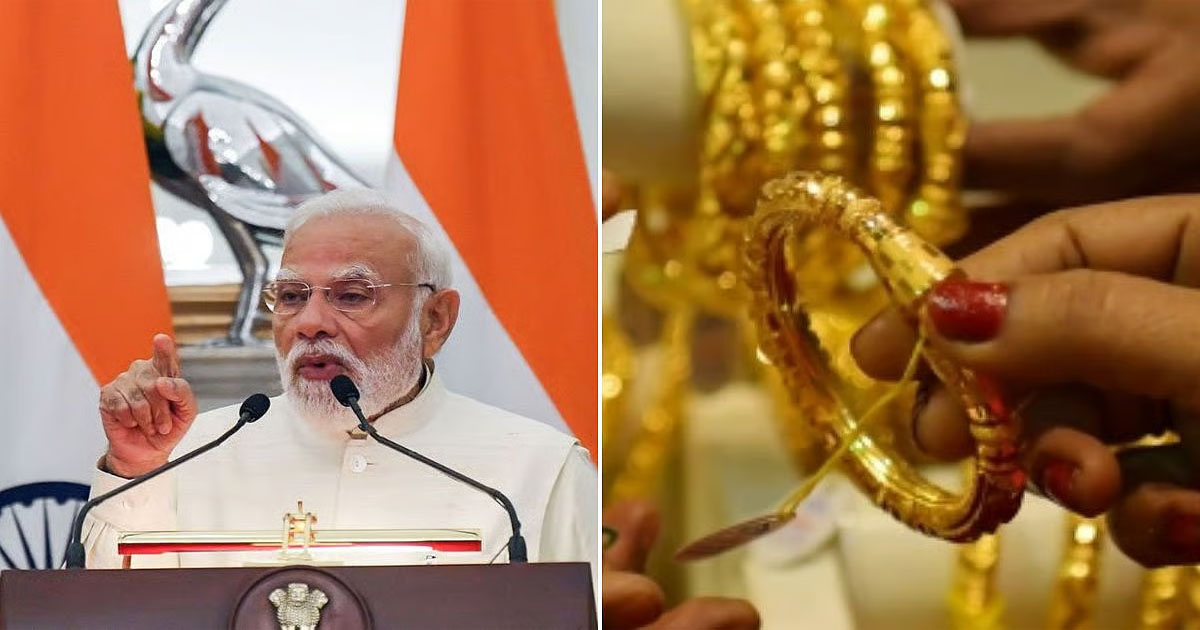
Mumbai: India’s gem and jewellery industry has warned that any broad reduction in gold jewellery purchases could impact employment linked to the sector, which supports over one crore people directly and several allied industries indirectly.
Responding to PM Narendra Modi’s appeal to avoid buying gold for a year amid rising geopolitical tensions in West Asia, All India Gem and Jewellery Domestic Council (GJC) chairman Rajesh Rokde said the industry supports the government’s national interest concerns but cautioned against measures that could hurt livelihoods.
“Whatever the Prime Minister has said is absolutely correct from the perspective of patriotism and national interest,” Rokde said.
“More than one crore people are directly employed in the industry. Insurance, banking, furniture, packaging and logistics sectors are also dependent on jewellery trade,” he said, warning that restrictions on jewellery buying could raise concerns over unemployment.
At the same time, Rokde supported discouraging bullion and coin purchases made purely for investment purposes. “Stopping unnecessary buying of bullion and coins is absolutely right,” he said.
The industry has instead urged the Centre to strengthen and modernise the Gold Monetisation Scheme (GMS) to bring idle household gold into the formal economy and reduce dependence on imports.
According to Rokde, Indians are estimated to hold around 40,000 to 50,000 tonnes of gold. “If even 10-20% of this gold is monetised, India may not need to import gold for the next 10 years,” he said, adding that the GJC has already submitted an end to end monetisation proposal to the government.
GJC vice-chairman Avinash Gupta said gold remains significant for Indian households, but excessive imports also affect the current acc ount deficit and foreign exchange reserves. He said a properly regulated GMS could help channel dormant household gold into the financial system.
Meanwhile, the digital precious metals industry has launched the Digital Precious Metals Assurance Council of India (DPMACI), a self-regulatory body formed by firms including MMTC-PAMP, SafeGold, Augmont, PhonePe, BharatPe, Mobikwik, Gullak, Lenden Club and CRED to improve transparency and consumer protection in the digital gold and silver market.

New Delhi, May 9: Gold prices rose 1.83 per cent during the week over persistent geopolitical uncertainty and volatile crude prices.
On Friday, MCX gold June futures gained 0.04 per cent while MCX silver May futures surged 1.34 per cent. Currently gold futures stand at Rs 1,52,589, while silver futures at Rs 2,61,999 per kg.
The price of 10 grams of 24-carat gold was at Rs 1,51,078 on Friday up from Rs 1,48,357 seen on Monday market opening, according to data published by the India Bullion and Jewellers Association (IBJA).
Precious metals continued to rise for four consecutive sessions as optimism over a potential US‑Iran peace agreement and a softer US dollar outweighed a stronger‑than‑expected US jobs report.
US jobs data showed that employment rose more than forecast in April while the unemployment rate held at 4.3 per cent, underscoring resilience in the labour market and reinforcing expectations that the Federal Reserve may keep interest rates higher for longer.
Central banks maintaining interest rates higher for longer, could pressure non-yielding assets like gold.
In international markets, Comex gold climbed about $50 to a session high of $4,760 per troy ounce, posting a weekly gain near 1.5 per cent. Market participants said the prospect of easing regional tensions and a weaker dollar supported demand for non‑yielding bullion.
Gold and silver have fallen nearly 10 per cent since the US-Iran conflict began on February 28.
The broader safe-haven structure remains intact, though the pace of the rally has moderated as the dollar steadies and broader risk sentiment shows tentative signs of improvement, market participants said.
Despite commodities flow disruption in the Strait of Hormuz dominating the macro narrative, markets are also entering a phase of technical consolidation following the sharp swings witnessed in recent weeks, analysts said.
Precious metals are witnessing mixed price action, with gold and silver attempting to stabilise after recent corrective pressure.
West Asian tensions were rekindled on Thursday after US and Iranian forces exchanged attacks near the strait, though US officials said the ceasefire remained in place.
Immediate resistance for MCX Gold is placed at Rs 1,54,000–Rs 1,55,500, and immediate support is seen near Rs 1,50,000–Rs 1,48,000, analysts said.
For MCX Silver, the Rs 2,65,000 zone acts as immediate resistance, and the Rs 2,60,000–Rs 2,58,000 zone now serves as immediate support, they added.

New Delhi, May 7: US tech giant Apple has announced an investment of Rs 100 crore to support the development of renewable energy infrastructure in India as part of its broader sustainability and carbon neutrality goals.
The company said the investment will be made in collaboration with CleanMax, one of India’s leading renewable energy developers, to help build more than 150 megawatts of new renewable energy capacity across the country.
According to the iPhone maker, the planned capacity would be enough to power nearly 1.5 lakh Indian households annually and may be expanded further in the coming years.
The initiative is aimed at strengthening renewable energy adoption across Apple’s supply chain operations in India and supports the company’s target of becoming carbon neutral across its entire footprint by 2030.
“At Apple, our commitment to the environment is also a driving force for innovation across the company and around the world,” said Sarah Chandler, Apple’s Vice President of Environment and Supply Chain Innovation.
“We are proud to expand our efforts to invest in India’s clean energy economy and protect the country’s precious natural resources,” she added.
Moreover, the US-headquartered firm had earlier partnered with CleanMax on rooftop solar projects to power its offices and retail stores in India with 100 per cent renewable energy.
Apart from renewable energy investments, it also announced new partnerships in India focused on reducing plastic pollution and promoting green entrepreneurship.
The company said it is working with WWF-India to support recycling and waste management initiatives to improve material recovery and reducing plastic leakage into ecosystems.
The iPhone maker is also partnering with Acumen to provide grants and mentorship support to early-stage green enterprises working in areas such as waste management, regenerative agriculture, and circular economy solutions.

Shocking Video! Man Gets Trapped Between Train & Platform At Andheri Station; Commuters Panic

Another Watermelon Scare After Mumbai’s Pydhonie Family Death: 15-Year-Old Dies, 3 Hospitalised In Chhattisgarh – Details Here

NTA cancels NEET-UG 2026 exam, announces retest; CBI to probe

NEET UG 2026 Exam Cancelled, 22.79 Lakh Candidates Affected: What Now?

EOW Files C Summary Report In Esplanade Court In ₹122.85 Crore Solar Krishi Urja Vahini 2.0 Tender Fraud Case

‘Son Falsely Implicated, We Are Well-Educated’: Father Of Accused Tausif Attar Defends Son After Skullcap, Namaz Coercion Allegations Rock TCS Nashik

Mumbai: 15th arrest in Rohit Shetty shooting case, shooter identified, arrested, more arrests possible

Maharashtra Shock: 22-Year-Old Arrested For Exploiting & Blackmailing Multiple Women In Kolhapur; Love Jihad Angle Suspected

27 Years After Gangster Sadiq Kalia’s Encounter By Daya Nayak, His Nephew Arrested For Alleged Revenge Killing In Mumbai

Google to invest up to $40 billion in Anthropic amid global AI race
-

 Crime4 years ago
Class 10 student jumps to death in Jaipur
-

 Maharashtra2 years ago
Mumbai Local Train Update: Central Railway’s New Timetable Comes Into Effect; Check Full List Of Revised Timings & Stations
-

 Maharashtra2 years ago
Mumbai To Go Toll-Free Tonight! Maharashtra Govt Announces Complete Toll Waiver For Light Motor Vehicles At All 5 Entry Points Of City
-

 Maharashtra2 years ago
False photo of Imtiaz Jaleel’s rally, exposing the fooling conspiracy
-

 National News2 years ago
Ministry of Railways rolls out Special Drive 4.0 with focus on digitisation, cleanliness, inclusiveness and grievance redressal
-

 Maharashtra1 year ago
Maharashtra Elections 2024: Mumbai Metro & BEST Services Extended Till Midnight On Voting Day
-

 National News2 years ago
J&K: 4 Jawans Killed, 28 Injured After Bus Carrying BSF Personnel For Poll Duty Falls Into Gorge In Budgam; Terrifying Visuals Surface
-

 Crime2 years ago
Baba Siddique Murder: Mumbai Police Unable To Get Lawrence Bishnoi Custody Due To Home Ministry Order, Says Report