
National News
How can Sonia, Rahul know significance of Vande Mataram: BJP

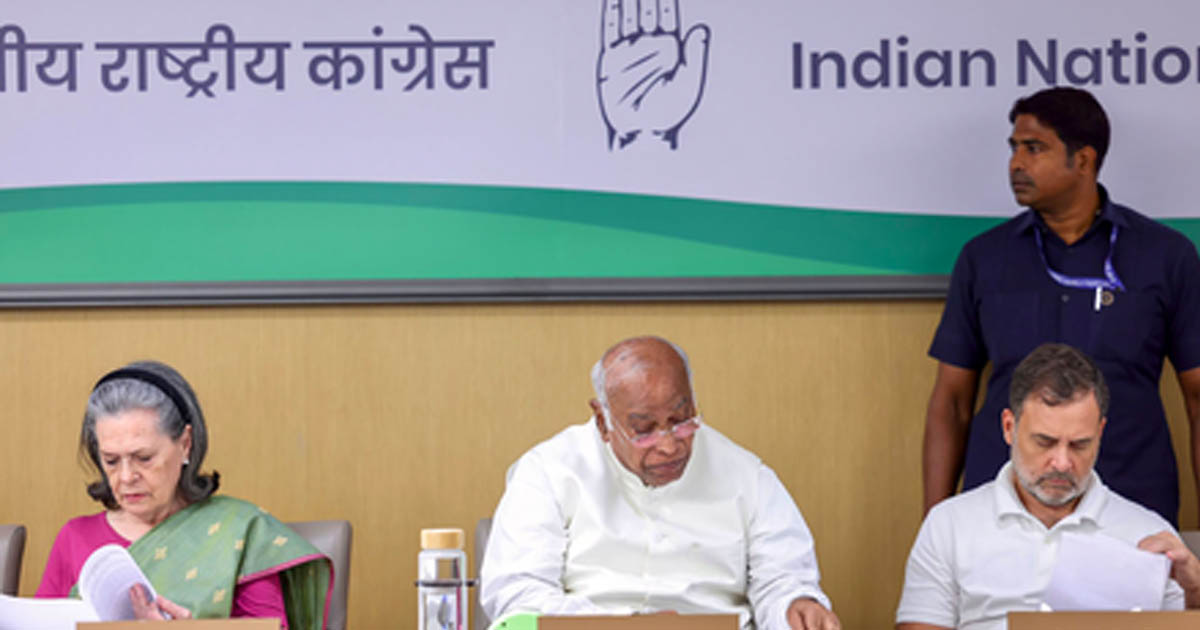
The Bharatiya Janata Party (BJP) on Thursday launched a fresh attack on the Congress over the decision of its Working Committee to continue with the practice of singing only the first two stanzas of the national song ‘Vande Mataram’ at party programmes, accusing the grand old party of disrespecting the national song and the sentiments associated with it.
The BJP’s reactions came a day after the Congress Working Committee (CWC) resolved to continue following the tradition established through a 1937 CWC decision, under which only the first two stanzas of ‘Vande Mataram’ are recited during Congress events.
The decision has assumed significance as the Centre has recently made the complete rendition of the national song part of official protocol.Reacting sharply to the Congress decision, Madhya Pradesh Minister Vishwas Sarang accused the party of dividing not only the country but also the national song, while questioning the Congress leadership’s understanding of the historical significance of ‘Vande Mataram’.
Sarang, speaking to IANS, said, “The Congress has divided this country and has also divided Vande Mataram. The Congress has been committing this sin. Whether it was Nehru, Indira Gandhi, Rajiv Gandhi or Sonia Gandhi, they have all been involved. Just four days ago, look at the way Sonia Gandhi insulted Vande Mataram. You talk about dividing the country, and you are dividing Vande Mataram.”He further highlighted the role of ‘Vande Mataram’ during India’s freedom struggle and said the song had served as a source of inspiration for those freedom fighters who fought against British rule.
“How can Sonia Gandhi and Rahul Gandhi know the significance of Vande Mataram?” Sarang said.
BJP leader Brij Bhushan Sharan Singh also criticised the Congress, alleging that the party frequently takes positions that hurt the sentiments of a large section of the country’s population.”Congress does everything that hurts the sentiments of the majority of people in this country. It does everything that goes against them, and Congress needs to look at itself in the mirror,” Singh told IANS.
He further attributed the Congress’ present political position to what he described as the party’s double standards and said that its approach had contributed to its decline despite its long political history.”It is because of this very double standards that, despite being the largest and oldest party, it has reached this stage today,” Singh said.Bihar government minister Vijay Sinha launched a strong attack on the Congress over its decision, accusing the party of being influenced by what he described as appeasement politics and questioning its understanding of Indian culture and the national song.
Speaking to IANS, Sinha said, “Congress is mentally enslaved, and the people in Congress are like bonded labourers. Such appeasement decisions at the behest of Sonia Gandhi, who is far removed from Indian culture and doesn’t even understand the meaning of ‘Vande Mataram’, would be suicidal.””This country will not accept anyone who doesn’t respect Mother India,” he added.Meanwhile, Maharashtra BJP MLA Ram Kadam said that ‘Vande Mataram’ had played a crucial role in inspiring revolutionaries and freedom fighters during India’s struggle for Independence.
Speaking to IANS, Kadam said, “Vande Mataram was the slogan of the revolutionaries and a source of inspiration during the freedom struggle. Many patriots went to the gallows, endured imprisonment and suffered lathi charges while chanting Vande Mataram.”Kadam alleged that the Congress had repeatedly criticised or questioned the national song and said that its recent position had drawn “widespread criticism from people across the country”.Meanwhile, the Congress continues to maintain its longstanding practice of singing the first two stanzas like it did during its struggle for India’s Independence and even after the nation became free.


The Delhi High Court on Wednesday questioned whether Cockroach Janata Party (CJP) leaders Saurav Das and Ashutosh Ranka could technically be described as Gen Z, after being informed that they were 27 and 32 years old, respectively, while hearing their plea challenging the extension of their judicial custody in the Jantar Mantar trespassing case.
A single-judge Bench of Justice Subramonium Prasad made the oral observations while hearing submissions by advocate Abhik Chimni, appearing for the two activists, who sought their release on personal bonds after the Special Executive Magistrate (SEM) rejected their sureties and extended their custody.
When Chimni informed the High Court about the ages of the two petitioners, Justice Prasad remarked, “Then you are not Gen Z. What is Gen Z?” After being told that people born after 1997 are generally considered Gen Z, the High Court reiterated that the petitioners did not fall within that category.
The Delhi High Court also questioned how the nature of protests and the causes associated with them had evolved, observing that although students and young people had participated in earlier protests, the cause being pursued had since changed.
“Earlier, it was a student protest; children were there, but now it’s another cause. These people remain the same, but the cause is changed,” Justice Prasad orally remarked.
The judge then questioned the association of those organising such demonstrations and the purpose behind it, observing that these aspects could assume significance when authorities examined the possibility of a breach of peace and public tranquillity.
“When there is apprehension of breach of peace and tranquillity, all these questions will assume importance. What is your association? What is the purpose of the association?” the High Court remarked.
It added that such questions assumed significance when authorities were required to assess the likelihood of a breach of the peace and disturbance of public tranquillity.
Justice Prasad observed that these issues could be examined in appropriate proceedings, but the immediate question before it concerned the insistence on furnishing bonds.
During the hearing, Chimni challenged the rejection of the sureties furnished by the petitioners and argued that the decision was legally unsustainable. He sought their release on the basis of personal bonds, contending that preventive custody could not be imposed arbitrarily.
However, the High Court questioned whether the rejection of sureties could be termed illegal and whether the SEM court’s order was amenable to a statutory revision. It also questioned the petitioners’ decision to invoke the High Court’s writ jurisdiction under Article 226 of the Constitution when an alternative remedy of filing a revision petition was available.
Observing that there was a distinction between the maintainability of a petition and whether it ought to be entertained at that stage, Justice Prasad indicated that the petitioners should first await the outcome of the proceedings before the SEM court.
The judge also referred to the breach of bonds furnished by the activists earlier and their subsequent presence at Jantar Mantar, which had been denotified as a designated venue for demonstrations.
The Delhi High Court said that the challenge to the denotification was pending before the Supreme Court and that the notification had not been stayed.
Questioning the need to pursue High Court proceedings before the SEM court took up the matter later in the day, Justice Prasad suggested that the petitioners withdraw the plea and consider their legal options after the proceedings at 2 p.m. “Would it not be better for you to withdraw this, see what happens at 2 PM and then follow the course of law. It is for you to make a decision,” the judge said.
After the matter was passed over to enable the counsel to take instructions, Chimni informed the High Court that the petitioners wished to withdraw the plea. The Delhi High Court permitted the withdrawal and disposed of the petition without expressing any opinion on the merits of the case, leaving all contentions open.
The development came on the day the judicial custody of the two activists was due to end, with both scheduled to be produced before the SEM court. On Monday, SEM Ritu Raj had extended their custody, observing that their conduct “shows no respect for law” and reflected their “habitualness in calling protest at de-notified areas”.
The SEM court had recorded that the investigating officer placed material on record indicating a likelihood of a breach of peace and disturbance of public tranquillity. It also recorded that the two activists had allegedly breached bonds furnished before the SEM, South-West District, on October 11, and subsequently committed a breach of peace in the present case.
Das and Ranka, along with CJP member Ajinkya Shinde, were among 14 people detained on October 13 after they allegedly entered Jantar Mantar through private premises and obstructed police personnel from discharging their official duties.
The CJP members were protesting against alleged irregularities in the Special Intensive Revision (SIR) of electoral rolls and had raised slogans against Chief Election Commissioner (CEC) Gyanesh Kumar.
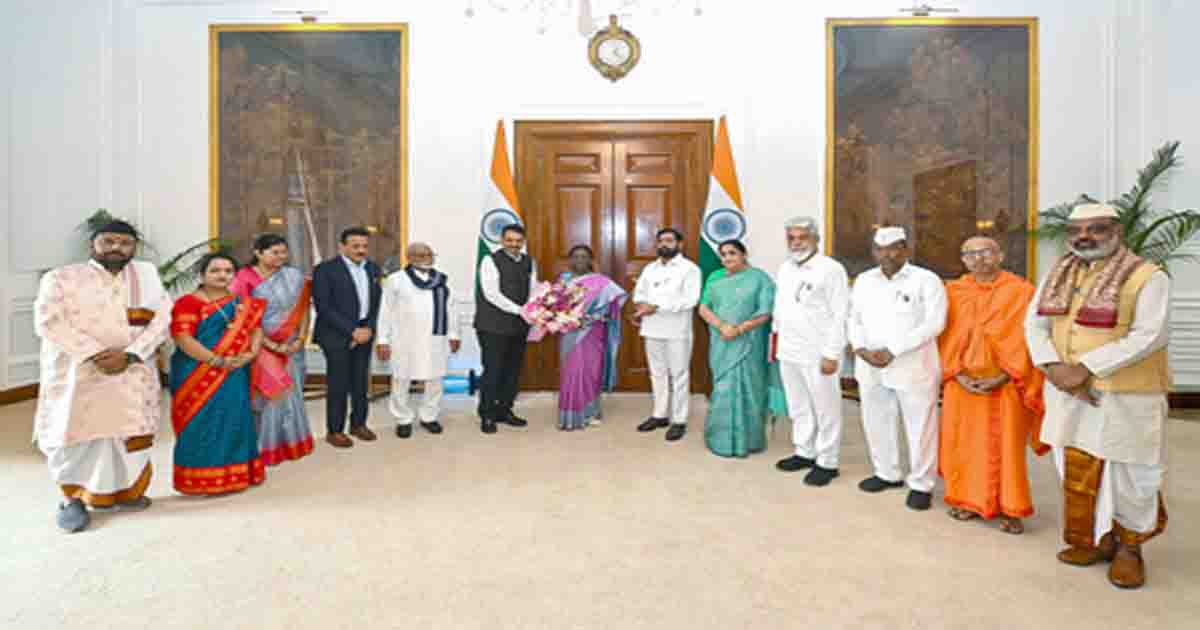
Maharashtra government led by Chief Minister Devendra Fadnavis on Monday called upon President Droupadi Murmu at Rashtrapati Bhavan to officially invite her to the flagship flag-hoisting ceremony of the grand Simhastha Kumbh Mela, scheduled for October 31 at Nashik and Trimbakeshwar.
The delegation included Deputy Chief Ministers Ekanth Shinde and Sunetra Pawar, alongside key cabinet ministers and senior administrative officials.
President Murmu was formally invited to grace the ceremonial flag-hoisting event on October 31, which marks the official commencement of the sacred Simhastha Kumbh Mela festivities across Nashik and Trimbakeshwar.
The President was also invited to participate in a series of landmark launch events slated for the inaugural day, including the grand Goda Aarti on the banks of the Godavari River, launch of the official Nashik-Trimbakeshwar Kumbh Mela Authority portal, release of the official Kumbh Mela Anthem (Geet), a commemorative Coffee Table Book and release of a dedicated Kumbh Mela Postage Stamp, said the government release.
During the audience, Chief Minister Fadnavis presented President Murmu with a specially designed artistic invitation box along with a unique gift hamper showcasing Maharashtra’s rich spiritual heritage, tribal entrepreneurship, textile artistry, agricultural bounty, and culinary traditions.
The Hamper included natural incense sticks, coarse grain food products, Mahua flower products, handcrafted bamboo artefacts, and wild forest honey—highlighting sustainable resource management and tribal artisan self-reliance. Besides, the authentic Yeola Paithani saree, symbolising Maharashtra’s traditional weaving legacy, was also part of the hamper.
The agricultural & regional specialities included Black raisins, cashews, traditional Nashik chivda, selected sweets, and dry fruits representing the agricultural wealth and local flavour of Nashik, stated the release.
Recently, CM Fadnavis reviewed the infrastructure and development preparations for the upcoming Nashik-Trimbakeshwar Simhastha Kumbh Mela (scheduled from October 2026 through July 2028, with core sacred bathing rituals centred in 2027).
CM Fadnavis inspected critical sites across the twin temple towns of Nashik and Trimbakeshwar. He expressed strong satisfaction with the construction velocity, stating that key interventions—such as ghat development, pilgrim pathways (like the Darshan Path), and major road decongestion projects—are advancing smoothly and will meet their scheduled deadlines.
He acknowledged that several infrastructure developments (such as the Goda Ghat and Trimbakeshwar Darshan Path) are complex and challenging, but praised the seamless coordination among state agencies like Maharashtra State Road Development Corporation and local authorities.
A comprehensive master plan worth Rs 1,100 crore has been deployed specifically for Trimbakeshwar. This covers the restoration and beautification of holy water tanks (Kunds) like Kushavarta, temple conservation, new road networks, parking complexes, and dedicated sanitation facilities.
Key infrastructural milestones include fast-tracking projects at Dwarka Circle (including advanced drainage system tests to prevent monsoon waterlogging), expanding connectivity via wider roads, and building a dedicated Sadhugram space through land acquisition and Town Planning schemes.
To handle massive pilgrim influxes, the state is facilitating major expansion works at Ozar Airport alongside arrangements at Shirdi Airport and plans for multiple helipads around Nashik to streamline VIP and tourist travel.
CM Fadnavis emphasised making the event a blend of deep-rooted faith and modern technology. Plans include virtual/augmented experiences for devotees worldwide who cannot physically partake in the holy dips.
A major priority of the administration is the comprehensive purification of the Godavari River and its local tributaries, alongside advanced Sewage Treatment Plant (STP) setups.
To ensure seamless crowd control, streamlined resource allocation, and absolute administrative clarity during the massive influx of pilgrims, the state government proposed enacting a dedicated Kumbh Mela Authority Act to vest core executive powers directly within a specialised administrative body.
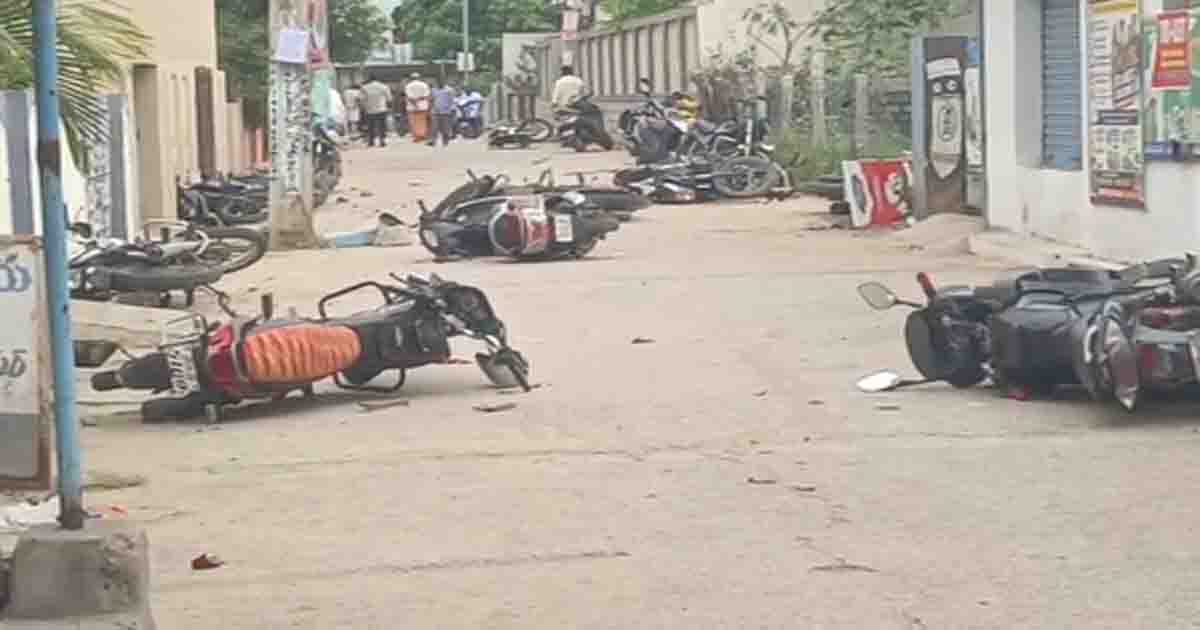
Filing of nominations for MPTC and ZPTC elections in Andhra Pradesh began on a violent note on Wednesday with attacks on candidates and leaders of the opposition YSR Congress Party, including Former Deputy Chief Minister K. Narayana Swamy.
YSR Congress Party (YSRCP) blamed Telugu Desam Party (TDP) and its allies in the ruling coalition for the attacks.
The opposition party alleged that violence, attacks and intimidation continued across the state.
YSRCP candidates and leaders faced physical attacks, destruction of nomination papers, police restrictions and illegal arrests in several constituencies. TDP and coalition leaders obstructed opposition candidates from filing nominations, while police failed to prevent the violence, it alleged.
Elections to Mandal Parishad Territorial Constituencies (MPTCs) and Zilla Parishad Territorial Constituencies (ZPTCs) are scheduled to be held on November 3.
In Chittoor district, TDP cadres allegedly attacked former Deputy Chief Minister Narayana Swamy near the Zilla Parishad Chairman’s office when he arrived to facilitate the filing of a ZPTC nomination from Penumuru.
According to YSRCP, its leaders were injured in the attacks by TDP cadres in Chandragiri, Tirupati district.
Former MPTC member Madan Reddy and YSRCP supporters Ramu and Lokesh suffered serious head injuries and were shifted to a government hospital. The attacks took place in the presence of Pulivarthi Vineel, son of TDP MLA Pulivarthi Nani, according to YSRCP leaders. They also accused him of bringing outsiders from Tamil Nadu to create violence.
The opposition party alleged that police failed to prevent the attacks.
In Srikalahasti in Tirupati district, a two-wheeler belonging to a YSRCP supporter who arrived to participate in the nomination process was damaged and set on fire near the MPDO office. TDP leaders also allegedly threatened YSRCP candidates attempting to file nominations.
YSRCP alleged that Jana Sena MLA Arava Sridhar and Jana Sena leaders obstructed the filing of nominations in Railway Koduru in Tirupati district. The opposition party also alleged attack on its supporters.
Local YSRCP leaders confronted the police and demanded that all YSRCP candidates be allowed to file nominations.
Police placed former MLA Brahmanaidu under house arrest, preventing him from assisting YSRCP candidates during the nomination process in Narasaraopet in Palnadu district.
Police arrested YSRCP State Executive Council member and Macherla constituency observer Kommineni Venkateswarlu when he arrived to support candidates filing MPTC nominations in Piduguralla Mandal in Palnadu district.
TDP cadres allegedly attacked YSRCP candidates who arrived at the Mandal office to file MPTC nominations in Macherla in Palnadu district. The attackers forcibly snatched nomination papers from the candidates, obstructing the nomination process.
YSRCP said these incidents demonstrate the continuing obstruction faced by YSRCP candidates during the MPTC and ZPTC nomination process.
The opposition party demanded immediate protection for candidates, action against those responsible for violence and an end to police interference in the election process.

‘Then you are not Gen Z’: Delhi HC questions CJP leaders Saurav Das, Ashutosh Ranka

Public will never accept this: NDA on Uddhav Thackeray ‘saffron identity’, ‘regime change’ remarks

Maha govt invites Prez Murmu to Simhastha Kumbh Mela flag hoisting

YSRCP alleges attacks on its leaders as nominations for MPTC, ZPTC polls begin

Delhi police bust inter-state car theft racket, two arrested; five stolen vehicles recovered

Rahul, Cong ecosystem want to force regime change: BJP after Neha Bora praises B’desh Gen-Z protest

BJP pays tribute to ex-President Abdul Kalam, recalls his enduring influence on generations of India’s youth

Attack on democratic rights: INDIA Bloc leaders on detentions of anti-ECI protestors

INDIA bloc begins protest march against ECI

Maha Congress stages agitation against Gyanesh Kumar
-

 Crime4 years ago
Class 10 student jumps to death in Jaipur
-

 Maharashtra2 years ago
Mumbai Local Train Update: Central Railway’s New Timetable Comes Into Effect; Check Full List Of Revised Timings & Stations
-

 Maharashtra2 years ago
Mumbai To Go Toll-Free Tonight! Maharashtra Govt Announces Complete Toll Waiver For Light Motor Vehicles At All 5 Entry Points Of City
-

 Maharashtra2 years ago
False photo of Imtiaz Jaleel’s rally, exposing the fooling conspiracy
-

 National News2 years ago
Ministry of Railways rolls out Special Drive 4.0 with focus on digitisation, cleanliness, inclusiveness and grievance redressal
-

 Maharashtra2 years ago
Maharashtra Elections 2024: Mumbai Metro & BEST Services Extended Till Midnight On Voting Day
-

 National News2 years ago
J&K: 4 Jawans Killed, 28 Injured After Bus Carrying BSF Personnel For Poll Duty Falls Into Gorge In Budgam; Terrifying Visuals Surface
-

 Crime2 years ago
Baba Siddique Murder: Mumbai Police Unable To Get Lawrence Bishnoi Custody Due To Home Ministry Order, Says Report