
Business
Commercial flight operations begin at Andhra’s Bhogapuram as Visakhapatnam airport slips into history

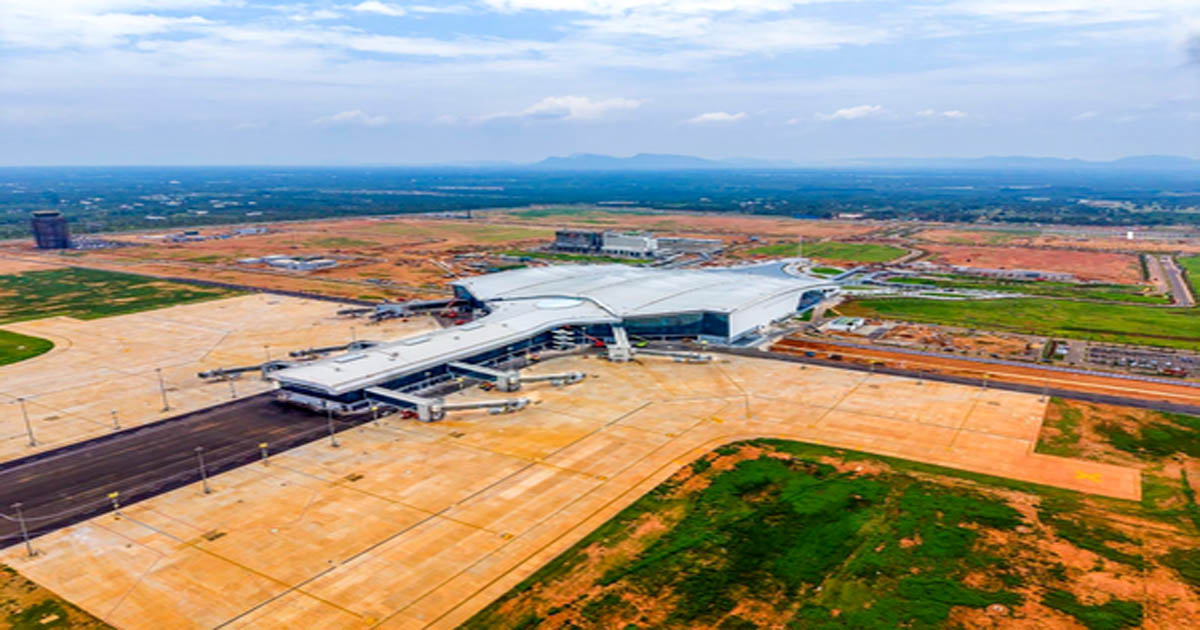
Visakhapatnam : Commercial flight operations commenced at the newly developed Alluri Sitarama Raju International Airport at Bhogapuram in Vizianagaram district from midnight as Visakhapatnam Airport in Andhra Pradesh slipped into history.
All commercial operations at the Civil Enclave at Visakhapatnam Airport (INS Dega) shifted to Bhogapuram Airport, about 45 km away, with effect from 00.01 hours on Monday (August 17).
The International Air Transport Code “VTZ” for Visakhapatnam Airport was transferred to Bhogapuram International Greenfield Airport. Scoot Airlines’ flight to Singapore was the first to take off from the new airport around midnight.
IndiGo flight from Hyderabad landed at Bhogapuram Airport at 6.45 a.m. GMR representatives, airport and Vizianagaram district officials welcomed the flight. Passengers were presented with Etikoppaka toys as mementoes.
First domestic flight from the new airport took off for Hyderabad at 7.30 a.m. Later flights to Bengaluru, Delhi and Hyderabad were operated.
Earlier, teary-eyed staff at Visakhapatnam Airport bid an emotional farewell to the last flight, which took off at 10.45 p.m. on Sunday. IndiGo 6E 2018 was the last flight to take off for Delhi.
Built during World War II and opened to civilian operations in 1962, the airport has been a key part of Visakhapatnam’s aviation history. However, the shifting of airport operations to Bhogapuram has rendered about 1,000 people unemployed at Visakhapatnam Airport. The workers have appealed to the state and Central governments to provide them alternate jobs.
According to the notification issued by the Civil Aviation Ministry late last month, the commercial operations at the Civil Enclave at Visakhapatnam Airport (INS Dega) will cease for 30 years, except for airport activity at time of national emergency or by aircraft owned or operated by or for the Indian Air Force or other Armed Forces of India or police or any such other authorities or for transportation of dignitaries by special government owned, leased or hired VIP aircraft.
Authorities are operating 20 electric buses from Visakhapatnam to Bhogapuram Airport for the convenience of air travellers.
IndiGo, Air India Express and other airlines are operating services to domestic destinations like Hyderabad, Tirupati, Chennai, Bengaluru, Delhi, Kolkata and Mumbai. Scoot Airlines and Air India operate flights to Singapore while IndiGo operates flights to Abu Dhabi.
All airlines shifted their operations from Visakhapatnam Airport to Bhogapuram Airport.
According to officials, 31 flights will be operated from Bhogapuram Airport on the first day. About 6,000 to 7,000 passengers will travel by these flights.
Prime Minister Narendra Modi inaugurated Bhogapuram Airport on August 1.
Developed and operated by GMR Visakhapatnam International Airport Limited (GVIAL) under the Public Private Partnership model at a cost of nearly Rs 4,727 crore, Bhogapuram is among the fastest-completed Greenfield international airports in India. It was completed within 31 months, nearly five months ahead of schedule.
The airport has been designed to handle six million passengers annually in the first phase, with a master plan to expand capacity to 40 million passengers annually in the future.
Its airside infrastructure includes a 3,800-metre Code 4E runway, capable of handling wide-body aircraft such as the Boeing 777, Boeing 787 Dreamliner, Airbus A330 and Airbus A340, a parallel taxiway, rapid-exit taxiways and 18 aircraft stands.
The airport is also equipped with advanced airfield lighting, navigation aids and CNS/ATM infrastructure to support both domestic and international operations.
The project is expected to play a pivotal role in boosting economic growth, tourism, industrial investment, exports, logistics, and the aerospace and defence sectors across the erstwhile Visakhapatnam, Vizianagaram, and Srikakulam districts.
The integrated project spans 2,703.26 acres, including 2,203.32 acres for the airport, 500 acres for the aviation hub, and 136.63 acres for Aviation University/EduCity.



Elon Musk has said that Google was interested in renting more computing capacity from SpaceX, signaling growing demand for artificial intelligence infrastructure as technology companies race to secure access to advanced computing resources.
Musk disclosed the interest in a post on social media platform X but did not provide further details about the potential arrangement.
The aerospace company already has a multi-year cloud services agreement with Google that was signed before SpaceX’s blockbuster initial public offering.
Under the deal announced in June, Google is set to pay SpaceX about $920 million per month from October this year through June 2029.
The computing capacity covered under the agreement includes roughly 110,000 Nvidia graphics processing units (GPUs), along with CPUs, memory and other supporting hardware used to power large-scale AI applications and cloud workloads.
Demand for AI computing infrastructure has surged since the emergence of generative artificial intelligence services, prompting major technology firms to pour billions of dollars into data centers equipped with advanced chips from Nvidia and other manufacturers.
SpaceX has increasingly positioned itself as a provider of large-scale computing resources. In May, AI startup Anthropic said it had reached a deal to access SpaceX’s computing capacity.
According to a regulatory filing in June, SpaceX disclosed compute-capacity agreements with Google and Anthropic valued at more than $70 billion in aggregate.
The company is also expanding beyond its existing computing hub near Memphis. Earlier this month, SpaceX said it planned to invest more than $74 billion in a new supercomputer facility at Starbase in Texas’ Rio Grande Valley, as well as a second campus in Cochise County, Arizona, as it seeks to meet rising demand for AI infrastructure.

The weakening of the global AI trade and the impressive growth in India’s corporate earnings are the principal factors which have brought the foreign institutional investors (FIIs) back to India, according to analysts.
The FII buying which was picked up early this month has been continuing relentlessly. FPIs have been buyers almost every day this month and the cumulative buying through November 26 stood at Rs 143,284 crore, according to the exchange data.
“This is an all-time record. Almost 50 per cent of the FII money which left India in the previous 10 months has come back just this month, so far,” said Dr VK Vijayakumar, Chief Investment Strategist, Geojit Investments Ltd.
This aggressive buying by the FIIs has made India the best performing market in the world in November. The massive capital inflows helped rupee reach 92.99 to the dollar, making the INR the best performing currency in Asia in November.
FIIs have been big buyers in financials, particularly banks -both private sector and public sector- telecommunications, FMCG, IT and consumer services. Going by the present trends, the FII inflows are likely to continue, said the analyst.
On Tuesday, Guru Nanak Jayanti resulted in a market holiday, therefore there were only 4 trading days this week. Foreign investors continued to invest with the following amounts on each respective day: Monday (5,673 crore); Wednesday (4,479 crore); Thursday (5,843 crore); and Friday (1,634 crore).
“This gave an overall figure of around 17,630 crore, continuing the 19-day investment streak and reaching around 1.33 lakh crore. Gross equity investments were 79,923 crore and equity outflows were 62,293 crore (provisional figures),” said Dheeraj Gaur, Chief Investment Strategy Officer, Choice Wealth.
In addition, having predominantly sold throughout the month to date, domestic institutional investors (DIIs) reversed course and invested a net amount of 6,333 crore last week.
Again, most of this was concentrated on Wednesday and Thursday. For the first time in weeks, both foreign and domestic investors were therefore in agreement on market direction, said analysts.

The Directorate General of GST Intelligence (DGGI) has uncovered a major tax fraud linked to the tobacco sector, exposing a syndicate that allegedly claimed more than Rs 88 crore in fraudulent GST refunds, an official statement said on Saturday.
According to the Finance Ministry, the operation was unearthed by the Patna Zonal Unit of the DGGI as part of its continuing crackdown on tax evasion in the cigarette industry.
Investigators found that the syndicate was operating through a network of shell entities that allegedly obtained invoices from dealers of branded cigarettes without receiving the actual goods, the ministry added.
These invoices were then used to fraudulently avail input tax credit in violation of GST provisions.
The probe further revealed that the group sourced substandard cigarettes of unknown origin and supplied them to the Falta Special Economic Zone (SEZ) in West Bengal under the Letter of Undertaking (LUT) route.
Based on these transactions, the entities allegedly claimed GST refunds against accumulated input tax credit.
The syndicate secured refunds exceeding Rs 88 crore over the past two years through the alleged modus operandi.
“Investigation has revealed that the syndicate obtained refunds exceeding Rs 88 crore during the last two years by adopting the aforesaid modus operandi,” according to the government.
Moreover, during searches and inspections, authorities identified around 8.76 crore sticks of suspected counterfeit and substandard cigarettes, packed under the names of well-known brands, at Falta SEZ.
The cigarettes — valued at more than Rs 150 crore based on their aggregate maximum retail price (MRP) — have been placed under prohibition.
The latest case is part of a broader crackdown on illegal activities in the tobacco sector, including clandestine manufacturing, diversion of branded cigarettes, ineligible ITC claims and misdeclaration of products supplied to SEZs.
In September and October alone, DGGI busted two illegal cigarette manufacturing units and seized around 25 lakh cigarette sticks along with cigarette-making and packaging machinery.
According to the government, six cases related to cigarette manufacture and supply have been booked during the current financial year.
Authorities have so far seized more than 10.07 crore sticks of cigarettes valued at over Rs 160 crore, while detecting fraudulent GST refund claims exceeding Rs 110 crore.

Delhi BJP President Harsh Malhotra seeks discoms’ policy for safe, affordable e-rickshaw charging

Iran says ‘violating’ oiler caught fire after hitting mines east of Hormuz Strait

Sanchar Saathi helped recover over 14 lakh lost phones, prevented cyber fraud worth crores, says PM Modi

SpaceX says Google interested in renting additional computing capacity

PM Modi’s hails Indian diaspora’s initiatives in Canada; pays tribute to Sikh artist Sobha Singh

Congress trying to protect 3 crore Bangladeshi infiltrators in voter list: HM Shah

Red Fort car blast probe exposes blueprint for spread of terror modules across India

Trump flags Iran targets as talks continue

‘Conspiracy, not accident’: NCP on Ajit Pawar death

BJP, Shiv Sena slam Mallikarjun Kharge for terming Diwali ‘Khushiyon ka Eid’
-

 Crime4 years ago
Class 10 student jumps to death in Jaipur
-

 Maharashtra2 years ago
Mumbai Local Train Update: Central Railway’s New Timetable Comes Into Effect; Check Full List Of Revised Timings & Stations
-

 Maharashtra2 years ago
Mumbai To Go Toll-Free Tonight! Maharashtra Govt Announces Complete Toll Waiver For Light Motor Vehicles At All 5 Entry Points Of City
-

 Maharashtra2 years ago
False photo of Imtiaz Jaleel’s rally, exposing the fooling conspiracy
-

 National News2 years ago
Ministry of Railways rolls out Special Drive 4.0 with focus on digitisation, cleanliness, inclusiveness and grievance redressal
-

 Maharashtra2 years ago
Maharashtra Elections 2024: Mumbai Metro & BEST Services Extended Till Midnight On Voting Day
-

 National News2 years ago
J&K: 4 Jawans Killed, 28 Injured After Bus Carrying BSF Personnel For Poll Duty Falls Into Gorge In Budgam; Terrifying Visuals Surface
-

 Crime2 years ago
Baba Siddique Murder: Mumbai Police Unable To Get Lawrence Bishnoi Custody Due To Home Ministry Order, Says Report