
General
Chandrayaan-3: Hello Superpowers, India Is On The Moon!

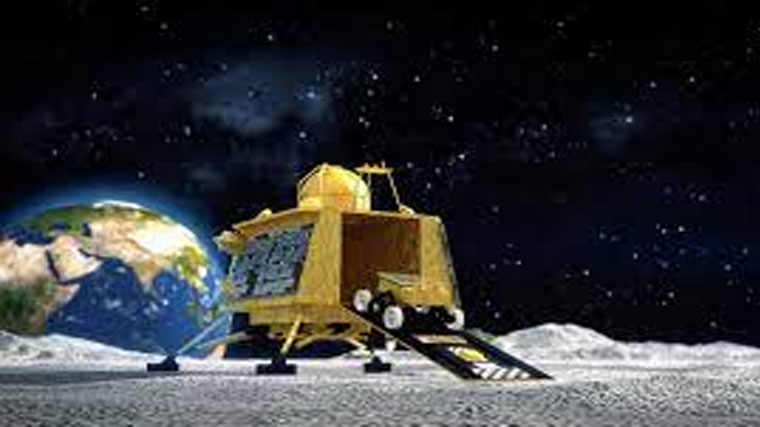
India is on the moon. With those five words, ISRO chairman S Somanath summed up the success of the Chandrayaan-3 mission, a longdrawn journey scripted by its dedicated scientists, unmindful of the recent setback to Chandrayaan-2. As the sun rose over the moon’s South Pole, the Vikram Lander, with Pragyan in its belly, gently touched on the Moon’s surface kicking up lunar dust and kick-starting a new chapter in what could be the beginning of a space odyssey to Mars, the sun and the space beyond. Responding to over a million prayers of Indians all over the world, Vikram held its nerve in what is described as ‘20 minutes of terror’ and landed flawlessly in the unchartered South Pole, making India the first country to leave its footprints in the area and the fourth nation after the US, Russia and China to land on the lunar surface.
It was a nail-biting moment at the ISRO headquarters in Bengaluru when at around 5.25 pm the Automatic Landing Sequence (ALS) was initiated, leaving Vikram to its own maneuvers in the final touchdown. The scientists broke into a huge applause hugging each other, crying in joy as the world cheered India’s achievement in taking within its embrace the ‘khoya khoya chand and the khula aasman.’
PM Modi celebrates the moment
Celebrating the moment, Prime Minister Narendra Modi, who is in Johannesburg in South Africa, said the moon landing is the dawn of a new era. “India will not stop on the moon. The new era of confidence and belief will take us beyond,” he said, adding that the Aditya L1 mission to the Sun and the human space mission, Gaganyaan, are next in the pipeline. Coming back to the Chandrayaan-3, at around 5 pm, the first of the series of the final commands emanated from Bengaluru, telling the ALS to take over and begin its four-phase descent towards the moon’s surface.
Highly controlled and powered descent
In a highly controlled and powered descent, closely monitored by the orbiting propulsion modules – Chandrayaan-2 and 3 — Vikram lander took its final steps, hurtling towards the moon’s surface at a velocity of 1.68 km per second, which is nearly 6048 km per hour – almost ten times the velocity of an airplane. Moments later, in the first phase, the Vikram lander slammed the brakes – called the rough braking phase — by firing its engines for about 11.5 minutes. Next came the fine braking phase when Vikram was made to further slow down and shift to a vertical mode to face the moon’s surface. This was the phase when the lander during the Chandrayaan-2 launch went out of control and crashed on the moon’s surface. At 800 meters above the Moon’s surface, both the horizontal and vertical velocities were reduced to zero giving Vikram 10 seconds to survey the landing strip. The lander was then made to go down further and hover once at 150 meters, taking images of hazards in quest for the best landing site. It then touched down on the lunar surface with just two engines firing and its sturdy legs absorbing the impact of 3m/second or about 10.8 km per hour. Soon after the sensors on the legs felt the lunar surface, the engines immediately shut down marking the end of the 20-minutes of terror. Vikram’s landing was dramatic as it kicked up dust, which took over two hours to settle due to weak gravity on the moon.
Pragyaan rolled out
Once the dust settled down, the child in Vikram’s belly, the Pragyaan, rolled out to ‘play’ on the moon’s surface. The rover took its baby steps towards the Moon’s surface after remaining in deep slumber for over 3.84 lakh km lasting 40 days. The big moment came when Vikram took images of the rover and Pragyaan responded by clicking images of the lander, the first ‘selfies’ clicked by India from the lunar surface. The lander and rover are both solar powered and are made to last one lunar day – which is equal to 14 Earth days. In these 14 days, the Pragyaan would be actively sniffing for water. During the Lunar day, the solar panels would be charged so that when the sun rises again, work can begin again.
NASA and European Space Agency (ESA) played a key role, says ISRO Chief S Somanath
In India’s journey to the moon, NASA and the European Space Agency (ESA) played a key role, said Somanath in his comments. ‘‘We cannot track the mission in the shadow areas and it is here that other agencies would key in,’’ he added. ESA supported the lander during the entire phase of lunar surface operations, helping to ensure that science data acquired by the rover arrives safely with ISRO. ISRO operates a 32-metre deep space tracking station in Byalalu, in Karnataka, that enabled it to locate, track, command and receive telemetry and scientific data from its distant spacecraft. India is not going to stop on the moon. With all the cheers coming from all over and the team work of hundreds of scientists at ISRO, space would be an unchartered expanse waiting to be explored, and the endeavour is to tread where no man has gone before.


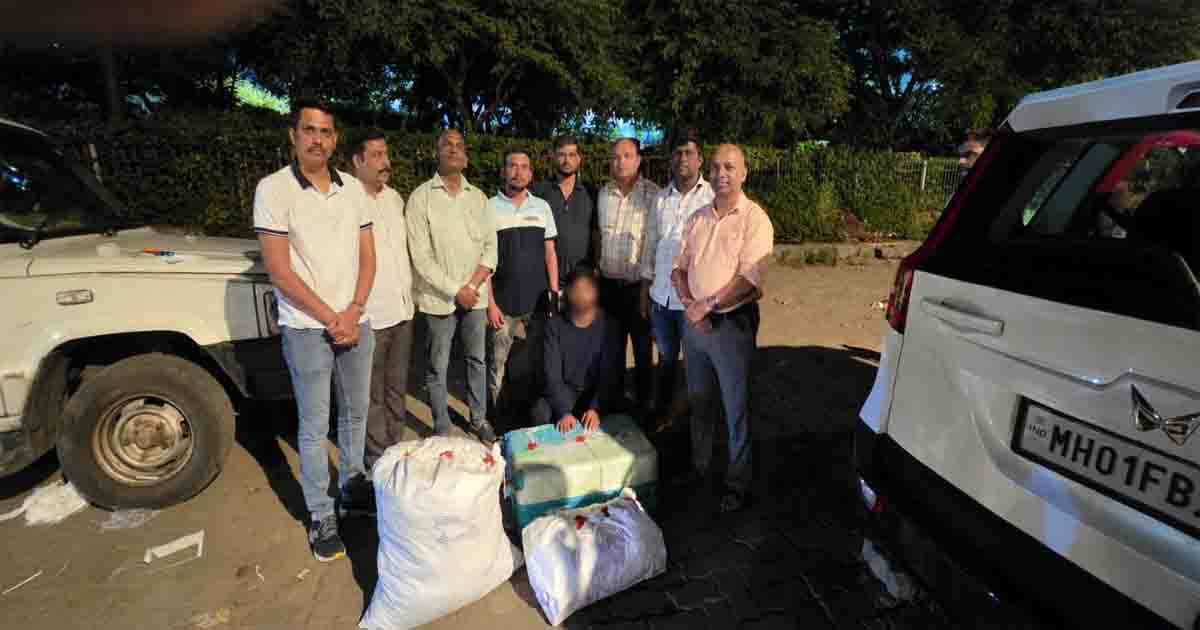
Mumbai: During a patrol, the Ghatkopar Unit of the Anti-Narcotics Cell detained an individual standing near the garden outside Lokmanya Tilak Terminus Railway Station—close to the Santacruz-Chembur Link Road bridge in Tilak Nagar, Chembur (East), Mumbai—on suspicion of selling narcotics.
Upon searching him, 22.960 kg of ‘ganja’ (cannabis) was recovered from his possession. He was subsequently arrested, and a case was registered against him under Sections 8(c) and 20(c) of the NDPS Act, 1985. Interrogation revealed that the accused had brought the contraband from the state of Odisha to Mumbai for sale. The arrested individual has been identified as Manish Kumar Baijnath Chaudhary, aged 25.
A total of 22.960 kg of ganja, valued at approximately ₹11,48,000, was seized from the accused.
This successful operation was carried out under the supervision of Joint Commissioner of Police (Crime) Deven Bharti, along with Anil Kumbhare, Krishnakant Upadhyay, and DCP Purnima Chougule-Shringi.
Maharashtra
Mayor Launches ‘Flex-Free Mumbai’ Campaign by Personally Removing Unauthorized Banners from His Electoral Constituency.

Mumbai: First Citizen, Mayor Ritu Tawde, has once again demonstrated that instead of merely making announcements or issuing directives, one should set an example through practical action. The Mayor recently announced a special campaign titled “Flex-free Mumbai for 365 days” (following the ten-day Ganeshotsav festival) to remove unauthorized flex banners, posters, and stickers from across the city. She has also appealed to all political parties to cooperate with this initiative.
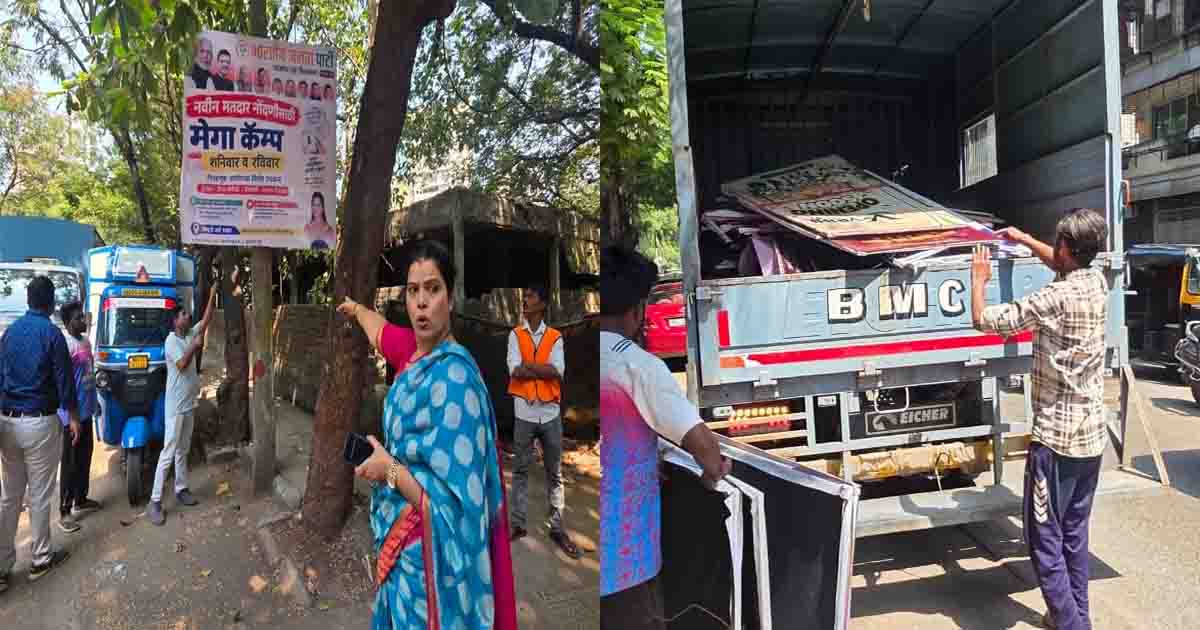
In this regard, Mayor Ritu Tawde personally took to the streets in her constituency today (October 14, 2026) to launch the campaign.
Mayor Ritu Tawde personally removed unauthorized advertising hoardings, banners, and posters installed at Jhulelal Chowk (Vikrant Circle) and Garodia Nagar—busy areas in Ghatkopar (East) falling under the ‘N’ Ward of the Mumbai Municipal Corporation. All unauthorized hoardings in the vicinity were immediately removed. Furthermore, the Mayor instructed officials to ensure that no new unauthorized hoardings are erected in the future.
Officers and staff from the Shops and Establishments (Licensing) Department, Maintenance Department, Encroachment Removal Department, and other relevant departments were present during the campaign.
Through her actions, the Mayor has set a new precedent for public representatives in Mumbai. This initiative demonstrated that when public representatives take the lead in curbing factors that mar the city’s beauty, it significantly facilitates the administration’s work. The efforts of the Municipal Corporation administration received a major boost when the Mayor herself took to the streets. …undertook the task of removing unauthorized flex banners, posters, and stickers.
To permanently rid Mumbai of the menace of plastic, flex materials, and unauthorized hoardings, Mayor Ritu Tawde has written to the municipal corporation administration, directing the strict implementation of a ‘zero-tolerance’ policy. To expand the reach of this campaign and foster unity across political lines, the Mayor is personally sending letters to the heads and leaders of all political parties. The policy entails stringent measures, such as mandating a QR code system for authorized hoardings (advertising boards), blacklisting printers and agencies that produce unauthorized signage, and ensuring the resolution of citizens’ complaints within a maximum of 72 hours.
Conveying her message during the campaign, Mayor Ritu Tawde stated that just as an example of environmental conservation was set during the Ganesh Utsav festival by prioritizing eco-friendly clay idols, it is the duty of every citizen and public representative to keep Mumbai free from plastic and flex waste throughout the year. The Mayor has appealed to public representatives from all parties, social activists, organizations, and citizens to support this campaign by taking similar initiatives in their respective areas to uphold Mumbai’s aesthetic appeal and civic discipline.
Mumbai’s citizens have welcomed this eco-friendly initiative by the Mayor, who launched the effort from her own municipal ward.
Maharashtra
Eknath Shinde Calls Rahul Gandhi’s Supreme Court March a Black Day in India’s History, Alleges INDIA Bloc Is Part of a Foreign Conspiracy.
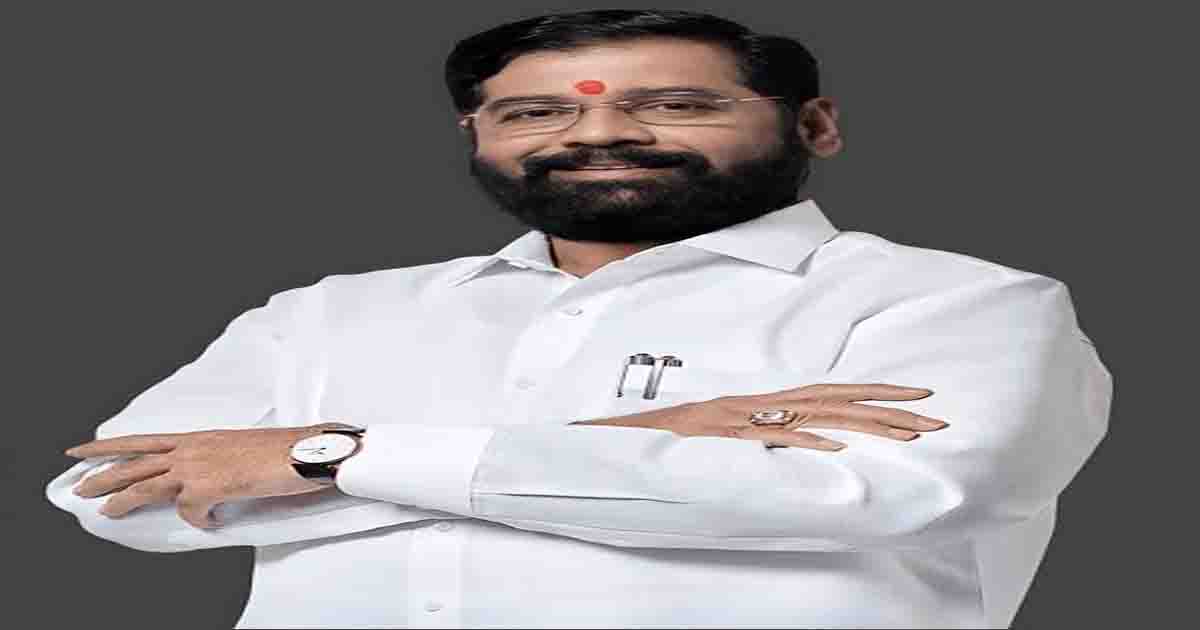
The ‘INDIA’ alliance organized a march to the Supreme Court in Delhi, attended by Rahul Gandhi, Priyanka Gandhi, and Members of Parliament from the alliance. Following this protest, it appears that the ‘INDIA’ alliance has adopted an aggressive stance. Commenting on the protest, Eknath Shinde remarked that yesterday was a ‘black day’ in the country’s history. He observed that the Constitution and the constitutional institutions established by Babasaheb were trampled upon. An unprecedented event occurred where a march to the Supreme Court was undertaken to exert pressure. Condemning the actions of Rahul Gandhi and the ‘INDIA’ alliance, he stated that no amount of condemnation would be enough. While acknowledging their right to protest in a democracy, he questioned the method of leading a march merely to file a petition. He emphasized that they should apologize for attacking India’s judicial system. Claiming that they are actively working to destroy the Constitution and strangle democracy, he added that the current situation poses a danger to the country. He expressed suspicion regarding the involvement of foreign forces, suggesting it could be part of an international conspiracy. Eknath Shinde said, “It is extremely unfortunate that they are pushing the country towards chaos; this is dangerous for the nation.” He added that since they cannot win elections or defeat the Prime Minister, they are resorting to such tactics. Shinde also leveled serious allegations, stating that the opposition is undermining the country’s freedom. Attempts are being made by foreign powers to destabilize the country. He emphasized the need to consistently speak out against their anti-national mindset. They operate under the conviction that they will not come to power at the Centre; this very thought drives their daily actions. It was the opposition itself that once attempted to destroy the Constitution. Referring to the Emergency, Shinde asked: if an Emergency were in place today, would protests even reach the Supreme Court? Nowadays, everyone is free to express their views. Is the current situation an Emergency, or was that the Emergency? Back then, everything was shut down. Is it right to march towards the judiciary and insult it? They talk about ‘breaking India’ and protest while threatening to leave the country. They know their demands are flawed; they are aware they will not get justice because their demands are baseless. They had protested against the increase in voter turnout. Now, if names are removed from the voter list, they protest—even though ‘Form 6’ exists to ensure no injustice occurs. It was merely a drama staged by ‘immature’ (shortsighted) people, all for the sake of gaining power. This is an insult to Lord Shiva; they lack wisdom. If the ‘third eye’ were to open, the ‘INDIA’ alliance would be wiped out. When people gather, they simply step out of their homes; they do not have to travel far—they find a ready-made platform and join in. They simply want to speak out against Modi. They claim that Modi has rendered them unemployed, so what other option do they have but to protest?

Samajwadi Party, education two banks of river who can’t meet: UP CM Yogi Adityanath

Tanker attacked northeast of Saudi Arabia: UKMTO

MP: Mild earthquake tremors felt in Singrauli

Maha CM calls emerging technologies key to India’s youth

Iran IRGC says supertanker exploded after hitting mine in Hormuz Strait

Rahul, Cong ecosystem want to force regime change: BJP after Neha Bora praises B’desh Gen-Z protest

BJP pays tribute to ex-President Abdul Kalam, recalls his enduring influence on generations of India’s youth

INDIA bloc begins protest march against ECI

Maha Congress stages agitation against Gyanesh Kumar

Complaint against Netflix & Mukesh Chhabra for inappropriate language on ‘India’s Got Latent 2’
-

 Crime4 years ago
Class 10 student jumps to death in Jaipur
-

 Maharashtra2 years ago
Mumbai Local Train Update: Central Railway’s New Timetable Comes Into Effect; Check Full List Of Revised Timings & Stations
-

 Maharashtra2 years ago
Mumbai To Go Toll-Free Tonight! Maharashtra Govt Announces Complete Toll Waiver For Light Motor Vehicles At All 5 Entry Points Of City
-

 Maharashtra2 years ago
False photo of Imtiaz Jaleel’s rally, exposing the fooling conspiracy
-

 National News2 years ago
Ministry of Railways rolls out Special Drive 4.0 with focus on digitisation, cleanliness, inclusiveness and grievance redressal
-

 Maharashtra2 years ago
Maharashtra Elections 2024: Mumbai Metro & BEST Services Extended Till Midnight On Voting Day
-

 National News2 years ago
J&K: 4 Jawans Killed, 28 Injured After Bus Carrying BSF Personnel For Poll Duty Falls Into Gorge In Budgam; Terrifying Visuals Surface
-

 Crime2 years ago
Baba Siddique Murder: Mumbai Police Unable To Get Lawrence Bishnoi Custody Due To Home Ministry Order, Says Report