
Business
Adani Ports handles a record 100 mmt cargo in just 99 days

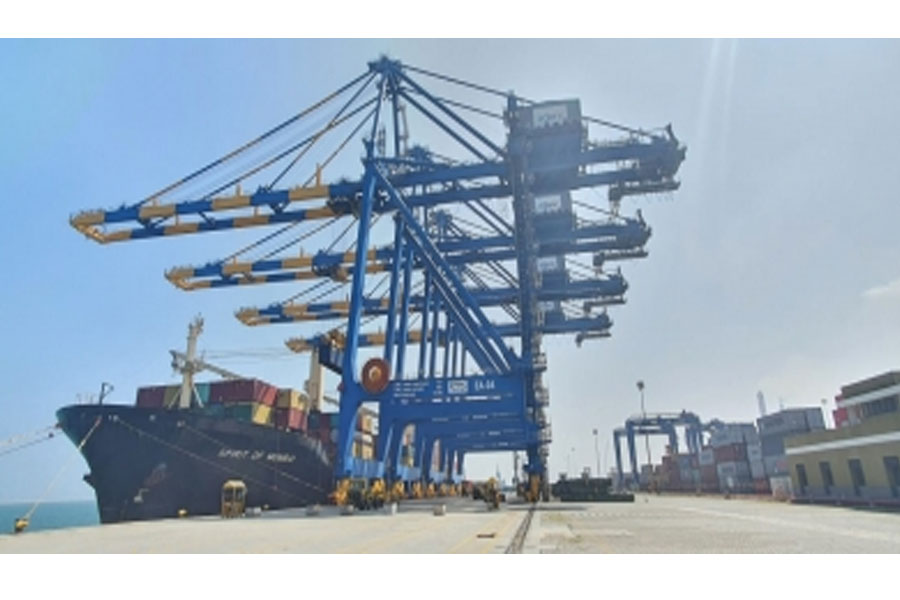
Adani Ports and Special Economic Zone Ltd (APSEZ), India’s largest integrated transport utility, has clocked a cargo throughput of 100 MMT in the first 99 days of FY23.
APSEZ hit this record volume on July 8, 2022. The milestone is significant as it demonstrates the rapidly improving efficiency of APSEZ, which needed a year to achieve 100 MMT cargo volume FY2014.
“In 2021, we stated our ambition to emerge as the world’s largest private port company and India’s largest integrated transport utility by 2030,” said Karan Adani, CEO and Whole Time Director of APSEZ.
“When APSEZ’s operations spanned five ports, it took 14 years for the company to achieve 100 MMT of annual cargo throughput. In the following five years and with operations across nine ports, APSEZ doubled cargo throughput to 200 MMT. We then achieved the milestone of 300 MMT in just three years. We are now poised to grow our cargo volumes by 60 per cent to 500 MMT by 2025 and emerge as the world’s largest port operator by 2030.”
The ability of APSEZ to handle 100 MMT cargo volume in less than one-third time when compared to the time taken in 2014 is driven by tech-based innovations to integrate conventional business processes with new age digital technologies. Other major factors that have catalysed APSEZ’s cargo highpoints are improved efficiencies in fleet and fuel management, asset monitoring, mobility, operational intelligence and performance monitoring of the applications.
APSEZ has set itself a target of 500 MMT of cargo throughput by 2025. In pursuit of this goal, the company has consistently raised its cargo throughput year after year. It reached the 100 MMT cargo throughput in 109 days last year. The present growth in cargo is supported by a 12 Y-o-Y jump in June 2022 at 31.88 MMT.
Coal volumes have continued to show a strong recovery of 25 per cent over the previous year. Compared to the previous year, other key segments that have led this monthly surge are crude at 17 per cent and container at 6 per cent. With a monthly growth volume of 21 per cent, Mundra led this record performance followed by Hazira, Kattupalli & Ennore combined, and Dahej.



Indian equity benchmarks opened lower on Thursday tracking weak Asian markets and concerns over elevated crude oil prices and high US bond yields.
Sensex opened 366.36 points or 0.50 per cent lower at 73,343.33, while Nifty began the trading session at 22,687.75, declining 123.60 points or 0.54 per cent.
Sector-wise, most indices traded in the red with auto, metal and healthcare shares leading losses in early trade.
Nifty Auto, Nifty Metal and Nifty Healthcare declined up to 0.98 per cent. Meanwhile, Nifty Pharma also slipped 0.78 per cent.
Broader weakness was also visible across FMCG, realty, cement and financial stocks.
Analysts said the recent trend of large-cap stocks outperforming mid and small caps appears to be gathering momentum as valuation concerns emerge in the broader market.
“The broader market resilience in recent months has been more a function of liquidity than earnings. This has created a paradox of overvalued mid and small caps coexisting with attractively valued large-caps. This trend is now getting corrected and is likely to sustain,” they said.
The eperts also pointed to external headwinds, including rising crude prices and elevated US Treasury yields which are encouraging traders to build short positions despite continued institutional buying.
“Sectoral churn towards fairly valued large caps is the ideal investment strategy now. It may take time, but this strategy will certainly be rewarded,” they added.
Technical analysts said the recent sharp decline and the breach of the 22,700 level on the Nifty raised the risk of a deeper correction.
“Recovery hopes rest on the ability of 22,590 to hold, but a move back above 22,840 will be needed to confirm renewed upside strength,” according to them.
On Wednesday, foreign institutional investors (FIIs) turned net buyers and purchased equities worth about Rs 1,022 crore. Domestic institutional investors (DIIs) also remained buyers with net purchases of around Rs 1,614 crore.
In Asian markets, major indices remained under pressure. Japan’s Nikkei, Hong Kong’s Hang Seng and South Korea’s Kospi dropped up to 2 per cent in early trading.
Overnight, Wall Street ended higher led by technology shares. The Nasdaq advanced around 1 per cent after strong corporate earnings boosted sentiment around artificial intelligence-related stocks, while the S&P 500 gained 0.58 per cent.
Meanwhile, Brent crude futures rose more than 1 per cent to trade around $110 per barrel, adding to inflation concerns and weighing on investor sentiment.

Indian equity benchmarks traded higher in early trade on Wednesday with gains of nearly 1 per cent each tracking positive global cues and buying in IT stocks.
In morning trade, Sensex was trading 0.94 per cent or 695 points higher at 74,548.69, hitting an intraday high against previous close of 73,852.90.
Similarly, Nifty surged 0.86 per cent or almost 200 points to 23,086.95 from previous close of 22,888.95.
Earlier in the day the benchmarks opened higher, with the Sensex opening at 74,337.93, up 485.03 points or 0.66 per cent.
Nifty opened at 23,016.00, up 127.05 points or 0.56 per cent.
Sector-wise, Nifty IT, Nifty PSU Bank, Nifty Cement, Nifty MidSmall IT & Telecom and Nifty Oil & Gas increased up to 1.97 per cent.
However, Nifty Media and Nifty Chemicals were trading in the red.
According to market experts, as Brent crude prices and US bond yields remained elevated, the market is likely to remain under pressure and the sell-on-rally construct will continue in the near-term.
However, improving earnings growth, fair valuations of large-caps and strong domestic liquidity will support the market on declines, they said.
IT and banking which have performed well in Q2 and are attractively valued, will see strong DII-led accumulation on corrections, the experts said.
Notably, the Q2 results season has started on a positive note and market action going forward will be more stock-specific and results-sensitive, experts noted.
In the last trading session on October 19, FIIs remained net sellers, offloading equities worth approximately Rs 1,148 crore, while DIIs continued to support the market with net purchases of around Rs 3,200 crore.
In addition, Asian shares traded higher following gains in US stock futures after upbeat earnings from major AI-linked companies renewed investor interest in technology shares.

Tesla has scheduled its annual shareholder meeting for December 3, where investors will vote on the re-election of Chief Executive Elon Musk and other directors, along with an advisory resolution on executive compensation and the appointment of the company’s auditor.
According to a proxy filing with the US Securities and Exchange Commission, Tesla has nominated Musk, Chair Robyn Denholm and director JB Straubel for new three-year terms on the board.
Shareholders will also be asked to approve, on a non-binding basis, executive compensation for 2025 and ratify PricewaterhouseCoopers as Tesla’s independent auditor for the fiscal year ending December 31.
Moreover, the proxy statement disclosed executive compensation attributed to Musk for 2025 of about $158.36 billion, consisting entirely of stock-based awards.
The figure reflects the accounting value assigned to performance-linked equity grants and does not represent cash compensation received by the billionaire entrepreneur.
Tesla said the awards remain contingent on the achievement of specified market capitalisation and operational targets.
The company previously reported in May that Musk’s realised compensation for 2025 was zero with none of the 12 tranches tied to the incentive program having been earned.
The equity package comprises roughly 423.7 million restricted shares that vest only after predetermined milestones are met.
In addition, any earned shares are generally subject to a five-year holding requirement, with limited exceptions.
The annual meeting will be held at Tesla’s Gigafactory Texas facility in Austin at 3 pm. However, Central Time and will also be accessible online.
Additionally, the filing highlighted several board-level links between Tesla and SpaceX.
However, the proxy statement did not reference any potential merger involving Tesla and SpaceX.
Apart from that, Elon Musk-backed SpaceX is scheduled to announce its third-quarter results on Tuesday after its shares fell nearly 35 per cent from their post-listing high.
This will be the company’s second quarterly earnings report since going public in June, following a volatile stretch for the stock.
The stock has dropped around 35 per cent from the record high it hit soon after its debut.

BJP worker brutally attacked, shot dead in Bengal’s Malda; police detain one

Delhi Police busts interstate heroin network, arrests seven; drugs worth Rs 60 Cr seized

One killed, 100 injured in traditional stick fight in Andhra Kurnool

Four injured in sleeper bus-tempo collision in J&K Udhampur

Sonia Gandhi makes Instagram debut, shares first look of her memoir ‘Belonging’

Rahul, Cong ecosystem want to force regime change: BJP after Neha Bora praises B’desh Gen-Z protest

Attack on democratic rights: INDIA Bloc leaders on detentions of anti-ECI protestors

BJP pays tribute to ex-President Abdul Kalam, recalls his enduring influence on generations of India’s youth

INDIA bloc begins protest march against ECI

Maha Congress stages agitation against Gyanesh Kumar
-

 Crime4 years ago
Class 10 student jumps to death in Jaipur
-

 Maharashtra2 years ago
Mumbai Local Train Update: Central Railway’s New Timetable Comes Into Effect; Check Full List Of Revised Timings & Stations
-

 Maharashtra2 years ago
Mumbai To Go Toll-Free Tonight! Maharashtra Govt Announces Complete Toll Waiver For Light Motor Vehicles At All 5 Entry Points Of City
-

 Maharashtra2 years ago
False photo of Imtiaz Jaleel’s rally, exposing the fooling conspiracy
-

 National News2 years ago
Ministry of Railways rolls out Special Drive 4.0 with focus on digitisation, cleanliness, inclusiveness and grievance redressal
-

 Maharashtra2 years ago
Maharashtra Elections 2024: Mumbai Metro & BEST Services Extended Till Midnight On Voting Day
-

 National News2 years ago
J&K: 4 Jawans Killed, 28 Injured After Bus Carrying BSF Personnel For Poll Duty Falls Into Gorge In Budgam; Terrifying Visuals Surface
-

 Crime2 years ago
Baba Siddique Murder: Mumbai Police Unable To Get Lawrence Bishnoi Custody Due To Home Ministry Order, Says Report