
Business
Adani Ports cargo volume jumps 26% leading to record revenue, EBITDA

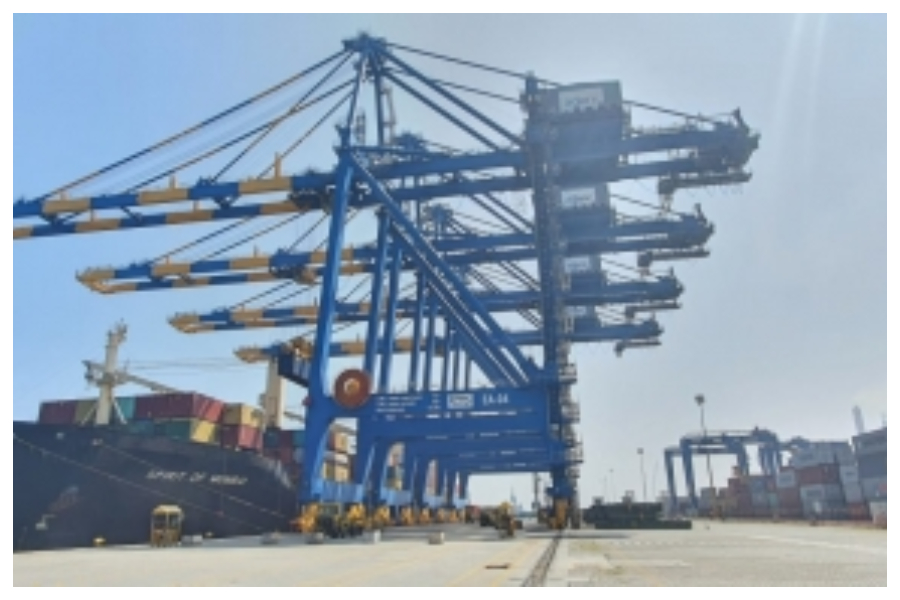
Adani Ports and Special Economic Zone Ltd (APSEZ), the largest transport utility in India, announced its results for the fourth quarter and year ended March 31.
“FY22 has been a stellar year for APSEZ, with achievement of various milestones for itself and new benchmarks for India’s maritime industry,” said Karan Adani, Chief Executive Officer and Whole Time Director of APSEZ.
The company did a record cargo volume of 312 MMT with Mundra port alone handling 150 MMT, a feat never achieved by any other commercial port in the country.
“The year saw a record number of acquisitions and some large project wins by APSEZ, further reinforced our progress towards the ambition of becoming the largest port globally by 2030,” Adani said.
The developments recorded include purchase of balance 25 per cent stake in KPCL, acquisition of Sarguja Rail Company for its 70 kms railway line asset having an annuity like business model, purchase of 41.9 per cent stake in the Gangavaram port and signing of an agreement with the promoters for acquisition of balance 58.1 per cent stake after the NCLT approval, acquisition of India’s leading third-party marine services provider, Ocean Sparkle Ltd (OSL), LOA from Haldia Port Trust for a 5 MMTPA bulk terminal, highest bidder for the West Bengal government’s greenfield deep-sea port project at Tajpur
The acquisitions in FY22 implied an investment of around Rs 11,400 crore for APSEZ and was successfully managed alongside an organic Capex of around Rs 3,750 crore, while ensuring that the net debt to EBITDA ratio remained unchanged at 3.4x.
“We cruised on our journey of becoming India’s largest transport utility with achievement of various milestones by our logistics business. These include investment in around 100 trains, eight operational MMLPs and total grain silo capacity of around 1.2 MMT, all by FY23. With 5 mn sqft of warehousing capacity under construction/ operation, we are on track to achieve our guided capacity of 60 mn sqft,” Adani said.
During the year, APSEZ concluded two very strategic partnerships ensuring sustainable business growth. The first being a JV with John Keells Holdings & Sri Lanka Port Authority for construction of Colombo West International Terminal-II; and the second is a partnership with Flipkart for the construction of a 5,34,000 sq. ft. fulfilment center in the upcoming logistics hub at Mumbai.
“We are confident of APSEZ’s growth prospects in FY23, given India’s expected GDP growth and boost to India’s Iron and Steel industry from China’s decision to cap its steel production and absence of exports from Russia. APSEZ is fully geared to ride this wave.
“We remain committed to our ambition of making our ports carbon neutral by 2025, and thereafter progress on the net zero journey, for which we will release our plan later this year,” added Karan Adani.


A prolonged Microsoft outage disrupted businesses, airlines and government operations across several countries on Friday, knocking out access to widely used services including Outlook, Teams and its AI assistant Copilot, as the technology giant struggled to restore normal operations hours after the disruption began.
The US-headquartered tech giant said the incident affected multiple Microsoft 365 products connected to its Exchange Online and email infrastructure.
Users across Asia and the United States reported difficulties accessing the services, with the disruption also spilling over into organisations that rely on Microsoft’s software for internal communication and customer support.
In its latest update, Microsoft said recovery efforts are ongoing across impacted infrastructure.
“We are seeing early signs of stabilisation, but service capacity has not yet returned to normal levels and health remains variable as traffic is carefully reintroduced,” the company said.
“Our primary mitigation path continues to focus on service stability and controlled recovery. Engineering teams are cycling affected infrastructure through traffic drain, restart, remediation, and staged return-to-service while monitoring closely. We are also evaluating additional mitigation options to improve recovery speed and consistency,” it added.
Microsoft said network and traffic-management actions remain in progress and it continues to prioritise backlog and queue health to preserve delayed mail during recovery.
“As part of this effort, we are extending the email timeout window to 48 hours to help protect delayed messages while service recovery continues,” the company said.
It added that it is not aware of any malicious activity causing the incident, and will share a full Post-Incident Report with root cause and defence-in-depth actions after recovery is complete.
The scale of the disruption was reflected in reports submitted to outage-tracking platform Downdetector, including for Copilot, Outlook and other services of the company.
The disruption also affected corporate schedules.
US-based industrial technology company Workhorse Group Inc. postponed its quarterly earnings conference call because of the outage.
Earlier in the day, domestic airlines — including IndiGo and Air India — also reported difficulties with their email systems, although flight operations remained unaffected.
Notably, Singapore’s Government Technology Agency confirmed that government email services were down and said it was working with Microsoft to resolve the problem.
In Japan, Deputy Chief Cabinet Secretary Masanao Ozaki said the country’s government IT infrastructure had also been affected and that authorities were “keeping a close eye on the developments.”
Japanese companies and institutions are turning to fax machines as the global Microsoft outage disrupts widely used services, including Outlook, Teams and AI software Copilot, forcing employees to reschedule meetings and putting routine business operations on hold, as per reports.

Microsoft faced severe outage across its platforms — 365, Outlook and Teams — as thousands of users across the globe, including India, on Friday morning were unable to access its services.
There were more than 1 lakh incidents of people reporting issues with Outlook at outage-tracking website downdetector.com.
The disruption also hit connectors used by OpenAI’s and Anthropic’s AI services.
“We’re aggressively pursuing all pathways to reduce impact,” Microsoft said in a statement, adding that it was providing updates in its admin center.
In its latest update, Microsoft attributed this incident to “a large number of servers being unexpectedly unavailable,” for reasons it did not explain.
Microsoft said it continues to investigate the outage.
In a post on X for users who can’t access the admin center, Microsoft said some of its infrastructure was experiencing “elevated load,” and that it was “redistributing connection traffic across our broader worldwide infrastructure to help balance the load.”
Its team has paused all deployments, is moving additional traffic off the affected infrastructure, and is restarting affected servers to return them to service, the tech company said.
The company says its Defender XDR security system is also affected by the outage.
Earlier in the day, Microsoft said it had fixed a Teams disruption affecting users in North America and that the impact had been fully resolved.
The company later said the issue may also affect Microsoft 365 service connectivity for users in other regions.
Microsoft faced a major outage in September, when a days-long outage hit Microsoft 365, its online productivity suite that includes Outlook.
The company had blamed a “core authentication configuration” issue that prevented users from accessing the service.

Domestic equity benchmarks opened lower on Friday and extended losses in early trade, tracking weak global cues and profit-booking after the sharp November rally.
Sensex declined about 450 points or 0.55 per cent to 81,457.74 in early deals, while Nifty fell 182 points or 0.71 per cent to 25,117.
Earlier, the Sensex opened at 81,833.78, down 77.23 points or 0.09 per cent, while the 50-scrip basket started the session at 25,209.85, down 89.50 points or 0.35 per cent.
Sectoral indices were also largely in the red zone, in which Nifty Realty led the fall, down over 1 per cent.
Meanwhile, Nifty Chemicals, Nifty Auto and Nifty Cement declined by up to 1 per cent. Nifty Oil & Gas, Nifty Private Bank, Nifty Consumer Durables and Nifty PSU Bank also traded lower.
On the other hand, healthcare and pharmaceuticals shares were trading higher. Nifty Pharma, Nifty Healthcare and Nifty 500 Healthcare surged up to 0.39 per cent.
However, the selling came after Nifty’s spectacular 9.7 per cent rally so far in November.
According to the market experts, the most important trigger for the swift rally was the aggressive comeback of the FIIs assisted by the weakening of the AI trade and improving earnings growth in India.
“Indications are that the FII buying will continue taking the monthly inflows easily to above Rs 1 lakh crore, which will be a record high. With this kind of aggressive FII buying, the bears will be on the back foot,” the market experts said.
They further noted that there are headwinds emerging that can spoil the party. Rising inflation in the US and India means a rising interest rate scenario which can turn out to be adverse for equity markets.
“In the US two rate hikes are likely in December and January. With the October CPI inflation in India rising to 6.09 per cent, the RBI will have to raise rates at least by 25 bp each in December and February. These concerns along with the ongoing DII profit booking can apply brakes on the rally, in the near term,” they added.
Additionally, Brent crude jumped to $95 per barrel amid fresh geopolitical concerns involving Saudi energy infrastructure and disruptions around the Strait of Hormuz.
In Asia, markets showed a mixed trend. Japan’s Nikkei traded about 1 per cent higher, while Hong Kong’s Hang Seng and South Korea’s KOSPI were up to 1 per cent down.
Overnight in the US, Wall Street ended lower on Thursday with the S&P 500 down 0.35 per cent and the Nasdaq down 0.39 per cent.

Rajasthan: 10.59 million voters to decide fate of 8,843 candidates in Panchayat polls tomorrow

BJP stoking social divisions over Chhath Puja: Aaditya Thackeray

Decision on merger of two factions must be taken collectively rather than individually: NCP’s Chhagan Bhujbal

Kaziranga tragedy shakes Assam: CM Sarma says state stands with bereaved families

Microsoft outage hits businesses, airlines and govts worldwide; recovery efforts on

Rahul, Cong ecosystem want to force regime change: BJP after Neha Bora praises B’desh Gen-Z protest

BJP pays tribute to ex-President Abdul Kalam, recalls his enduring influence on generations of India’s youth

Attack on democratic rights: INDIA Bloc leaders on detentions of anti-ECI protestors

Congress trying to protect 3 crore Bangladeshi infiltrators in voter list: HM Shah

Online betting: ED conducts searches at 20 premises in Mumbai, Pune, Hyderabad
-

 Crime4 years ago
Class 10 student jumps to death in Jaipur
-

 Maharashtra2 years ago
Mumbai Local Train Update: Central Railway’s New Timetable Comes Into Effect; Check Full List Of Revised Timings & Stations
-

 Maharashtra2 years ago
Mumbai To Go Toll-Free Tonight! Maharashtra Govt Announces Complete Toll Waiver For Light Motor Vehicles At All 5 Entry Points Of City
-

 Maharashtra2 years ago
False photo of Imtiaz Jaleel’s rally, exposing the fooling conspiracy
-

 National News2 years ago
Ministry of Railways rolls out Special Drive 4.0 with focus on digitisation, cleanliness, inclusiveness and grievance redressal
-

 Maharashtra2 years ago
Maharashtra Elections 2024: Mumbai Metro & BEST Services Extended Till Midnight On Voting Day
-

 National News2 years ago
J&K: 4 Jawans Killed, 28 Injured After Bus Carrying BSF Personnel For Poll Duty Falls Into Gorge In Budgam; Terrifying Visuals Surface
-

 Crime2 years ago
Baba Siddique Murder: Mumbai Police Unable To Get Lawrence Bishnoi Custody Due To Home Ministry Order, Says Report