
Business
Piyush Goyal rolls out red carpet for Swiss firms to invest in India (Ld)

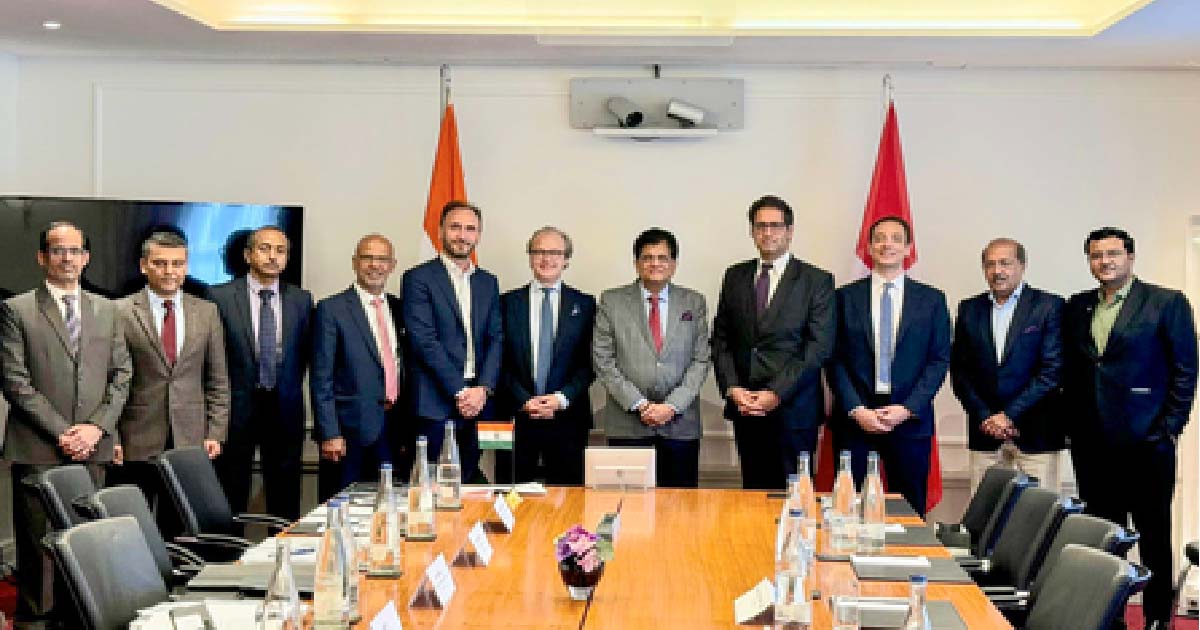
New Delhi, June 10: Commerce and Industry Minister Piyush Goyal has invited Swiss companies to expand their footprint in India and take advantage of the country’s dynamic and rapidly growing market.
The minister held a meeting in Bern with the leadership from several premier Swiss companies across diverse sectors and urged them to see India as a strategic hub for manufacturing, talent, and innovation.
The discussions focussed on enhancing synergies between Indian and Swiss enterprises, with a special emphasis on innovation, technology transfer, and sustainable manufacturing, according to an official statement issued on Tuesday.
Goyal assured the business leaders of India’s unwavering commitment to fostering a conducive business environment through transparent regulatory processes, a robust Intellectual Property regime, and pro-investment policy frameworks.
Following these strategic discussions, the Minister chaired two focussed roundtables with sectoral leaders from the Swiss industry —covering biotech and pharma, healthcare, and precision engineering, Defence, and Emerging Technologies.
These sessions, hosted with the support of the Indian Embassy in Switzerland, highlighted India’s scale, affordability, and rising innovation ecosystem.
The Minister called on Swiss businesses to leverage the dedicated EFTA Desk at Invest India for handholding and facilitation support.
He reiterated India’s willingness to work towards regulatory harmonisation and mutual recognition agreements, highlighting India’s proactive stance on building reciprocal bridges to encourage Swiss and Indian investments.
In addition to industry interactions, the Minister also met with members of the Switzerland Chapter of the Institute of Chartered Accountants of India (ICAI).
He lauded the chapter for their contributions and for upholding the high standards and global reputation of the ICAI, while strengthening the India–Switzerland professional and business ecosystem.
Swiss industry leaders across a diverse range of sectors — including biotechnology, precision manufacturing, healthcare, automation, Defence, cybersecurity, and advanced materials — expressed strong confidence in India’s trajectory as a global economic powerhouse and an innovation-led growth destination, the statement said.
Companies commended India’s unique strengths: A vast and dynamic market, growing middle class, world-class engineering and scientific talent, and a policy environment that actively promotes ease of doing business, IP protection, and technology partnerships.
For many, India is not only a promising market but also an ideal base for manufacturing, R&D, and co-creation of globally competitive solutions.
Several firms indicated active interest in forming joint ventures, scaling operations, and localising production to serve both Indian and international markets.
From cutting-edge cancer therapies and cell sciences to industrial automation, fibre optics, space technologies, and digital security, Swiss companies underscored their alignment with India’s developmental priorities and sectoral growth plans.
The sentiment was one of strategic alignment and long-term commitment.
Many participants described India as a natural partner and conveyed readiness to invest in its next phase of growth, not only to tap into domestic demand but to position India as a hub in their global value chains, the statement added.


New Delhi, Dec 19: India’s benchmark index Nifty is expected to touch 29,094 in one year based on long‑term valuation averages and earnings durability, a report said on Friday.
Wealth management firm PL Wealth said in the report that India enters the end of 2025 from a position of relative macro strength with record‑low inflation, a dovish monetary stance, resilient domestic demand and improved corporate earnings visibility.
“In the near term, large-cap stocks remain preferred due to their earnings stability and strong balance sheets, while selective exposure to high-quality mid-cap names is being added as visibility improves,” the wealth management firm cited its strategy.
Over the next 6 to 24 months, the earnings cycle is expected to broaden across consumption, financials, capex-linked sectors and select industrials, supported by benign inflation, lower interest rates and sustained domestic liquidity.
“India’s current macro configuration is among the most constructive we have seen in over a decade,” said Inderbir Singh Jolly, CEO, PL Wealth Management.
While global uncertainties will continue to create short-term volatility, India’s structural strengths—policy reform, financialisaton of savings and improving corporate balance sheets—position it well for sustained long-term growth, Inderbir added.
RBI’s 25 basis‑point cut to a 5.25 per cent policy repo rate lowered its CPI inflation projections and upgraded GDP growth estimates, signalling confidence in the sustainability of domestic demand, the report said.
The firm also noted FY26 GDP growth projection of 7.3 per cent underpinned by robust infrastructure spending, resilient consumption and key policy measures such as GST rationalisation and income-tax cuts.
The FY26 September quarter earnings season delivered broad-based strength, with several sectors—including hospitals, capital goods, cement, electronics manufacturing services, ports, NBFCs and telecom—reporting double-digit growth in EBITDA and profits.
The firm noted that Nifty earnings per share estimates for FY26–FY28 imply an earnings CAGR of nearly 14 per cent. Domestic institutional investors have anchored markets with record net inflows of over Rs 6.8 trillion year‑to‑date.

Mumbai, Dec 19: Indian stock markets opened on a positive note on Friday, taking cues from supportive global markets, even as benchmark indices remained on track to close the week in the red for the third consecutive session.
In early trade, the Sensex was trading at 84,866.06, up 384.25 points or 0.45 per cent at around 9:20 AM.
The Nifty index was also higher, quoting at 25,926.90, up 104 points or 0.4 per cent. The index continues to trade within the 25,700–25,900 range, reflecting trader indecision.
“Immediate resistance is placed at 25,900–26,000, while key supports are seen at 25,700 and 25,600,” analysts said.
Buying interest was seen in several heavyweight stocks. Shares of TMPV, Eternal, Infosys, Power Grid, BEL, Sun Pharma, and Bajaj Finserv gained up to 1.5 per cent and emerged as the top performers on the Sensex.
On the other hand, ICICI Bank and Bharti Airtel were the only stocks trading in the red during early deals.
Sectorally, all indices were trading higher. The Nifty Healthcare index led the gains, rising 1.14 per cent, followed closely by the Nifty Pharma index, which was up 1.1 per cent.
The Nifty Auto index also gained around 0.5 to 0.57 per cent.
The broader markets mirrored the positive sentiment, with the Nifty Midcap index gaining 0.45 per cent, while the Nifty Smallcap index was up 0.47 per cent.
Meanwhile, investors remain cautious ahead of several key global and domestic triggers.
Globally, market participants are keeping an eye on retail sales data from the UK, wage tracker data from the euro area, and the US Federal Reserve’s balance sheet numbers. On the domestic front, investors are awaiting the Reserve Bank of India’s Monetary Policy Committee meeting minutes and the latest foreign exchange reserve data.
In terms of institutional activity, foreign institutional investors turned net buyers, purchasing shares worth Rs 614.26 crore on Thursday.
Domestic institutional investors also supported the market, with net purchases of Rs 2,525.98 crore during the same session.

Mumbai, Dec 18: The unified payments interface (UPI) transaction volumes rose 33.5 per cent (year-on-year) to 59.33 billion transactions in the July-September period, as transaction value grew 21 per cent to Rs 74.84 lakh crore, a report showed on Thursday.
India reached 709 million active UPI QRs, marking a 21 per cent increase since July 2024. Dense QR acceptance across kiranas, pharmacies, transport hubs, and rural markets has made scan-and-pay the default payment mode nationwide, according to the report by Worldline India.
Person-to-merchant (P2M) transactions continued to outpace person-to-person (P2P), reflecting UPI’s dominance in everyday retail payments.
P2M transactions were up 35 per cent to 37.46 billion transactions while P2P transactions rose 29 per cent to 21.65 billion transactions, the report said.
The third quarter (Q3 2025) further reinforced India’s position as the world’s most dynamic real-time payments economy — where every scan, tap, and click is reshaping consumer and merchant behaviour.
The average ticket size declined to Rs 1,262 (from Rs 1,363), highlighting increased usage for micro-transactions such as mobility, food, healthcare essentials, and hyperlocal commerce.
Point of sale (PoS) terminals grew 35 per cent to 12.12 million (July 2024–July 2025). Bharat QR stood at 6.10 million, witnessing marginal decline amid the shift toward UPI QR dominance.
Private banks led acceptance deployment, accounting for 84 per cent market share. While credit card issuance grew by 8 per cent (on-year) to 113.39 million cards, debit cards reached 1.02 billion and prepaid cards stood at 470.1 million.
Credit card transactions grew 26 per cent to 1.45 billion, with transaction value at Rs 6.07 lakh crore. Debit card transactions declined 22 per cent, reflecting migration of low-ticket spends to UPI, the report showed.
Mobile and tap-based payments continued to accelerate, with contactless adoption gaining momentum across metros, mobility services, and quick-service retail.
“The outlook for Q4 2025 and early 2026 points to accelerated innovation and deeper ecosystem integration. Interoperable QR is expected to move from pilot phases to everyday usage across mobility, healthcare, fuel stations, and public utilities—delivering a unified scan-and-pay experience,” the report mentioned.

After Babri, it’s Kashi Mathura’s turn. Baba Bageshwar Dham’s provocation in Mumbai.

AAP debut in BMC,will contest all 227 seats on it’s own, rules out allianceannounces

Three Noida schools receive hoax bomb threat emails; UP Police launch probe

‘BMC Election Not A Family Business’: BJP Secretary Flags Nepotism Concerns Ahead Of Mumbai Civic Polls

Nifty to touch 29,094 in 12 months supported by durable earnings, strong macro backdrop

Kalyan College Namaz Controversy: SIO Demands Action Against Perpetrators

Sensex, Nifty open lower amid weak global cues

Veteran Bollywood Actor Dharmendra Passes Away at 89

Sensex, Nifty open marginally down amid negative global cues

Mega Block On Sunday, 23-11-2025: Mumbai Local Train Services To Be Affected On CR’s Main Line, No Block On Harbour & Trans-Harbour Line; Check Details
-

 Crime3 years ago
Class 10 student jumps to death in Jaipur
-

 Maharashtra1 year ago
Mumbai Local Train Update: Central Railway’s New Timetable Comes Into Effect; Check Full List Of Revised Timings & Stations
-

 Maharashtra1 year ago
Mumbai To Go Toll-Free Tonight! Maharashtra Govt Announces Complete Toll Waiver For Light Motor Vehicles At All 5 Entry Points Of City
-

 Maharashtra1 year ago
False photo of Imtiaz Jaleel’s rally, exposing the fooling conspiracy
-
 National News1 year ago
Ministry of Railways rolls out Special Drive 4.0 with focus on digitisation, cleanliness, inclusiveness and grievance redressal
-
 Maharashtra1 year ago
Maharashtra Elections 2024: Mumbai Metro & BEST Services Extended Till Midnight On Voting Day
-

 National News1 year ago
J&K: 4 Jawans Killed, 28 Injured After Bus Carrying BSF Personnel For Poll Duty Falls Into Gorge In Budgam; Terrifying Visuals Surface
-

 Crime1 year ago
Baba Siddique Murder: Mumbai Police Unable To Get Lawrence Bishnoi Custody Due To Home Ministry Order, Says Report