
Business
Indian stock markets end lower amid escalating geopolitical tensions


Mumbai, May 6: Indian stock markets ended lower on Tuesday, as escalating geopolitical tensions dampened investor sentiment and triggered broad-based selling across sectors.
The Sensex slipped by 155.77 points, or 0.19 per cent, to settle at 80,641.07. Meanwhile, the Nifty dropped more sharply by 81.55 points, or 0.33 per cent, closing at 24,379.60.
Several major stocks weighed on the indices. Eternal (formerly Zomato), State Bank of India (SBI), Tata Motors and NTPC were the top losers on the Sensex, falling between 1.94 per cent and 3.15 per cent.
On the other hand, some stocks managed to buck the trend. Bharti Airtel, Tata Steel, Mahindra and Mahindra, Hindustan Unilever, and Nestle India were among the ten Sensex gainers, rising by 1.66 per cent.
The selling pressure was even stronger in the broader market. The Nifty Midcap100 index fell by 2.27 per cent, while the Nifty Smallcap100 index dropped by 2.50 per cent — reflecting deeper losses beyond the frontline stocks.
Except for Nifty Auto, all sectoral indices on the NSE ended lower, with Nifty PSU Bank taking the biggest hit.
Out of 12 stocks, 11 in the PSU Bank index closed lower, pushing the index down by 1.18 per cent to close the session at 54,271.40.
Major drags included Bank of Baroda, which plunged 10.91 per cent, followed by Union Bank of India and Bank of India, which fell 6.19 per cent and 6.33 per cent, respectively.
The real estate sector also saw heavy losses. The Nifty Realty index declined by 3.58 per cent, led by a 6.36 per cent drop in Godrej Properties and a 4.96 per cent fall in Sobha Limited.
Adding to the nervousness in the market, the India VIX, often referred to as the fear index, rose by 3.58 per cent to 19 points — indicating increased market volatility.
The decline suggests investor caution across sectors, with profit booking and global cues possibly weighing on sentiment, market experts noted.


New Delhi, Dec 1: Since inflation is set to remain well below target for the foreseeable future, HSBC Global Investment Research on Monday projected that the RBI will cut rates by 25 bp during its monetary policy committee (MPC) meeting on December 5 — taking the policy repo rate to 5.25 per cent.
Growth has been strong so far, benefitting from the front loading of government spending and GST-cut led retail spending.
However, the November Flash manufacturing PMI (56.6) indicated that GST-led boost may have peaked with the overall new orders coming in soft, said the report.
“Growth is strong for now, but could soften in the March 2026 quarter as the fiscal impulse becomes contractionary and exports slow. We expect the RBI to ease policy rates in the upcoming December policy meeting,” the report mentioned.
The July-September quarter GDP growth came in at 8.2 per cent YoY, higher than 7.8 per cent in the previous quarter and higher than “our above-consensus forecast of 7.5 per cent”. While GVA growth came in at 8.1 per cent, nominal GDP grew 8.7 per cent.
The GDP momentum was clearly higher than our above-consensus forecast. There are some good reasons for the strength, said the report.
One, GST rate cuts were implemented on the September 22, but the announcement was made on August 15.
“We think that production picked up in anticipation of a rise in consumer demand. Two, our recent work indicates that lower income states are starting to rise, even growing faster than the higher income states,” the HSBC report mentioned.
This, too, could possibly explain the strength in India’s growth momentum. After all, national GDP is the sum of state Gross State Domestic Products (GSDP).
According to the report, India’s growth has held up decently despite the 50 per cent reciprocal tariff on India’s exports by the US since August.

New Delhi, Dec 1: The unified payments interface (UPI) saw 32 per cent transaction count growth (year-on-year) at 20.47 billion in the month of November — along with registering 22 per cent annual growth in transaction amount at Rs 26.32 lakh crore, the National Payments Corporation of India (NPCI) data showed on Monday.
Average daily transaction amount in November stood at Rs 87,721 crore, the NPCI data showed.
The month of November recorded 682 million average daily transaction counts, up from 668 million registered in October.
Meanwhile, monthly transactions via instant money transfer (IMPS) stood at 6.15 lakh crore in November, up 10 per cent year-on-year, as transaction count stood at 369 million. Daily transaction amount via IMPS stood at Rs 20,506 crore.
In October, UPI witnessed 25 per cent transaction count growth (year-on-year) at 20.70 billion — along with registering 16 per cent annual growth in transaction amount at Rs 27.28 lakh crore.
Notably, UPI continues to dominate the country’s digital payments landscape, with transactions surging 35 per cent year-on-year (YoY) to reach 106.36 billion in the first half of 2025, data showed.
The total value of these transactions stood at a massive Rs 143.34 lakh crore — highlighting how deeply digital payments have become a part of everyday life in India, according to Worldline’s India Digital Payments Report (1H 2025).
Person-to-merchant (P2M) transactions grew 37 per cent to 67.01 billion, driven by the “Kirana Effect,” where small and micro businesses have become the backbone of India’s digital economy. India’s QR-based payment network also saw tremendous growth, more than doubling to 678 million by June 2025 — a 111 per cent rise from January 2024.
India’s Digital Public Infrastructure (DPI) has played a transformational role in enabling universal access to services, bridging urban–rural gaps and strengthening the country’s position as a global digital powerhouse.
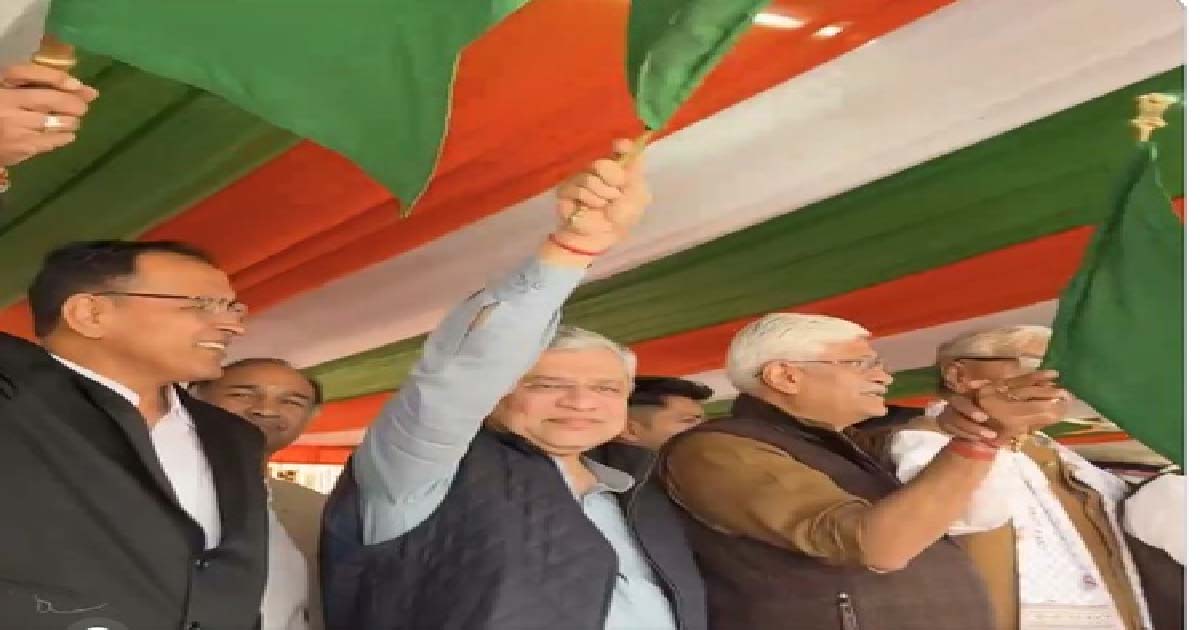
Jaipur, Nov 29: Railway Minister Ashwini Vaishnaw and Union Tourism Minister Gajendra Singh Shekhawat jointly flagged off the Swarnanagari Express on Saturday, which will connect Jaisalmer with Delhi.
During the inauguration ceremony, responding to the request of Union Minister Shekhawat and the locals, the Railways Minister announced the renaming of the newly-launched train from Jaisalmer–Shakur Basti–Jaisalmer to Swarnanagari Express.
He announced that the train will begin regular operations on December 1.
The minister said that development work at Jaisalmer railway station is in its final phase and is expected to be completed within a month.
“Efforts will be made to ensure that Prime Minister Narendra Modi inaugurates the upgraded station,” he said.
Union Minister Vaishnaw also confirmed that the railway line between Jaisalmer and Jodhpur will be upgraded soon.
According to officials, these initiatives will significantly improve connectivity, boost tourism, and strengthen strategic infrastructure in the border region.
Ashwini Vaishnaw said that the connectivity will strengthen national security.
Preparations are underway to connect several regions along the Rajasthan–Pakistan border with new railway lines.
He said that extending rail connectivity to these sensitive areas will significantly enhance the country’s security infrastructure.
Under this initiative, new railway lines are proposed for Anupgarh, Bikaner, Jaisalmer, Barmer, and Bhildi.
The minister arrived in Jaisalmer on Saturday to inaugurate a new train service to Delhi.
The minister also visited stalls under the One Station, One Product scheme and made purchases to promote local artisans.
He said that the Detailed Project Report (DPR) for the proposed border-area railway lines is being prepared and will be completed in the coming months.
“A complete effort will be made to connect the entire border region,” he assured.
He added that railway projects worth approximately Rs 55,000 crore are currently in progress across Rajasthan, including the redevelopment of 85 railway stations.
Work is also advancing on multiple new railway corridors and infrastructure projects.
The new initiatives, officials said, will improve connectivity, boost tourism, and strengthen strategic infrastructure in the border region.

Mumbai Local Train Update: Central Railway Services Disrupted, 30-40 Minutes Delay Reported; Commuters Flood X With Complaints

He can’t go bang-bang straight away: Gavaskar breaks down Kohli’s masterclass vs SA

Mumbai: 51-Year-Old Businesswoman Stripped & Assaulted At Gunpoint In Mahalaxmi Office

RBI to cut policy repo rate by 25 bp on Dec 5: HSBC

UPI transactions grow 32 pc in Nov as consumption remains robust

Kalyan College Namaz Controversy: SIO Demands Action Against Perpetrators

FIR filed against unidentified person in Bilaspur train collision

A powerful explosion near Delhi’s Red Fort… High alert across Delhi after the blast; 8 people killed; forensic team arrives at the scene.

Good News Navi Mumbaikars! Ulwe Coastal Road 60% Complete, Major Link Between Atal Setu & Upcoming NMI Airport Progresses Smoothly

Mumbai Local Train Update: Megablock On Central, Harbour, Trans-Harbour & Western Railway Lines On Nov 16; Check Details
-

 Crime3 years ago
Class 10 student jumps to death in Jaipur
-
 Maharashtra1 year ago
Mumbai Local Train Update: Central Railway’s New Timetable Comes Into Effect; Check Full List Of Revised Timings & Stations
-
 Maharashtra1 year ago
Mumbai To Go Toll-Free Tonight! Maharashtra Govt Announces Complete Toll Waiver For Light Motor Vehicles At All 5 Entry Points Of City
-

 Maharashtra1 year ago
False photo of Imtiaz Jaleel’s rally, exposing the fooling conspiracy
-
 National News1 year ago
Ministry of Railways rolls out Special Drive 4.0 with focus on digitisation, cleanliness, inclusiveness and grievance redressal
-
 Maharashtra1 year ago
Maharashtra Elections 2024: Mumbai Metro & BEST Services Extended Till Midnight On Voting Day
-

 National News1 year ago
J&K: 4 Jawans Killed, 28 Injured After Bus Carrying BSF Personnel For Poll Duty Falls Into Gorge In Budgam; Terrifying Visuals Surface
-

 Crime1 year ago
Baba Siddique Murder: Mumbai Police Unable To Get Lawrence Bishnoi Custody Due To Home Ministry Order, Says Report