
National News
Back from Ukraine: Escaping war to land in the thick of life’s battles

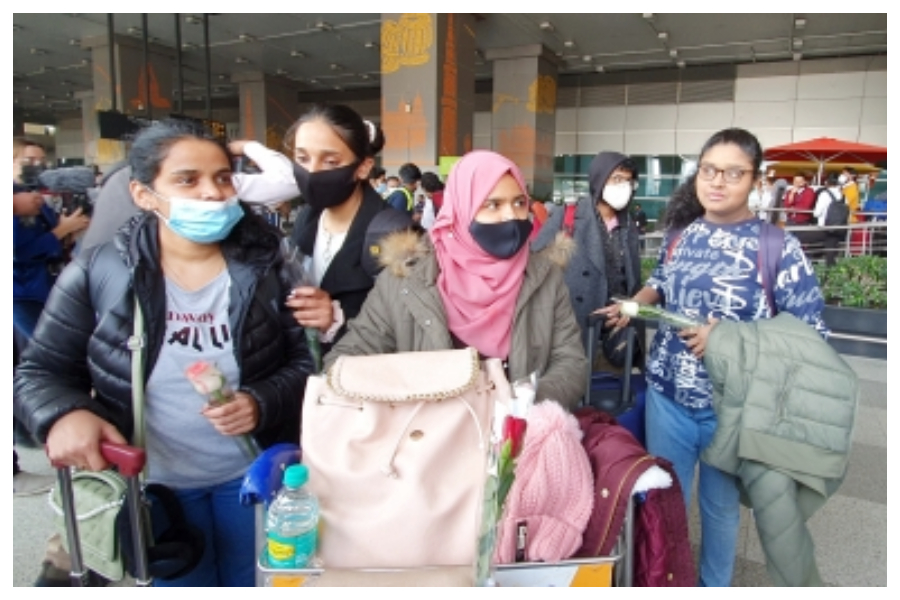
The troubles of the students returning from Ukraine to India are not over yet. Most of the Indian students have returned to their homes safely, but their future now hangs in the balance.
Among them, there are about 4,000 students who were in the final year of the MBBS course. There is no option available to these students who have spent 5 years of their life and lakhs of rupees on MBBS studies.
Deshraj Advani, an expert and mentor of medical education in the country, says that the biggest problem before the students is that how will it be confirmed that which student has studied in which university for how many years and how was his performance in the last semester.
According to Advani, these students do not even have concrete provisional proof of their partially-completed studies that they have done in Ukraine.
Although such provisional proofs are not recognised anyway, it can at least for the satisfaction of the students, who are hopeful that soon the war between Russia and Ukraine will end and they will be able to go back to Ukraine to complete their studies.
However, even if the war ends soon, it will not be possible for every student to return to Ukraine and resume their studies.
Randeep, a student who returned from Ukraine, said that he was studying at the Medical University in Lugansk State, but his university has been destroyed in missile attacks. In such a situation, he is worried that even after the war gets over, how he would resume his studies there.
According to educationist C.S. Kandpal, there were about 18,000 Indian students studying medicine in Ukraine, it is not possible to provide immediate admission (in Indian colleges) to all these students.
Kandpal says that seats are already full in almost all medical colleges. In such a situation, it does not seem to be possible to have any immediate arrangement for these students.
Students returning from Ukraine are also aware of the current situation. Shreya Sharma, doing MBBS from Vinnitsa National Medical University, Ukraine, said that it is a reality that the Indian government cannot accommodate all 18,000 students here.
Not only this, the rules of the National Medical Commission of India regarding foreign medical graduates are also very strict. Furthermore, there is no such rule in the country according to which those returning from abroad in mid of their MBBS course can get admission in the medical colleges here.
Even for those who have completed medical studies from abroad, there are strict criteria, which they need to fulfill before starting their practice in India.
Despite its small population, Ukraine has about 20 medical universities.
There are three types of universities in Ukraine — National Medical University, National University and State University.
About 6,000 Indian students go to Ukraine every year to study MBBS and BDS.
In India, every year about eight lakh students appear for the MBBS entrance exam, out of these, only one lakh students get admission in Indian medical colleges. This is the reason why every year thousands of Indian students have to move to other countries, including Ukraine, to study medicine.
According to the Government of India, there are a total of 88,120 MBBS seats and as many as 27,498 BDS seats in government and private medical colleges in the country, and about 50 per cent of MBBS seats are in private colleges.
Data suggests that only five per cent of the total students who appear in the NEET exam get admission in the government medical colleges.
Devansh Gupta, an Indian student who has studied MBBS from Ukraine, says that in government medical colleges in India, a student needs to spend around Rs 15 to Rs 20 lakh on his fees to complete his MBBS. Whereas in private medical colleges, each student has to spend more than Rs 80 lakh to complete the course.
“On the other hand, the best private medical colleges in Ukraine charge fees up to Rs 5 lakh annually, due to which the entire MBBS course gets completed in about Rs 25 to Rs 30 lakh,” Gupta asserts while explaining why many students flee to Ukraine for studying medicine.


Ballari, Jan 3: The Karnataka Police have registered FIRs against BJP MLA and mining baron Janardhana Reddy and Congress MLA Nara Bharat Reddy on Saturday in connection with the violence that erupted over a banner-related issue, which resulted in the death of a grand old party worker in Ballari.
Police have intensified the investigation to ascertain who fired the bullet that killed Congress worker Rajashekar.
An FIR has been registered against several people, including MLA Bharat Reddy, in connection with the death of Rajashekar.
The FIR was lodged at the Bruce Pet Police Station in Ballari, and the investigation is currently underway.
The FIR names several individuals, including Ballari city MLA Nara Bharat Reddy’s close associate Satish Reddy, Chanal Shekhar, Nara Pratap Reddy and Nara Suryanarayana Reddy. The FIR was registered based on complaints filed by MLA Janardhana Reddy and BJP worker Nagaraj.
MLA Janardhana Reddy filed a complaint alleging assault and attempt to murder against several persons, including MLA Bharat Reddy.
In a separate complaint, BJP worker Nagaraj alleged trespass, caste-based abuse, attempt to murder and rioting. BJP state president B.Y. Vijayendra was also present when the complaints were filed.
Investigations have indicated that the bullet that struck Rajashekar was a 12 mm single-bore bullet fired from a single-barreled gun.
Police sources revealed that four gunmen connected to Satish Reddy, a close associate of MLA Bharat Reddy, are currently absconding.
Police stated that shots were fired during the violence, and one gunman was seen firing at the residence of Janardhana Reddy.
Supporters of Bharat Reddy told the police that shots were fired after Janardhana Reddy’s supporters allegedly indulged in intense stone-pelting towards Satish Reddy.
Meanwhile, another bullet shell was seized from Janardhana Reddy’s residence.
Inspector General of Police Varthika Katiyar visited Ballari on Saturday and inspected the security arrangements. The city has since returned to normalcy.
Responding to questions regarding who fired at the Congress worker, she said the investigation is ongoing to ascertain the facts.
Meanwhile, Housing and Waqf Minister Zameer Ahmad Khan, who is also the District In-charge Minister for Ballari, is visiting the city. He is scheduled to meet the family members of Rajashekar.
Sources said Chief Minister Siddaramaiah and the party high command have taken serious note of the developments and instructed Congress MLA Bharat Reddy to exercise restraint.
Bharat Reddy’s aggressive statements against Janardhana Reddy had embarrassed the Congress.
The government’s decision to suspend Ballari Superintendent of Police Pavan Nejjur has triggered a debate, as the officer was suspended within hours of assuming charge.
Minister for Law and Parliamentary Affairs H.K. Patil said the officer was suspended for failing to visit the spot during the violence. “It was important that he visited the spot, even if he had taken charge just 30 minutes earlier,” he said.

Mumbai: While several rebels withdrew their independent nominations at the last moment following intervention by party leaders, some continued to contest against their own party’s official candidates. Of the 2,185 candidates who had filed nomination papers for the 2026 BMC elections, 453 withdrew on the final day, Friday, leaving 1,729 candidates still in the fray.
A total of 2,516 nominations were submitted for 227 seats in the BMC elections, including candidates from all major parties and independents. Of these, 164 nominations were found invalid and rejected on technical grounds. The final number of candidates stands at 2,185, as some filed nominations for multiple wards. Mumbai’s political drama reached a fever pitch on Friday as the deadline to withdraw nomination papers for the BMC elections approached. Major alliances, including the Thackeray-MNS combine and the BJP-Shiv Sena coalition, worked overtime to rein in “rebel” candidates who had filed independent nominations after being denied official party tickets, intensifying the pre-poll tension.
By the end of the day, both the BJP and Shiv Sena (UBT) managed to convince several rebel candidates to withdraw their nominations, securing their official nominees. However, some rebels remain in the fray, heightening tensions within their parties. In Ward 95, former corporator Chandrashekhar Waingankar has filed an independent nomination against Shiv Sena (UBT)-MNS alliance candidate Hari Shastri, with the party unable to persuade him to step aside. Similarly, in Ward 159, UBT candidate Pravina Morajkar will face a rebel challenge from Kamalakar Naik.
The rebellion wave continues to shape the BMC elections in several wards. In Ward 202, Shiv Sena (UBT) candidate and former mayor Shraddha Jadhav will go up against rebel Vijay Indulkar, who has refused to withdraw. Ward 196 sees Shiv Sena (UBT) candidate Padmaja Chemburkar contesting against Sangita Jagtap. In Ward 193, Shiv Sena (UBT) candidate Hemangi Worlikar is up against rebel Suryakant Koli and in Ward 177, a former BJP corporator Nehal Shah has filed an independent nomination against Mahayuti candidate Kalpesha Kothari.
Some of the rebellion who withdrew on the last day are : In Ward 225, BJP candidate Harshita Narvekar, sister of Assembly Speaker Rahul Narvekar, faced a challenge from BJP Mumbai Vice-President Kamalakar Dalvi. The party successfully convinced Dalvi to withdraw on the final day; he had filed independently after being denied a ticket. The ward will now see a direct contest between BJP and Shiv Sena (Shinde faction) candidate and former corporator Sujata Sanap. Similarly, in Ward 1, former BJP corporator Sunita Yadav had filed an independent nomination against Mahayuti candidate Rekha Yadav, she has now withdrawn her nomination. In Mulund Ward 106, Shiv Sena UBT-MNS candidate Satyavan Dalvi and BJP candidate Prabhakar Shinde remain in the fray. Rebel candidate Sagar Devre had filed independently but was persuaded to withdraw.
In Ward 173, BJP rebel Vaishali Pagare withdrew her nomination. So Shiv Sena Shinde faction candidate Pooja Ramdas Kamble is now the main contender. Other notable withdrawals include former corporator Janak Sanghvi from Ward 221, who had initially filed against BJP candidate Akash Purohit, and Ramakant Gupta from Ward 185, who had opposed BJP candidate Ravi Raja. Both nominations were later retracted, easing tensions within the party.
Mumbai Press Exclusive News
Mumbai BMC elections: Abu Asim Azmi appeals to disgruntled Samajwadi Party workers


In the Mumbai Municipal Corporation elections, Samajwadi Party leader and MLA Abu Asim Azmi has appealed to the claimants deprived of party tickets that if for some reason any candidate has not got a party ticket, the party leadership will provide them with an opportunity in the future, but in this election, they should show unity with the Samajwadi Party candidates for the problems and rights of the people. He said that in the BMC elections, the Samajwadi Party had decided to field candidates on 150 seats so that the socialist ideology would be promoted. The candidates on the party ticket were provided with tickets and the candidates also filed their candidatures, but unfortunately, many claimants did not get tickets because there were many difficulties in the distribution of tickets. Thank you to everyone for contesting elections on the party ticket in Mumbai and promoting the party’s ideology. Candidates were announced in several wards in a phased manner and 150 candidates have been fielded for the election phase. Abu Asim Azmi said that I appeal to all the workers and contenders to work for the party candidate instead of getting angry over the deprivation of the ticket because it is our responsibility to strengthen the party and promote the ideology of the Samajwadi Party. The candidates who have not been given a chance this time should not be unhappy. The election is not just for one candidate but for the ideology of the party. Whoever is given the ticket, he is the face and candidate of the Samajwadi Party. Therefore, the party should support the candidate and strengthen the party. It is a victory of unity. You will all work for the Samajwadi Party to raise your voice on the problems of the citizens and I am sure that the Samajwadi Party will make history this time.

Congress worker death case: FIR lodged against MLAs in Karnataka’s Ballari

Maharashtra Civic Body Elections 2026: BJP-Led Mahayuti In Driver’s Seat With 68 Unopposed Wins So Far; Check Details

Mumbai Weather Update For Jan 3, 2026: City Starts Saturday Cool, But Air Quality Remains Unhealthy; Overall AQI At 224

Nifty surges over 1 pc this week led by bank, auto stocks

BMC Elections 2026: Rebel & Withdrawn Candidates; Check Full Details Below

Mukesh Ambani, Shiv Sena UBT Chief Uddhav Thackeray & Son Aaditya Share Warm Greetings At Mumbai’s Swadesh Event

Lionel Messi’s G.O.A.T India Tour: Football Legend To Arrive On December 14 In Mumbai; CM Devendra Fadnavis Shares Excitement On X

Mumbai Crime: Father–Son Real Estate Duo Booked For ₹31.26-Crore Investment Fraud In Jogeshwari Redevelopment Project

Mamata Banerjee announces judicial committee to probe chaos at Salt Lake Stadium over Lionel Messi’s visit

Bigg Boss 19 Winner Gaurav Khanna’s EXCLUSIVE Interview: ‘Dil Jeete Hai Isliye Show Jeeta Hoon!’
-

 Crime3 years ago
Class 10 student jumps to death in Jaipur
-

 Maharashtra1 year ago
Mumbai Local Train Update: Central Railway’s New Timetable Comes Into Effect; Check Full List Of Revised Timings & Stations
-

 Maharashtra1 year ago
Mumbai To Go Toll-Free Tonight! Maharashtra Govt Announces Complete Toll Waiver For Light Motor Vehicles At All 5 Entry Points Of City
-

 Maharashtra1 year ago
False photo of Imtiaz Jaleel’s rally, exposing the fooling conspiracy
-

 National News1 year ago
Ministry of Railways rolls out Special Drive 4.0 with focus on digitisation, cleanliness, inclusiveness and grievance redressal
-

 Maharashtra1 year ago
Maharashtra Elections 2024: Mumbai Metro & BEST Services Extended Till Midnight On Voting Day
-

 National News1 year ago
J&K: 4 Jawans Killed, 28 Injured After Bus Carrying BSF Personnel For Poll Duty Falls Into Gorge In Budgam; Terrifying Visuals Surface
-

 Crime1 year ago
Baba Siddique Murder: Mumbai Police Unable To Get Lawrence Bishnoi Custody Due To Home Ministry Order, Says Report