
National News
‘Don’t spread these things to a larger level’, SC on pleas challenging HC order on Hijab

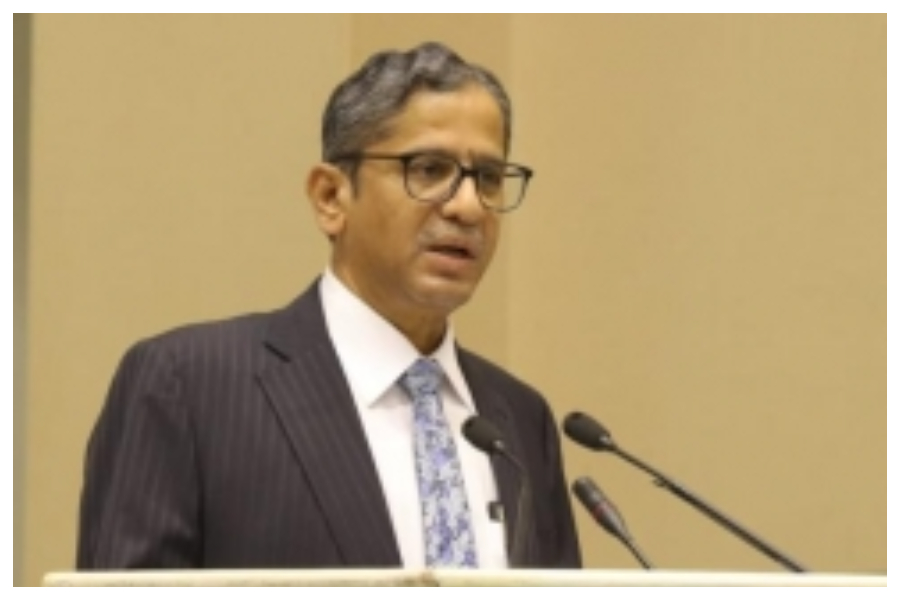
Chief Justice N.V. Ramana on Friday orally told the counsel of a petitioner, challenging the Karnataka High Court interim order in the Hijab matter, to think whether it is proper to bring the issue at the national level.
Senior advocate Devadutt Kamat mentioned the plea challenging the Karnataka High Court before a bench headed by Chief Justice N.V. Ramana. Kamat submitted that the high court has restrained the students from disclosing their religious identities, which results in suspension of Article 25 and this will lead into larger consequences.
The Chief Justice said: “Court is already hearing the matter”. Solicitor General Tushar Mehta submitted that the high court order has not come out so far and it should be allowed to decide the issue. Mehta emphasized that the matter should not be made either religious or political.
Chief Justice orally observed, “Don’t spread these things to a larger level…we don’t want to express anything on it.”
Justice Ramana told Kamat, “We are watching it and we know what is happening. Think, is it proper to bring it to the national level..”
Kamat mentioned the plea by a petitioner challenging the Karnataka High Court’s interim order to students not to insist on wearing religious attire till the court has decided the matter.
The Chief Justice emphasized that if there is constitutional rights’ violation of any one it would intervene at the appropriate time and its responsibility to protect constitutional rights of everyone.
The top court declined to go into the merits of the matter. “We will take it up at an appropriate time,” said the bench.
Another plea has been filed through advocates Rahamatullah Kothwal and Adeel Ahmed said: “The right to wear hijab falls under right to expression under Article 19(1)(a), right to privacy and freedom of conscience under Article 25. The same cannot be infringed upon without a valid law.” The college administration has resisted a group of students’ insistence to wear Hijab. The matter has triggered reaction, where others have worn saffron shawls.
Adeel submitted before the bench that students’ practical exams are scheduled on February 15.
The plea filed by Mohamed Arif Jameel and D.J. Halli Federation of Masajids Madaaris and Wakf Institutions contended that the high court through its order has sought to curtail the fundamental right of Muslim student-women by not allowing them to wear the hijab and pursue their education. “It is, therefore, necessary that an appropriate order be made staying the operation of the impugned order till the disposal of this petition otherwise the purpose of filing of special leave petition may be defeated and the same may be rendered in-fructuous”, said the plea.
The plea said the students concerned have to appear in practical examinations scheduled on February 15 and any interference on their access to institutions would impede on their right to education.
A three-judge bench of Chief Justice Ritu Raj Awasthi, Justice Krishna S.Dixit and Justice J.M. Khazi had passed the oral observations and scheduled the hearing on petitions challenging Hijab ban on Monday. The high court said: “We will pass an order. Let the schools-colleges start. But till the matter is resolved, no student should insist on wearing religious dress”.

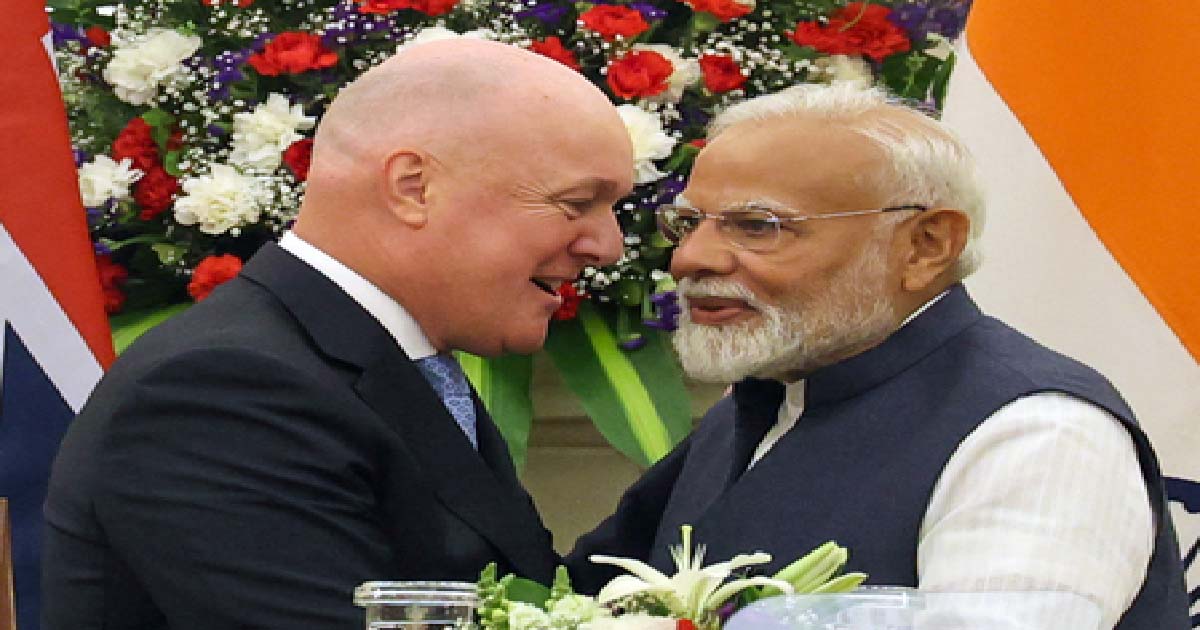
New Delhi, Dec 22: Prime Minister Narendra Modi held a telephone conversation with New Zealand’s Prime Minister, Christopher Luxon, on Monday as the two leaders jointly announced the successful conclusion of the historic, ambitious and mutually beneficial India-New Zealand Free Trade Agreement (FTA).
During the conversation, both leaders expressed confidence in doubling bilateral trade over the next five years as well as an investment of $20 billion in India from New Zealand over the next 15 years.
The negotiations began in March this year and the two leaders concluded the FTA in a record time of nine months, reflecting the shared ambition and political will to further deepen ties between the two countries, according to a statement from Prime Minister’s Office (PMO).
“The FTA would significantly deepen bilateral economic engagement, enhance market access, promote investment flows, strengthen strategic cooperation between the two countries, and also open up new opportunities for innovators, entrepreneurs, farmers, MSMEs, students and youth of both countries across various sectors,” said the statement.
The leaders also welcomed the progress achieved in other areas of bilateral cooperation such as sports, education, and people-to-people ties, and reaffirmed their commitment towards further strengthening of the India-New Zealand partnership.
This historic FTA eliminates and reduces tariffs on 95 per cent of New Zealand’s exports – among the highest of any Indian FTA – with almost 57 per cent being duty-free from day one, increasing to 82 per cent when fully implemented, with the remaining 13 per cent subject to sharp tariff cuts.
It puts New Zealand exporters on an equal or better footing to our competitors across a range of sectors and opens the door to India’s rapidly expanding middle class, according to an official statement from New Zealand.
“The Indian economy is forecast to grow to NZ$12 trillion by 2030. The India-NZ Free Trade Agreement unleashes huge potential for our world-class exporters to the world’s largest country and will significantly accelerate progress towards New Zealand’s ambitious goal of doubling the value of exports over 10 years,” it added.
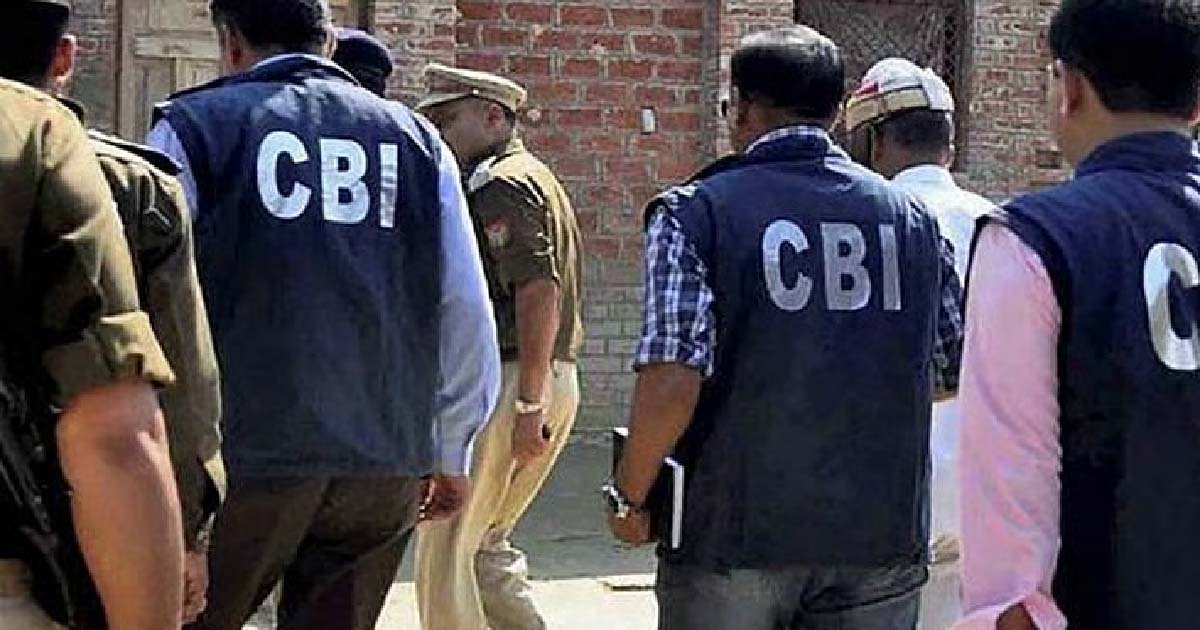
Mumbai: The CBI has identified two more persons allegedly involved in the case where agency officials arrested Nitesh Rai, branch manager of a private bank in Mumbai, last month for facilitating the opening of mule accounts. Investigation has revealed that the arrested official, in collusion with cybercriminals, accepted illegal gratification and, by abusing his official position, processed account opening forms, thereby creating channels for the movement and layering of cybercrime proceeds.
“During the investigation of the said case, from April 30, 2025 to May 4, 2025, it has been revealed that accused Nitesh Rai, while functioning as Branch Manager, Bandra Reclamation Branch, Mumbai, facilitated the opening of mule accounts and obtained illegal gratification from A.N. Pathan and P.B. Sahni for the improper performance of his official duties,” said a CBI official.
“Investigation has further revealed that on one occasion, a sum of Rs 10,000 was transferred into the Axis Bank account of Nitesh Rai on January 2, 2025, as illegal gratification in lieu of processing Account Opening Forms. The demand for illegal gratification and the work to be carried out thereafter were discussed by Nitesh Rai over WhatsApp chat with Sahni.”
“Pursuant to the demand, Sahni, through Pathan, arranged for the transfer of Rs 10,000 into the account of Nitesh Rai. The payment was facilitated through money exchange by Pathan. Upon receipt of the said illegal gratification, Nitesh Rai processed the Account Opening Forms.” “Pathan and Sahni thereby induced a public servant for improper performance of his official duties,” the official added.
National News
‘Mahayuti’s victory in local body elections due to money power, poll panel’s inaction’: Shiv Sena(UBT) in Saamana

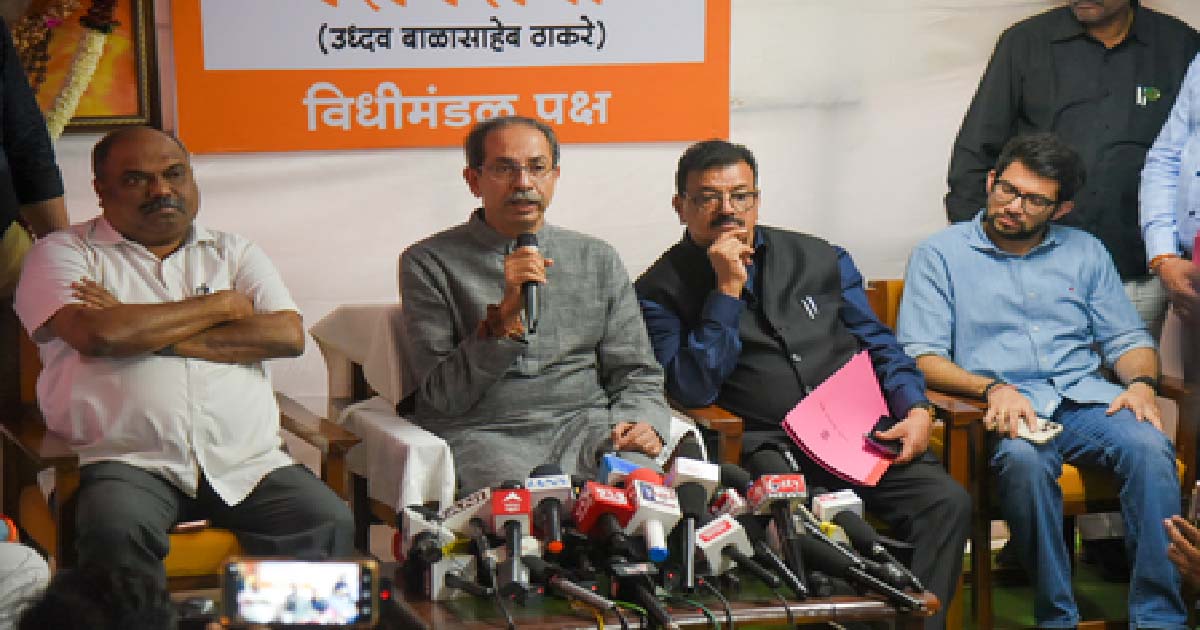
Mumbai, Dec 22: The Shiv Sena Uddhav Balasaheb Thackeray (UBT) on Monday alleged that the BJP-led Mahayuti won the elections to the nagar parishad and nagar panchayat in Maharashtra due to money and muscle power.
The party in its mouthpiece, ‘Saamana’, said that if “these victories are to be bought with money, then the pride and honour of Maharashtra have been dragged through the dust. Chhatrapati Shivaji Maharaj’s Maharashtra appears to be crawling, helpless before the money. This picture is dangerous for the country.”
The Saamana editorial sharply criticised the State Election Commission (SEC) for its perceived “inaction”, describing the body as being in a state of “slumber” while instances of kidnapping, terror, and open money distribution took place across the state.
The editorial claimed that the BJP has started a sole business of winning every election through dishonesty. “After the British, the BJP and its allies have looted the country the most. Elections are fought and won using that very looted money. Furthermore, a significant amount of ‘drug money’ was also used in the election. This raises questions about what our democracy is doing and how the ‘Voter King’ actually votes.”
According to the latest figures from the State Election Commission (SEC), the BJP has emerged as the single largest party, winning over 100 municipal president posts. The Shinde-led Shiv Sena and Ajit Pawar’s NCP have each secured more than 40 seats. In contrast, the combined opposition, including the Congress, Sharad Pawar’s NCP(SP), and Shiv Sena(UBT), managed to secure roughly 60 seats. This result mirrors the “pattern” seen in the recent Assembly elections, where the Mahayuti secured a similar landslide victory, said the editorial.
The Thackeray camp has characterised the elections as a “game of money power”, alleging that in several municipal areas, the “market rate” for a single vote ranged from Rs 4,000 to Rs 10,000. In more competitive zones, it is claimed that the BJP pushed the rate as high as Rs 20,000 to Rs 25,000 per vote, leading to internal friction within the ruling alliance.
A specific incident was reported in Sindhudurg, where a public spat broke out between Shinde-faction MLA Nilesh Rane and BJP State President Ravindra Chavan over the distribution of funds.
“Reports of coercion and electoral malpractice and voter intimidation in particular have surfaced from multiple districts. In Dharmabad (Nanded), allegations emerged that BJP office-bearers detained nearly 1,500 voters, including women, in a marriage hall to force them to accept bribes ranging from Rs 2,000 to Rs 4,000. Those who refused were reportedly threatened. In Ambernath, police investigations were launched into allegations of bogus voting involving over 200 women brought in from neighbouring areas. In Panvel, discrepancies in voter lists were flagged, including one instance where 268 voters were allegedly listed with the same father’s name,” said the editorial.
The Thackeray camp has cited the local body elections held in the neighbouring state of Telangana, where the State Election Commission did not use EVMs but conducted on a ballot paper, resulting in a crushing defeat for the BJP.
“In Telangana’s local bodies, the Congress made a strong surge and secured a major victory. Similarly, in Punjab’s local body elections, AAP surged ahead, leaving both the BJP and Congress behind. In both these states, despite the BJP playing a heavy game of money, the voters were not bought,” it said.
The editorial observed that the way the elections are conducted and fought in Maharashtra raises a serious question of the integrity of the democratic process.
As the state moves toward the next major electoral battle — the BMC elections in January 2026 — the questions regarding electoral transparency and the influence of wealth in Maharashtra’s politics will continue to intensify.

India-New Zealand FTA: PM Modi, Luxon aim to double bilateral trade over 5 years

Mumbai: CBI Identifies 2 More In Mule Account Scam Involving Private Bank Manager

‘Mahayuti’s victory in local body elections due to money power, poll panel’s inaction’: Shiv Sena(UBT) in Saamana

Mumbai-Bound Air India Flight Returns To Delhi Airport Minutes After Take Off Due To Technical Glitch

Sensex, Nifty open in green zone amid positive global cues

Kalyan College Namaz Controversy: SIO Demands Action Against Perpetrators

Sensex, Nifty open lower amid weak global cues

Veteran Bollywood Actor Dharmendra Passes Away at 89

Mega Block On Sunday, 23-11-2025: Mumbai Local Train Services To Be Affected On CR’s Main Line, No Block On Harbour & Trans-Harbour Line; Check Details

Mukesh Ambani, Shiv Sena UBT Chief Uddhav Thackeray & Son Aaditya Share Warm Greetings At Mumbai’s Swadesh Event
-

 Crime3 years ago
Class 10 student jumps to death in Jaipur
-
 Maharashtra1 year ago
Mumbai Local Train Update: Central Railway’s New Timetable Comes Into Effect; Check Full List Of Revised Timings & Stations
-
 Maharashtra1 year ago
Mumbai To Go Toll-Free Tonight! Maharashtra Govt Announces Complete Toll Waiver For Light Motor Vehicles At All 5 Entry Points Of City
-
 Maharashtra1 year ago
False photo of Imtiaz Jaleel’s rally, exposing the fooling conspiracy
-
 National News1 year ago
Ministry of Railways rolls out Special Drive 4.0 with focus on digitisation, cleanliness, inclusiveness and grievance redressal
-
 Maharashtra1 year ago
Maharashtra Elections 2024: Mumbai Metro & BEST Services Extended Till Midnight On Voting Day
-
 National News1 year ago
J&K: 4 Jawans Killed, 28 Injured After Bus Carrying BSF Personnel For Poll Duty Falls Into Gorge In Budgam; Terrifying Visuals Surface
-
 Crime1 year ago
Baba Siddique Murder: Mumbai Police Unable To Get Lawrence Bishnoi Custody Due To Home Ministry Order, Says Report