
National News
‘Through visionary leadership, he empowered India economically’: Rahul Gandhi on Manmohan Singh’s death anniversary

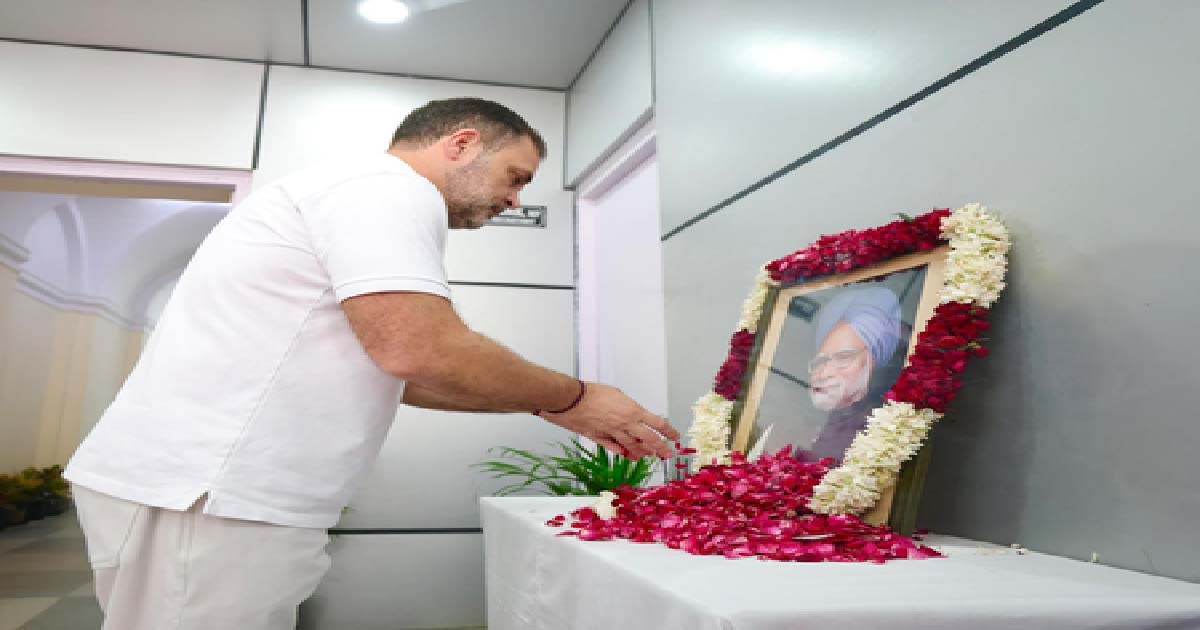
New Delhi, Dec 26: Leader of Opposition in the Lok Sabha, Rahul Gandhi, on Friday paid tribute to former Prime Minister Dr Manmohan Singh on his death anniversary, describing him as a visionary leader whose policies empowered India economically and strengthened the nation’s global standing.
Rahul Gandhi also paid floral tributes to Manmohan Singh on his first death anniversary at Congress office at 24, Akbar Road, New Delhi.
Taking to social media platform X, Rahul Gandhi said, “Humble tribute to former Prime Minister of India Dr. Manmohan Singh ji on his death anniversary.”
He further said that Dr Singh’s leadership transformed India’s economy and uplifted millions.
“Through his visionary leadership, he empowered India economically. His historic efforts and bold decisions for the underprivileged and poor in the country gave India a new identity on the world stage. His humility, hard work and honesty will always be an inspiration to all of us,” Rahul Gandhi said in his post.
Dr Manmohan Singh, India’s 14th Prime Minister, is widely acknowledged as a distinguished economist, thinker, and scholar. He is remembered for his diligence, academic approach to governance, accessibility, and unassuming demeanour, qualities that defined his long and illustrious public career.
Born on September 26, 1932, in a village in the Punjab province of undivided India, Dr Singh displayed academic excellence from an early age. He completed his matriculation from Punjab University in 1948 before embarking on a remarkable academic journey abroad.
Dr Singh earned a First Class Honours degree in Economics from the University of Cambridge in 1957 and went on to complete a D.Phil in Economics from Nuffield College, Oxford University, in 1962. His seminal book, ‘India’s Export Trends and Prospects for Self-Sustained Growth’, published by Clarendon Press, Oxford, in 1964, offered an early critique of India’s inward-looking trade policy and reflected his deep understanding of economic development.
His academic credentials were further strengthened through his teaching assignments at Punjab University and the prestigious Delhi School of Economics. He also served briefly at the United Nations Conference on Trade and Development (UNCTAD) Secretariat, which later led to his appointment as Secretary-General of the South Commission in Geneva between 1987 and 1990.
In 1971, Dr Singh joined the Government of India as Economic Advisor in the Ministry of Commerce. He was appointed Chief Economic Advisor in the Ministry of Finance in 1972, marking the beginning of his influential role in shaping India’s economic policies.
Over the years, Dr Singh held several key positions in public service, including Secretary in the Ministry of Finance, Deputy Chairman of the Planning Commission, Governor of the Reserve Bank of India, Advisor to the Prime Minister, and Chairman of the University Grants Commission.
Dr Singh’s tenure as Finance Minister from 1991 to 1996 proved to be a watershed moment in India’s economic history. At a time of severe balance-of-payments crisis, he introduced wide-ranging economic reforms that liberalised the economy and laid the foundation for sustained growth. These reforms earned him global recognition and remain inseparably linked to his vision and leadership.
Throughout his lifetime, Dr Singh received numerous national and international honours. Among the most notable were the Padma Vibhushan in 1987, the Jawaharlal Nehru Birth Centenary Award of the Indian Science Congress in 1995, and multiple international accolades, including the Asia Money and Euro Money awards for Finance Minister of the Year. He was also conferred honorary degrees by leading universities such as Cambridge and Oxford.
Dr Singh represented India at several international forums and led delegations to major global conferences, including the Commonwealth Heads of Government Meeting in Cyprus and the World Conference on Human Rights in Vienna in 1993.
In his political career, Dr Manmohan Singh served as a member of the Rajya Sabha from 1991 and as Leader of Opposition between 1998 and 2004. He was sworn in as Prime Minister on May 22, 2004, and assumed office for a second term on May 22, 2009, leaving behind a legacy of integrity, intellect, and service to the nation.

National News
No permission for Jantar Mantar protest, Delhi Police seek closure of 57 metro stations

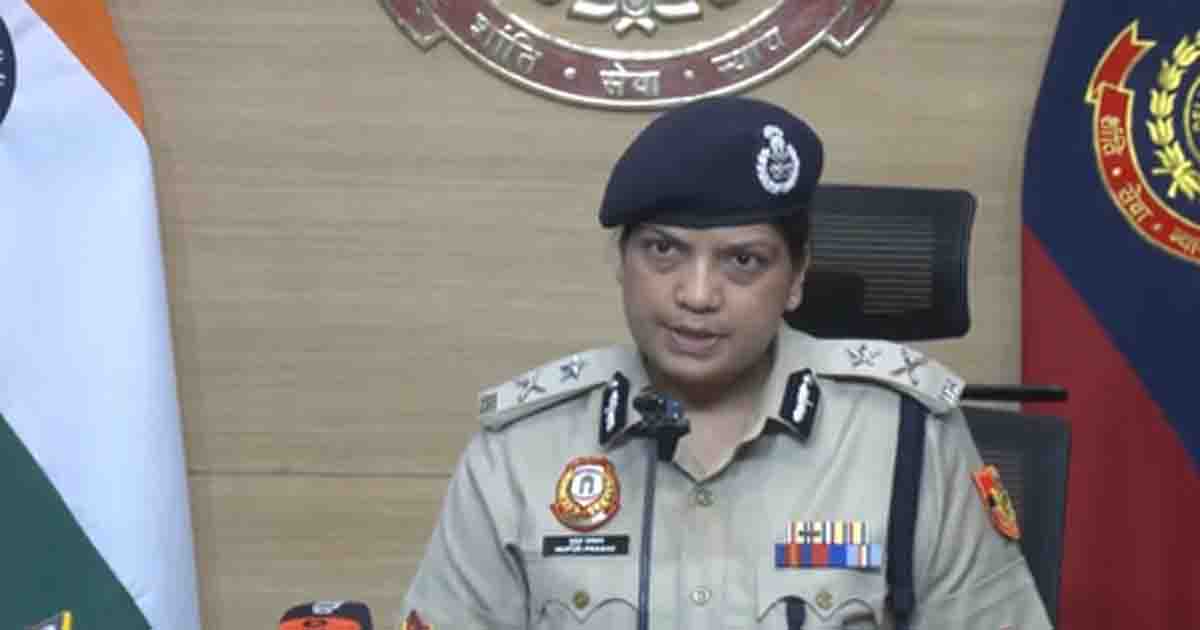
New Delhi, Oct 9: Ahead of the proposed protest by the CJP at Jantar Mantar on October 10, the Delhi Police on Friday said permission for the demonstration has been denied due to the organisers’ failure to comply with legal directions and their own undertakings during an earlier protest.
Citing the prevailing law-and-order situation, public safety and the need to regulate traffic, the police said the decision was taken after considering the circumstances surrounding the proposed demonstration.
Addressing a press conference, Joint Commissioner of Police (New Delhi Range) Nupur Prasad said the police had received an application from Sourav Das, co-convenor of the Cockroach Janta Party (CJP), regarding a proposed protest at Jantar Mantar seeking accountability from the Chief Election Commissioner (CEC).
“The intimation was considered, and it was found that it was given at very short notice. As per the prescribed guidelines, the intimation has to be received 10 days prior to the planned protest,” she said.
Prasad further said that on an earlier occasion, the CJP had been granted permission to hold a protest at the venue, but it had failed to comply with lawful directions and its own undertakings.
“Therefore, due to the failure to follow the legal directions and their own undertakings, and considering the prevailing law-and-order situation, public safety and traffic regulation, permission has been rejected this time,” she said.
The Joint CP also said that Section 163 of the Bharatiya Nagarik Suraksha Sanhita (BNSS) was in force in the New Delhi area, with preventive restrictions imposed to maintain public order and safety.
She warned that appropriate legal action would be taken against anyone found violating the provisions of Section 163 of the BNSS.
The Delhi Police have also proposed closing the entry and exit points of 57 metro stations from 9 p.m. on Friday until Saturday. The proposal has been sent to Delhi Metro Rail Corporation (DMRC) officials, and confirmation is awaited. These include Janpath, Patel Chowk, Supreme Court, ITO, Delhi Gate, Kashmere Gate, Rohini West, Welcome, Shalimar Bagh, Adarsh Nagar, and Hauz Khas.
Police officials said the proposal concerns the closure of entry and exit points, while interchange facilities may remain available to commuters.
The proposed restrictions and transport measures come amid preparations to manage public movement, maintain law and order and minimise traffic disruptions in the national capital during the planned protest.
Crime
Week after Supernova suicide, 36-year-old man dies after fall from 12th floor of Greater Noida West society

Greater Noida, Oct 9: Nearly a week after a young man jumped to his death from the 43rd floor of Noida’s Supernova building in Sector 94, sending shockwaves in the area, a 36-year-old man died after falling from the 12th floor of a residential society in Greater Noida West on Friday, with his family telling police that he had been struggling with depression, officials said.
The deceased was identified as Anil Kumar, son of Santosh Kumar, a resident of Ace Divino Society under the Bisrakh police station limits. He originally hailed from Prithvipur village in Madhya Pradesh’s Niwari district.
According to police, they received information about the incident on Friday and sent a team to the spot. The personnel gathered details about the incident and completed the identification process.
Police subsequently took custody of the body, completed the inquest proceedings and sent it for post-mortem examination.
During preliminary enquiries, the deceased’s family told police that Kumar had been experiencing depression for some time. However, police are still examining the circumstances leading to the incident, and the family’s statement alone does not establish the cause of the fall.
Police said further legal formalities were underway. More details are expected to emerge as the investigation progresses and the post-mortem examination is completed.
Earlier, on October 3, Sambhav Jain jumped from the 43rd floor of Noida’s Supernova building in Sector 94. The 29-year-old man was a resident of Manesar in Haryana’s Gurugram.
Meanwhile, according to preliminary information received earlier, the impact of the fall was such that the victim’s body was severed into two pieces. A sound resembling a bomb blast was reportedly heard in the complex due to the impact of the fall.
According to reports, the young man who committed suicide was staying at Supernova’s AIR BNB and committed suicide as he was depressed after his divorce and his baby’s illness that had resulted in mounting medical bills.
In another case of suicide reported last month, a first-year MCA student hanged himself in his room in Sector Alpha-2, under the jurisdiction of the Beta-2 Police Station in Greater Noida.
He had reportedly moved to Noida about a month prior to the incident and was pursuing his first-year MCA course through online classes.
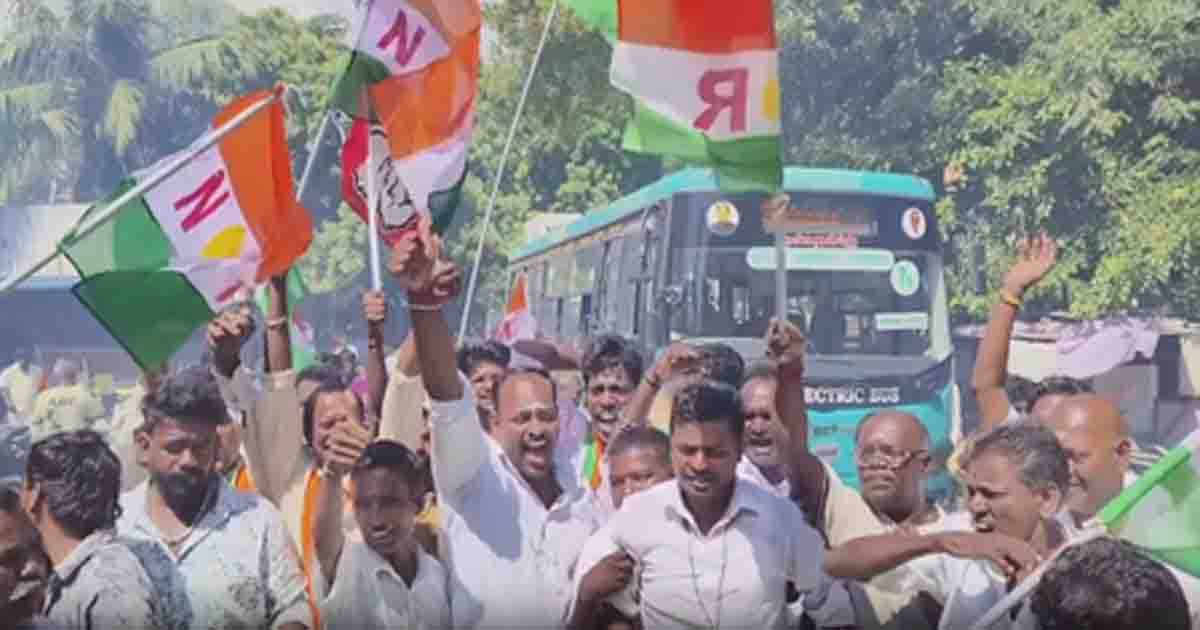
Puducherry, Oct 9: The ruling All India N.R. Congress (AINRC) retained the Thattanchavady Assembly constituency in Puducherry on Friday, with its candidate Ashok Anand winning the bypoll by 8,482 votes, delivering a decisive victory for Chief Minister N. Rangasamy’s party.
Anand secured 13,358 votes, while Congress candidate E. Vinayagam finished second with 4,876 votes.
The DMK’s K. Sethu Selvam came third with 2,664 votes, according to the Election Commission’s results.
The bypoll was necessitated by Rangasamy’s resignation from Thattanchavady after he won both this constituency and Mangalam in the April Assembly election. The Chief Minister chose to retain Mangalam, leaving Thattanchavady vacant and requiring a fresh election.
The result allows the N.R. Congress to retain a constituency closely associated with Rangasamy’s political career. It also gives the ruling alliance an electoral boost just months after the formation of the government following the Assembly polls.
Eleven candidates contested the election, held on Tuesday (October 6). Apart from the three principal contenders, the field included CPI candidate A.M. Saleem and Naam Tamilar Katchi nominee S. Karthikumari, along with candidates from other parties and Independents.
Anand, a former legislator, contested with support from the BJP, AIADMK and Lakshiya Jananayaga Katchi.
Congress candidate Vinayagam had the backing of the Tamizhaga Vetri Kazhagam, adding another political dimension to the contest in the union territory.
Counting began at 8 a.m. on Friday at the Motilal Nehru Government Polytechnic College in Lawspet. Postal ballots were taken up first, followed by votes recorded in electronic voting machines, which were counted over four rounds.
Anand established an advantage from the opening stages of counting and maintained his lead as the rounds progressed.
The final tally confirmed a substantial gap between the ruling party’s candidate and his nearest rival. A total of 21,756 electors voted, comprising 10,056 men, 11,695 women and five third-gender voters.
The constituency recorded a turnout of 80.81 per cent, lower than participation in the April general election.
Following polling, the electronic voting machines were moved to the polytechnic college and stored in a strongroom under three-tier police security. The arrangements remained in place ahead of counting.
The verdict completes the electoral process triggered by the Chief Minister’s decision to vacate the seat, returning Thattanchavady to the N.R. Congress and sending Anand to the Assembly as its elected representative.

No permission for Jantar Mantar protest, Delhi Police seek closure of 57 metro stations

Week after Supernova suicide, 36-year-old man dies after fall from 12th floor of Greater Noida West society

Puducherry bypolls: AINRC retains Thattanchavady; Cong comes second

PhonePe and DPCGC forge partnership to drive regulatory compliance in the OTT ecosystem

DRI seizes gold worth Rs 1.8 crore hidden in luggage trolley, probe underway

Gift to President Putin part of PM Modi bid to globally display India’s heritage

PM Modi’s warm camaraderie with Putin, Xi on full display at BRICS Summit

Complaint against Netflix & Mukesh Chhabra for inappropriate language on ‘India’s Got Latent 2’

INDIA bloc begins protest march against ECI

Maha Congress stages agitation against Gyanesh Kumar
-

 Crime4 years ago
Class 10 student jumps to death in Jaipur
-

 Maharashtra2 years ago
Mumbai Local Train Update: Central Railway’s New Timetable Comes Into Effect; Check Full List Of Revised Timings & Stations
-

 Maharashtra2 years ago
Mumbai To Go Toll-Free Tonight! Maharashtra Govt Announces Complete Toll Waiver For Light Motor Vehicles At All 5 Entry Points Of City
-

 Maharashtra2 years ago
False photo of Imtiaz Jaleel’s rally, exposing the fooling conspiracy
-

 National News2 years ago
Ministry of Railways rolls out Special Drive 4.0 with focus on digitisation, cleanliness, inclusiveness and grievance redressal
-

 Maharashtra2 years ago
Maharashtra Elections 2024: Mumbai Metro & BEST Services Extended Till Midnight On Voting Day
-

 National News2 years ago
J&K: 4 Jawans Killed, 28 Injured After Bus Carrying BSF Personnel For Poll Duty Falls Into Gorge In Budgam; Terrifying Visuals Surface
-

 Crime2 years ago
Baba Siddique Murder: Mumbai Police Unable To Get Lawrence Bishnoi Custody Due To Home Ministry Order, Says Report