
Maharashtra
‘Shinde Era Is Over, He Will Never Be CM Again,’ Says Shiv Sena-UBT Leader Sanjay Raut As BJP Picks Devendra Fadnavis As Maharashtra’s Next Chief Minister

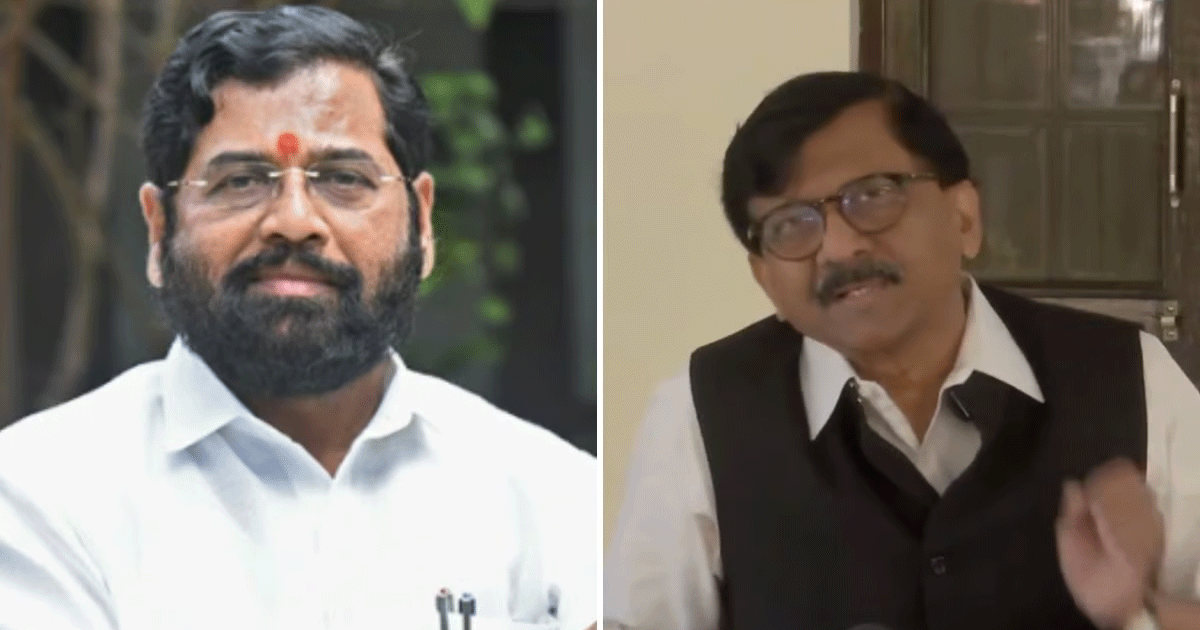
New Delhi: Shiv Sena (UBT) leader Sanjay Raut on Thursday took a jibe at outgoing Maharashtra Chief Minister Eknath Shinde after the Mahayuti alliance picked Devendra Fadnavis to be the next CM, saying that “Shinde era is over” and he will never be CM again.
Sanjay Raut’s remark came after the incumbent Mahayuti alliance picked Devendra Fadnavis to be the next CM and offered the outgoing CM Eknath Shinde the post of deputy CM, following their historic win in Maharashtra.
Raut claimed that Shinde was ‘used’ by the Bharatiya Janata Party and now “has been tossed aside.”
Statement Of Shiv Sena-UBT Leader Sanjay Raut
“Shinde era is over, it was just for two years. His usage is now over and he has been tossed aside. Shinde will never be the CM of this state again. They (BJP) can even break Shinde’s party, this has always been BJP’s line in politics. They break and finish the party of those who work with them,” Raut said.
Raut further questioned the delay in revealing the CM of Maharashtra despite having a clear majority. He suggested something was wrong within the Mahayuti alliance.
“Devendra Fadnavis will be the CM of the state from today. He has the majority but despite that, they were unable to form the Government for 15 days – it means that there is something wrong within their party or Mahayuti. This issue will start showing from tomorrow,” Raut said.
About The Swearing-In Ceremony
Devendra Fadnavis will be sworn in as Maharashtra Chief Minister at the Azad Maidan in Mumbai today. Two deputy chief ministers, NCP leader Ajit Pawar and Shiv Sena chief Eknath Shinde, will also be sworn in at the ceremony in the presence of Prime Minister Narendra Modi.
The decision came after days of speculation and political manoeuvring as Eknath Shinde wanted to become the chief minister of Maharashtra. However, the BJP, refused to budge and later, Shinde said he would back PM Modi’s pick.
Maharashtra Assembly Election Result
The Maharashtra Assembly Election 2024 witnessed a decisive victory for the Bharatiya Janata Party (BJP)-led Mahayuti alliance, securing a landslide win with 235 seats. The results marked a significant milestone for the BJP, which emerged as the single-largest party with 132 seats.
The Shiv Sena and Nationalist Congress Party also made notable gains, with 57 and 41 seats, respectively.
While, the Maha Vikas Aghadi (MVA) suffered a major setback with Congress winning just 16 seats. Its alliance partner, Shiv Sena (UBT), won 20 seats, while the NCP (Sharad Pawar faction) secured only 10 seats.

Maharashtra
Congress leader Dalwai urges Fadnavis to free Maha activists detained ahead of Delhi stir

Mumbai, Oct 10: Former Rajya Sabha MP and veteran Congress leader Husain Dalwai has written to Maharashtra Chief Minister Devendra Fadnavis, expressing strong outrage over the detention of senior social activist Firoze Mithiborawala and several other activists across Maharashtra.
Dalwai, in his letter on Friday, said that activists and student union members were traveling to New Delhi to participate in a peaceful rally scheduled for Saturday.
The protest, organised by various student organisations and the Cockroach Janata Party (CJP), aims to demand transparency in the electoral process.
Dalwai stated that the police used high-handed tactics to detain Mithiborawala directly from his residence in Mumbai and kept him in police custody to prevent him from reaching the national capital.
Additionally, several other activists and students travelling by train from Maharashtra were intercepted and detained at various railway stations.
Terming the police action as “authoritarian” and a direct violation of fundamental democratic rights, Dalwai highlighted that the Indian Constitution guarantees freedom of speech, movement, and peaceful assembly. He condemned treating peaceful activists and youth like criminals.
In his appeal, Dalwai urged the Chief Minister to immediately intervene in the matter, take note of the police crackdown, and issue directives to administration officials for the immediate and honourable release of all detained activists and students across the state.
Earlier, the Shiv Sena (Uddhav Balasaheb Thackeray) launched a scathing attack on the Centre, accusing it of driving Indian democracy to its grave.
The Thackeray camp in the party mouthpiece “Saamana” editorial commented on the intensifying political showdown surrounding Chief Election Commissioner (CEC) Gyanesh Kumar, widespread opposition protests, and an unprecedented state-sponsored crackdown on democratic dissent.
The editorial highlighted that Senior Congress leader Rahul Gandhi’s aggressive campaign against CEC Gyanesh Kumar—triggered by allegations of electoral manipulation—has sent shockwaves through the ruling Bharatiya Janata Party (BJP).
It asserted that instead of addressing accusations of systemic electoral irregularities, the ruling establishment is shielding the election chief at all costs, calling the protection of such actions a “betrayal of the nation”.
Condemning the handling of recent demonstrations, the editorial pointed out a glaring double standard by the administration. While Opposition leaders like Rahul Gandhi and Priyanka Gandhi were dragged, manhandled, and bundled into police vehicles during peaceful protests at Jantar Mantar, BJP Mahila Morcha activists staging abrasive demonstrations outside the Congress headquarters were granted absolute immunity by the home ministry, alleged the “Saamana” editorial.
The Thackeray camp claimed that the government planned to deploy around two lakh armed members of Bajrang Dal to Jantar Mantar to crush the opposition’s youth-led “cockroach” movement. It argued that relying on political gangs and “private armies” to violently suppress lawful public dissent invites absolute anarchy and civil unrest.
Maharashtra
Democracy on the edge: Shiv Sena (UBT) attacks Centre over CEC row, crackdown on dissent
Mumbai, Oct 10: The Shiv Sena (UBT) on Saturday launched a scathing attack on the Centre, accusing it of driving Indian democracy to its grave.
The Thackeray camp in the party mouthpiece Saamana editorial commented on the intensifying political showdown surrounding CEC Gyanesh Kumar and widespread opposition protests demanding his resignation.
The editorial highlighted that Senior Congress leader Rahul Gandhi’s aggressive campaign against CEC Gyanesh Kumar — triggered by allegations of electoral manipulation — has sent shockwaves through the ruling BJP.
It asserted that instead of addressing accusations of systemic electoral irregularities, the ruling establishment is shielding the election chief at all costs, calling protection of such actions a “betrayal of the nation”.
Condemning the handling of recent demonstrations, the editorial pointed out a glaring double standard by the administration. “While opposition leaders like Rahul Gandhi and Priyanka Gandhi were dragged, manhandled, and bundled into police vehicles during peaceful protests at Jantar Mantar, BJP Mahila Morcha activists staging abrasive demonstrations outside the Congress headquarters were granted absolute immunity by the Home Ministry,” alleged the editorial.
The Thackeray camp claimed the government planned to deploy around two lakh armed members of Bajrang Dal at Jantar Mantar to crush the opposition’s youth-led “cockroach” movement.
It argued that relying on political gangs and “private armies” to violently suppress lawful public dissent invites absolute anarchy and civil unrest.
Detailing ongoing administrative blocks, the editorial noted that Delhi Police denied formal permissions for protests, long-distance trains heading toward Delhi were canceled en route, and young demonstrators traveling to participate were intercepted and arrested.
Citing remarks from senior BJP veteran Murli Manohar Joshi regarding Abraham Lincoln’s democratic principles — which emphasise free elections, transparent bureaucracy, and responsible governance — the editorial lamented that none of these tenets survive under the current dispensation, where constitutional bodies face institutional capture.
The Uddhav Thackeray-led Shiv Sena said the current political climate surpasses authoritarian levels, with the ruling administration allegedly willing to break opposition resolve through physical intimidation rather than political accountability.
As opposition parties rally and tensions and friction between state machinery and protestors peak, it warned that public discontent against the erosion of democratic frameworks has reached a critical threshold.

Mumbai, Oct 9: The ED arrested two accused in fresh action against a trans-national organised narcotics trafficking syndicate operated by fugitive don Dawood Ibrahim’s aide Salim Ismail Dola and his associates, an official said on Friday.
The Enforcement Directorate (ED), Mumbai Zonal Office, arrested Pravin alias Nagesh Ramchandra Shinde and Brijesh Kanjibhai Moradiya under Section 19 of the Prevention of Money Laundering Act (PMLA), 2002.
The ED investigation was initiated based on multiple FIRs registered by various law enforcement agencies in Mumbai against Salim Dola and others for offences relating to illicit trafficking of narcotic drugs and psychotropic substances.
The investigation conducted so far has revealed the existence of a highly organised trans-national criminal network engaged in procurement of precursor chemicals, clandestine manufacture of Mephedrone (MD), interstate transportation and distribution of narcotic drugs, international trafficking of narcotic substances, collection and layering of proceeds of crime through hawala channels, and acquisition of movable and immovable assets in the names of associates and other persons, the ED said in a statement.
Investigation revealed that Pravin alias Nagesh Ramchandra Shinde was involved in the illegal clandestine manufacturing of MD and in activities connected with generation, handling, possession, utilisation and movement of proceeds derived from illicit sale of the said narcotic substance, the ED said.
Investigation has further revealed that the illicit proceeds were used to acquire immovable properties and other assets in the names of persons closely associated with him, it said.
The investigation also revealed that Brijesh Moradiya was involved in arranging the procurement and supply of the precursor chemical used for the illicit manufacture of MD.
The cash received from Salim Dola through the Angadiya channel for procuring the precursor chemical was deposited and routed through multiple third-party/family accounts and entities controlled/arranged by him and his associates, then transferred through the banking channel to various chemical companies/entities, thereby facilitating procurement of the precursor chemical.
Simultaneously, amounts involved in these transactions were received by Brijesh Moradiya and his associates/family accounts in the guise of commission from the sale of the chemical and the same were thereafter further transferred, layered and utilised.
The ED had earlier conducted search operations at 21 locations across Mumbai, Surat, Ankleshwar and Rajkot on June 2, 2026 and June 3, 2026 in this case and had covered the entire spectrum of the organised narcotics network of Salim Dola targeting end-to-end nodes of the syndicate including precursor chemical suppliers, chemical traders, manufacturers/distributors of the synthetic narcotic drug Mephedrone (MD), Hawala Operators and persons holding benami properties worth crores of rupees acquired from proceeds generated through the organised drug syndicate.
The searches resulted in the seizure and freezing of cash, foreign currency, gold bars, and bank balances valued at Rs 1.33 crore (approx.), along with $2,200. Additionally, documents relating to immovable properties worth several crores of rupees located in India and Dubai were recovered, indicating substantial investments made from the proceeds of the organised drug syndicate, the statement said.

LoP Rahul Gandhi to meet CM Vijay, address students in Chennai today

Congress leader Dalwai urges Fadnavis to free Maha activists detained ahead of Delhi stir

Mumbai Police detain Mahatma Gandhi great-grandson ahead of CJP protest

UP: Driver burnt to death as moving car catches fire in Barabanki

200 people detained in Delhi ahead of CJP Jantar Mantar protest

Gift to President Putin part of PM Modi bid to globally display India’s heritage

PM Modi’s warm camaraderie with Putin, Xi on full display at BRICS Summit

INDIA bloc begins protest march against ECI

Complaint against Netflix & Mukesh Chhabra for inappropriate language on ‘India’s Got Latent 2’

Maha Congress stages agitation against Gyanesh Kumar
-

 Crime4 years ago
Class 10 student jumps to death in Jaipur
-

 Maharashtra2 years ago
Mumbai Local Train Update: Central Railway’s New Timetable Comes Into Effect; Check Full List Of Revised Timings & Stations
-

 Maharashtra2 years ago
Mumbai To Go Toll-Free Tonight! Maharashtra Govt Announces Complete Toll Waiver For Light Motor Vehicles At All 5 Entry Points Of City
-

 Maharashtra2 years ago
False photo of Imtiaz Jaleel’s rally, exposing the fooling conspiracy
-

 National News2 years ago
Ministry of Railways rolls out Special Drive 4.0 with focus on digitisation, cleanliness, inclusiveness and grievance redressal
-

 Maharashtra2 years ago
Maharashtra Elections 2024: Mumbai Metro & BEST Services Extended Till Midnight On Voting Day
-

 National News2 years ago
J&K: 4 Jawans Killed, 28 Injured After Bus Carrying BSF Personnel For Poll Duty Falls Into Gorge In Budgam; Terrifying Visuals Surface
-

 Crime2 years ago
Baba Siddique Murder: Mumbai Police Unable To Get Lawrence Bishnoi Custody Due To Home Ministry Order, Says Report