
Business
Nifty, Sensex surge over 2 pc this week amid renewed hopes of US-India trade deal

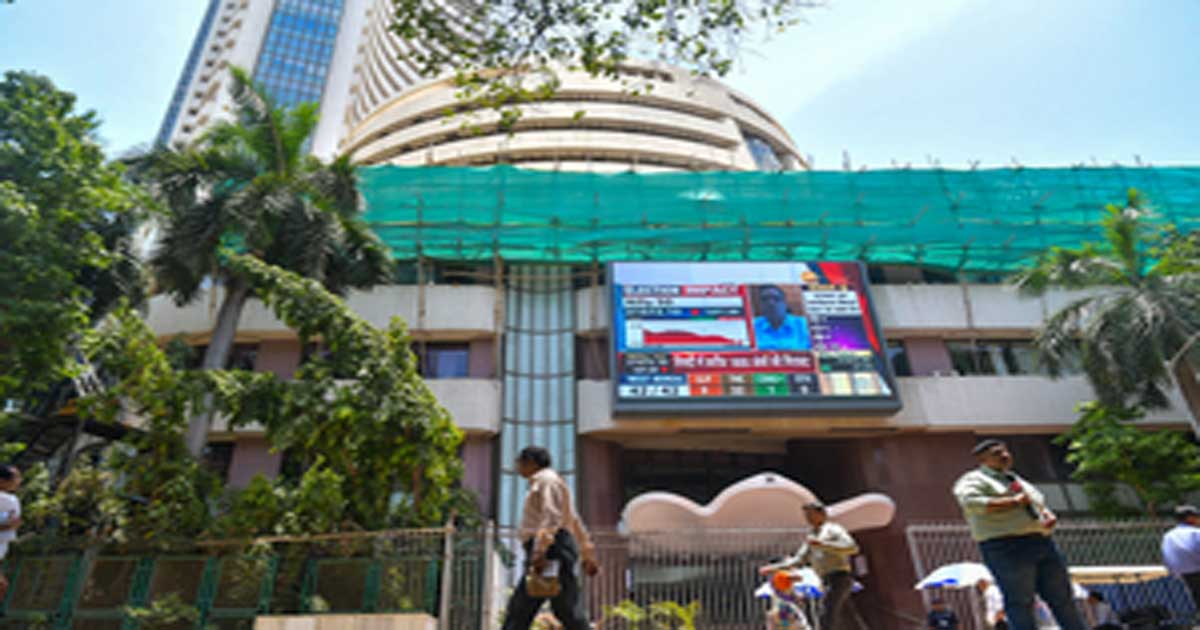
Mumbai, Oct 18: The Indian equity benchmarks ended the week decisively higher amid short covering from foreign institutional investor (FII) participants and resilient domestic cues.
Market optimism was bolstered by clarity in the India–US trade relations, with both sides tentatively agreeing to conclude the first phase of the deal by November.
The sentiment remained upbeat as Bank Nifty achieved a new milestone, driven by robust buying interest in leading banking stocks. Investor confidence was buoyed by easing concerns around asset quality in the financial sector and expectations of improved volume growth in the festive quarter.
Benchmark indices Nifty and Sensex rose 2.10 and 2.04 per cent during the week, with FMCG, pharma, and auto indices being the major contributors to the rally.
Analysts said that consumption-driven sectors also saw a surge along with a broad-based recovery across realty, healthcare, and banking.
IT stocks remained under pressure due to global discretionary spending concerns and mounting asset quality stress in the US banking system.
Profit booking was also seen in media, and metal stocks, which capped the overall upside of the indices.
The broader market, however, took a breather after a strong run-up, with Nifty Midcap 100 slipping 0.57 per cent and Nifty Small-cap 100 marginally down by 0.05 per cent, indicating selective profit taking by investors.
“Nifty on the weekly chart has formed a sizable bull candle with a higher high and higher low, signalling continuation of the up move. The index broke out above a three-month symmetrical triangle consolidation pattern, indicating a positive bias,” analysts from Bajaj Broking Research said.
They expect the index to head towards 25,900 and then towards 26,200 levels in the coming weeks.
In the holiday-led truncated Diwali week, investors are likely to remain cautious in view of the release of key economic data, such as US inflation, employment, and India’s PMI figures.
Investors are also keen on the cues from the ongoing earnings season and policy signals from major global central banks.



The Income Tax Department has recently nudged select taxpayers who have invested in residential and commercial properties in the UAE to avail of the Foreign Assets of Small Taxpayers – Disclosure Scheme, 2026 (FAST-DS), offering a one-time opportunity to declare these overseas assets which have been undisclosed so far, according to Finance Ministry sources.
The scheme provides a time-bound window to regularise eligible disclosures by paying 30 per cent tax on the fair market value and an equal amount of penalty in addition to tax. A crucial feature of the scheme is that it is fully online, trust-based, and self-declaratory.
A valid declaration brings immunity from further assessment, penalty and prosecution under the Black Money (Undisclosed Foreign Income and Assets) and Imposition of Tax Act, 2015 (Black Money Act). The scheme further provides an opportunity to taxpayers to report unaccounted assets and income on payment of a Rs 1 lakh fee to avoid a penalty of Rs 10 lakh each year prescribed in the Black Money Act.
Till now, approximately 1,100 taxpayers have filed applications under the scheme, which is open till December 31, 2026, sources said.
The Central government has launched the Foreign Assets of Small Taxpayers – Disclosure Scheme, 2026 (FAST-DS), offering a one-time opportunity to disclose foreign assets and income that have been undisclosed so far.
To facilitate taxpayers, the Department has created a facility in the e-filing portal where a taxpayer can see information with respect to assets reported on their PANs by the foreign jurisdictions under Automatic Exchange of Information (AEOI), popularly known as CRS/FATCA. Taxpayers can log in to the e-filing portal and download this information for the three-year period 2022-2024.
Sources informed that the information received under AEOI from the signatories of CRS/FATCA frameworks has only been displayed in the e-filing portal. Department receives information under other multilateral frameworks which has not been displayed in the portal due to various risk factors or non-disclosure commitments. Further, the Income Tax Department collects information from other sources as well. The Department decided, in a high-level meeting on October 23, that such information may also be shared with relevant taxpayers, wherever possible, to enable them to take advantage of the scheme.
The Income Tax Department has also planned outreach programmes to create awareness among taxpayers, corporates as employers, educational institutes, professional bodies and industry associations. The Central Board of Direct Taxes (CBDT), which is the apex body that heads the Income Tax Department, has also made a Committee in each region under the Principal Chief Commissioner to help taxpayers resolve their queries and concerns.

The Indian unit of Elon Musk-backed electric vehicle (EV) maker Tesla — Tesla India Motors and Energy — has reported revenue of Rs 247.31 crore and a net profit of Rs 5.16 crore for FY26.
According to regulatory filing, revenue from operations surged nearly 12-fold from Rs 20.83 crore in FY25.
The carmaker’s net profit increased from Rs 55.49 lakh as the company expanded its presence in the Indian market following the launch of its first showroom in Mumbai in 2025. However, FY26 was the first year in which vehicle sales contributed to Tesla India’s reported revenue.
In the previous financial year, the company’s turnover had come entirely from services-related operations.
Vehicle sales generated Rs 214.69 crore during FY26, accounting for nearly 87 per cent of total revenue, while services contributed Rs 32.40 crore.
The performance came despite a relatively small sales base as the company recorded 346 vehicle registrations in India between September 2025 and March 2026.
Meanwhile, registrations accelerated to 650 units during April-September FY27, surpassing the entire previous year’s tally within the first six months of the fiscal year.
Average monthly registrations rose from around 49 units during the initial launch phase to about 108 units.
Apart from that, the company strengthened its balance sheet through fresh capital infusion.
Filings showed Tesla injected about Rs 86 crore into its Indian subsidiary during FY26.
In addition, cash expenditure on property, plant and equipment and capital work-in-progress climbed to Rs 62.54 crore in FY26 which was higher than Rs 1.16 crore in the previous year.
Earlier in October, CEO Musk showcased a new version of its Roadster sports car — a prototype that briefly lifted off the ground during a demonstration at a SpaceX facility in Texas.
He highlighted that the vehicle navigated an elevated curved track before becoming airborne for a short distance and landing safely, drawing comparisons to the concept of a flying car.

Shares of non-banking financial company Shriram Finance on Monday traded more than 6 per cent lower, hitting an 11-month low and emerged as the top Nifty loser.
The NBFC stock declined as much as 6.55 per cent to 810.20, recording an intraday low on the BSE in morning trade.
It was trading at Rs 829.20, a decrease of 4.36 per cent by 10:57 am.
The selling pressure in the stock came after the NBFC firm cut its loan growth forecast and flagged higher credit costs, overshadowing better-than-expected Q2 profit.
Moreover, the company cut its assets under management (AUM) growth guidance for FY27 to 15-17 per cent from 18 per cent, citing weak monsoon and geopolitical uncertainty and pressure on borrowers in drought-hit regions.
Meanwhile, analysts flagged asset quality concerns with reducing share price targets.
Analysts at global brokerage Jefferies said credit costs could stay elevated for one to two more quarters due to stress in Maharashtra, Karnataka and Telangana.
According to domestic brokerage Motilal Oswal, higher slippages and write-offs reflected drought-like conditions in several states, though overall asset quality remained broadly stable.
“SHFL delivered a mixed quarter, with PPoP beating estimates on higher NIM and lower opex, while earnings were in line due to higher credit costs. AUM growth at 17 per cent YoY was stronger than estimated,” it said.
Similarly, JM Financial said rising early delinquencies and rural stress remain key concerns. The brokerage also stated, “Deteriorating asset quality indicators amid drought-like conditions remain a concern.” However, the stock has corrected 14 per cent over the past month. Recent equity infusion and rating upgrades to AAA should cushion margins.
On the aforesaid exchange, the NBFC stock has recorded a 52-week high of Rs 1,153.65 and a 52-week low of Rs 710.40.

Income Tax Dept nudges taxpayers owning undeclared properties in UAE

Delhi BJP protests near Kharge official residence over remark on PM Modi

Maha: State Board approves Wildlife Sanctuary status for two reserves; notifies 14 new conservation reserves

Nepali gang arrested for murder of retired IPS officer’s wife in Hyderabad

Raj Thackeray slams urban planning, traffic crisis in Navi Mumbai; says he awaits power in Maharashtra

Rahul, Cong ecosystem want to force regime change: BJP after Neha Bora praises B’desh Gen-Z protest

Attack on democratic rights: INDIA Bloc leaders on detentions of anti-ECI protestors

BJP pays tribute to ex-President Abdul Kalam, recalls his enduring influence on generations of India’s youth

INDIA bloc begins protest march against ECI

Maha Congress stages agitation against Gyanesh Kumar
-

 Crime4 years ago
Class 10 student jumps to death in Jaipur
-

 Maharashtra2 years ago
Mumbai Local Train Update: Central Railway’s New Timetable Comes Into Effect; Check Full List Of Revised Timings & Stations
-

 Maharashtra2 years ago
Mumbai To Go Toll-Free Tonight! Maharashtra Govt Announces Complete Toll Waiver For Light Motor Vehicles At All 5 Entry Points Of City
-

 Maharashtra2 years ago
False photo of Imtiaz Jaleel’s rally, exposing the fooling conspiracy
-

 National News2 years ago
Ministry of Railways rolls out Special Drive 4.0 with focus on digitisation, cleanliness, inclusiveness and grievance redressal
-

 Maharashtra2 years ago
Maharashtra Elections 2024: Mumbai Metro & BEST Services Extended Till Midnight On Voting Day
-

 National News2 years ago
J&K: 4 Jawans Killed, 28 Injured After Bus Carrying BSF Personnel For Poll Duty Falls Into Gorge In Budgam; Terrifying Visuals Surface
-

 Crime2 years ago
Baba Siddique Murder: Mumbai Police Unable To Get Lawrence Bishnoi Custody Due To Home Ministry Order, Says Report