
National News
Maharashtra nearing Maoist-free status, says Fadnavis; directs fresh security and development push

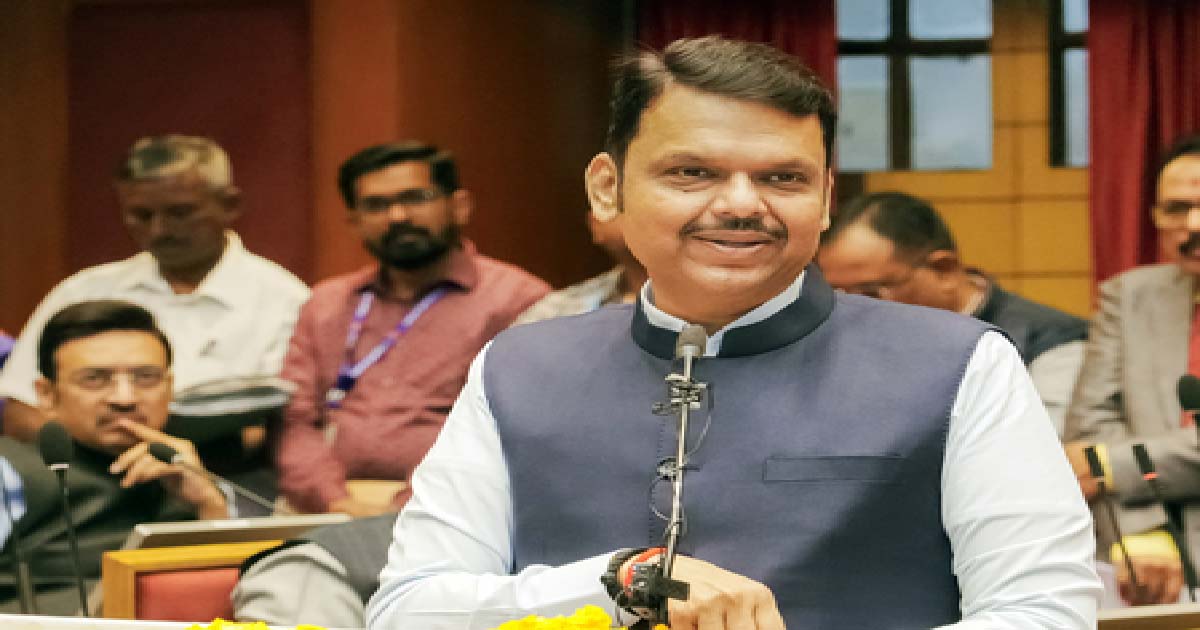
Nagpur, Dec 12: Maharashtra Chief Minister Devendra Fadnavis on Friday said that while the Union government has set 2026 as the target year for eliminating the Maoist threat across the country, Maharashtra is already a step ahead and stands on the threshold of becoming Maoist-free.
He said the progress achieved was due to the result of the state government’s clear policy direction and sustained work by the police.
Fadnavis was speaking while presiding over a review meeting of the State-Level Committee on the National Plan and Action Framework. During the meeting, he issued a series of directives aimed at strengthening security arrangements and deepening development work in affected regions.
He instructed officials to set up new police posts in remote and inaccessible areas to end the Maoist activities. These police posts, he said, must have adequate manpower and proper facilities to support long-term operations.
The Chief Minister also directed officials to ensure that all villagers receive the benefits of government schemes and to expand efforts to create employment opportunities for local youth. He asked the administration to set up marketplaces for the sale of local products. Fadnavis praised the police for their work, which has resulted in the surrender of several Maoists carrying rewards.
Fadnavis directed that the process of awarding a one crore rupee reward to the Gadchiroli Police be completed without delay. The amount had been announced in recognition of the force’s work in weakening Maoist influence and securing the surrender of hardcore Maoist leaders and cadres.
He also instructed that police who have performed exceptionally in anti-Maoist operations should receive timely promotions. According to him, proposals concerning Gadchiroli that require clearance at the ministry level must be processed with priority and strictly as per rules.
The CM directed officials to begin work immediately on a new Superintendent of Police office in Gadchiroli, adding that the state would make funds available. He also asked for the procurement of 33 new vehicles for the police to be completed at the earliest.
Referring to the police post set up at the site where Maoists had celebrated after killing 17 police personnel in a 2009 attack at Laheri in Bhamragad taluka, Fadnavis said the new police post strengthened public trust in the police. He described it as a clear sign that the influence of Maoists was nearing an end.
“The government is actively countering the Maoist movement with robust development work, particularly in connectivity. Construction will begin on the 17.30 km Dhodraj-Nilgunda-Kawande road. Further development includes the construction of the Korma Nala Bridge and the Bedre Bridge beyond Kawande, extending road connectivity up to Bijapur,” he said.
Fadnavis further said that a 750-metre bridge would be built over the Indravati River on the Damrancha-Sandra route. For better communication in Gadchiroli, he said the number of mobile towers had increased significantly, with 271 in place by 2022 and plans for 521 additional towers between 2023 and 2025.

New Delhi, April 8: Global crude oil prices on Wednesday plunged sharply up to 20 per cent, after US President Donald Trump announced a two-week ceasefire with Iran that includes a pledge to restore navigation through the Strait of Hormuz — the narrow waterway at the heart of the world’s most acute energy crisis in decades.
The international benchmark Brent crude futures shed nearly 16 per cent or $17.39 to $91.88, hitting an intraday low, while US WTI crude declined almost 20 per cent or $21.90 to $91.05.
The Strait of Hormuz, through which roughly a fifth of global oil flows, has been at the centre of the conflict. Iran had restricted passage for several weeks, contributing to rising prices and supply concerns. Markets had been on edge ahead of Trump’s deadline for Iran to reach a deal, with traders fearing a major escalation could disrupt shipments across the Gulf and send prices sharply higher.
Oil prices had surged in recent weeks amid fears that the strait could be closed or severely restricted. The waterway handles shipments critical to global supply chains, including crude oil and liquefied natural gas.
The US-Israel-Iran conflict has been paused for two weeks after approximately 40 days of hostilities that began in February.
President Trump’s shift in stance came just ahead of his stated deadline for Iran to reopen the Strait of Hormuz or risk extensive strikes on its civilian infrastructure.
Meanwhile, Iran indicated it would halt its military operations provided attacks against it ceased simultaneously. Foreign Minister Abbas Araghchi, in a formal statement, confirmed that safe passage through the Strait of Hormuz would be ensured for two weeks in coordination with Iranian armed forces.
The conflict had triggered an unprecedented surge in oil prices in March, with gains exceeding 60 per cent during the period.
Additionally, Indian equity benchmarks also rallied sharply on the development, trading more than 3 per cent higher in early trade. The Sensex jumped nearly 4 per cent, while the Nifty surged 3.5 per cent to their respective intraday highs.
National News
Priyanka Chaturvedi Defends India’s Stand On Staying Off US–Iran Ceasefire Talks, ‘Why Should We Be Part? Wasn’t Our War’

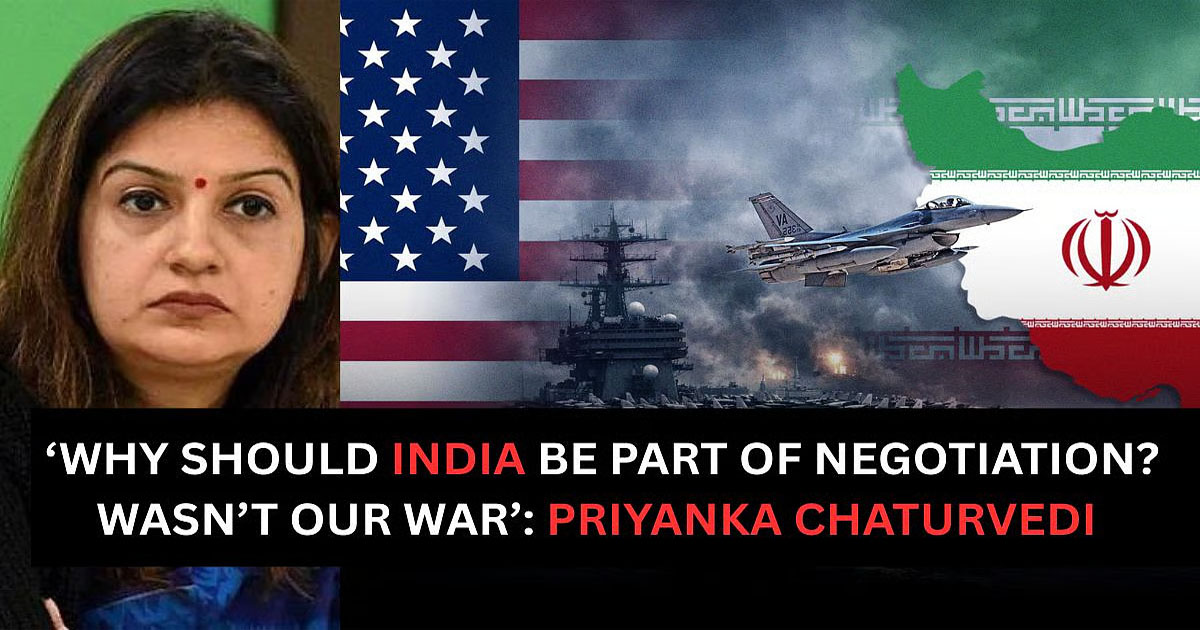
Shiv Sena-UBT leader Priyanka Chaturvedi defended India’s stand on not being part of the negotiating table between the US and Iran and questioned why it should be involved, saying the conflict ‘wasn’t our war.’ Her remarks come amid an ongoing debate over India’s stance on the escalating West Asia tensions.
Taking to her official handle on X, Chaturvedi also mocked Pakistan’s role as a mediator, and said, “And for them, it is like that tort who, for a fee will say it will resolve the crisis- best described by India’s FM in an all party meeting.”
She also spoke on the ceasefire, saying that Iran kept its position, the US saved face, Israel faced a reality check, while Pakistan got a ‘thank you note,’ and India secured its oil supply.
US President Donald Trump agreed to a 14-day ceasefire after talks with Pakistan Prime Minister Shehbaz Sharif and Pakistan Army chief Asim Munir, according to a post shared by him on his official Truth Social account. Trump also accepted the 10-point proposal from Iran. The Iranian side then accepted Trump’s peace overture and agreed to safe passage via the Strait of Hormuz for two weeks, as well as a pause in military operations.
Based on conversations with Prime Minister Shehbaz Sharif and Field Marshal Asim Munir, of Pakistan, and wherein they requested that I hold off the destructive force being sent tonight to Iran, and subject to the Islamic Republic of Iran agreeing to the COMPLETE, IMMEDIATE, and SAFE OPENING of the Strait of Hormuz, I agree to suspend the bombing and attack of Iran for a period of two weeks. This will be a double sided CEASEFIRE! The reason for doing so is that we have already met and exceeded all Military objectives, and are very far along with a definitive Agreement concerning Longterm PEACE with Iran, and PEACE in the Middle East. We received a 10 point proposal from Iran, and believe it is a workable basis on which to negotiate. Almost all of the various points of past contention have been agreed to between the United States and Iran, but a two week period will allow the Agreement to be finalized and consummated. On behalf of the United States of America, as President, and also representing the Countries of the Middle East, it is an Honor to have this Longterm problem close to resolution. Thank you for your attention to this matter! President DONALD J. TRUMP
Business
Employees’ body to meet on April 13 as Central govt staff keen on 8th Pay Commission decisions

New Delhi, April 7: Millions of Central government employees and pensioners await the outcome of the drafting committee of the National Council (Joint Consultative Machinery) on April 13 to get cues on the 8th Pay Commission salary revision, a report said on Tuesday.
The drafting committee meeting scheduled for 11:00 am at the JP Choubey Memorial Library (AIRF office premises) here will review a final common memorandum and discuss pay scale revisions, annual increments, allowances and other benefits, the report from NDTV Profit said.
“The April 13 meeting is in continuation of the March 12, 2026, meeting when all drafting committee members of the 8th Pay Commission met to discuss the common memorandum of all employee and pensioner bodies,” said NC-JCM secretary, Shiv Gopal Mishra, in a letter to members of the drafting committee.
The government has not yet announced the official date for the salary increase. Arrears will be calculated based on the date fixed for the implementation of the 8th Pay Commission
even as employee and pensioner groups press for arrears to be calculated from January 1, 2026, the report said.
The Federation of National Postal Organisations has asked the government to merge the 58 per cent dearness allowance with basic pay and give interim relief from the same date.
The salary increase will hinge on the fitment factor the government adopts which analysts expect to exceed 2.5. Some employee groups have sought a fitment factor of 3.15, even though the official decision may take over a year, the report said.
Pankaj Chaudhary, MoS Finance, told Parliament in March that the 8th Pay Commission will make its recommendations on pay, allowances, pensions, and other benefits for central government employees. The 8th Pay Commission is expected to complete this work within 18 months from November 2025.

Samajwadi Party Appoints Abu Farhan Azmi as Mumbai Maharashtra General Secretary

Maha youth arrested for defamatory video targeting CM Fadnavis over Ajit Pawar plane crash

Iran agrees to open Strait of Hormuz after Trump’s 14-day ceasefire announcement

Oil falls after Trump signals Iran pause

Crude oil prices tank up to 20 pc over Iran ceasefire announcement

Married Mumbai Woman Mocked In Andheri Society Over ‘Lift Kissing’ CCTV Video, Files Police Complaint

LPG Crisis In Maharashtra: Cyber Crime On Rise Amid Shortage, 2 Women Lose ₹4 Lakh In ‘Gas Update’ Online Scam In Kalyan-Dombivli

Dhurandhar 2 Box Office Collection Day 1: Ranveer Singh Starrer Takes An Exceptional Opening; Crosses ₹100 Crore Mark

Thane Horror: Man Slashed With Chopper In Naupada For Refusing ‘Vargani’, Caught On Camera

Mumbai Police Busts Fake Apple Accessories Racket In Ghatkopar, ₹16.33 Lakh Goods Seized; Six Booked
-

 Crime4 years ago
Class 10 student jumps to death in Jaipur
-

 Maharashtra2 years ago
Mumbai Local Train Update: Central Railway’s New Timetable Comes Into Effect; Check Full List Of Revised Timings & Stations
-

 Maharashtra1 year ago
Mumbai To Go Toll-Free Tonight! Maharashtra Govt Announces Complete Toll Waiver For Light Motor Vehicles At All 5 Entry Points Of City
-

 Maharashtra2 years ago
False photo of Imtiaz Jaleel’s rally, exposing the fooling conspiracy
-

 National News1 year ago
Ministry of Railways rolls out Special Drive 4.0 with focus on digitisation, cleanliness, inclusiveness and grievance redressal
-

 Maharashtra1 year ago
Maharashtra Elections 2024: Mumbai Metro & BEST Services Extended Till Midnight On Voting Day
-

 National News2 years ago
J&K: 4 Jawans Killed, 28 Injured After Bus Carrying BSF Personnel For Poll Duty Falls Into Gorge In Budgam; Terrifying Visuals Surface
-

 Crime1 year ago
Baba Siddique Murder: Mumbai Police Unable To Get Lawrence Bishnoi Custody Due To Home Ministry Order, Says Report