
National News
Kashmir mourns massacre of civilians with bandh; 2 locals, 2 foreigners among 16 killed by terrorists


Srinagar, April 23: A pall of gloom descended on Kashmir Valley on Wednesday as widespread condemnation and a complete protest shutdown followed the brutal killing of 16 people in Tuesday’s terror attack.
The 16 dead included 2 locals and 2 foreigners who were among the tourists caught in Tuesday’s deadly carnage by terrorists.
All trade, travel, industry, transport and educational institutions remained shut in the entire Valley on Wednesday after political, religious, social and professional organisations condemned the brutal killing of innocent people by terrorists in Baisaran meadow of Pahalgam on Tuesday afternoon.
Horrifying details are now emerging about the beastly behaviour of the killers.
Eyewitnesses said the terrorists separated the men from the women and children.
The men were told to recite the ‘Kalima (A Muslim prayer)’. Those identified as non-Muslims were shot at point blank range while two locals, who reportedly protested against the brutal and inhuman behaviour of the killers were also shot dead.
Tourists mainly belonging to Karnataka, Maharashtra, UP and Gujarat were the victims of the terror attack.
Reports said the two locals had entered into an argument with the killers about their beastly behaviour of killing innocent civilians.
The dead include a Navy officer, Lieutenant Vinay Narwal of Haryana, who was married on April 16. An IB officer, Manish Ranjan from Bihar is also among the slain civilians.
The eyewitnesses said the survivors were so frightened and mortified that when the security forces reached the spot that is 6 kms from Pahalgam town, the survivors started weeping and wailing as the terrorists had also come wearing Indian Army fatigues.
The survivors calmed down only after the security personnel assured them that they were Indian security forces.
The carnage has shaken the conscience of the locals as protests, condemnation, candlelight marches and a widespread mourning descended on the Valley as the news of brutal, gruesome and cowardly massacre of innocent people spread here.
Union Home Minister, Amit Shah chaired a high level security review meeting in Raj Bhawan here on Tuesday night.
HM Shah is visiting the terror attack site today morning.
A massive anti-terrorist operation has been started in Pahalgam to hunt down the killers of innocent people.
Prime Minister, Narendra Modi reached New Delhi after cutting short his visit to Saudi Arabia.
Security in the entire J&K has been tightened in the wake of Tuesday’s attack, which is the worst ever terrorist attack after the Pulwama attack of 2019.
This is also the worst ever attack on tourists after separatist violence started here in 1990s.

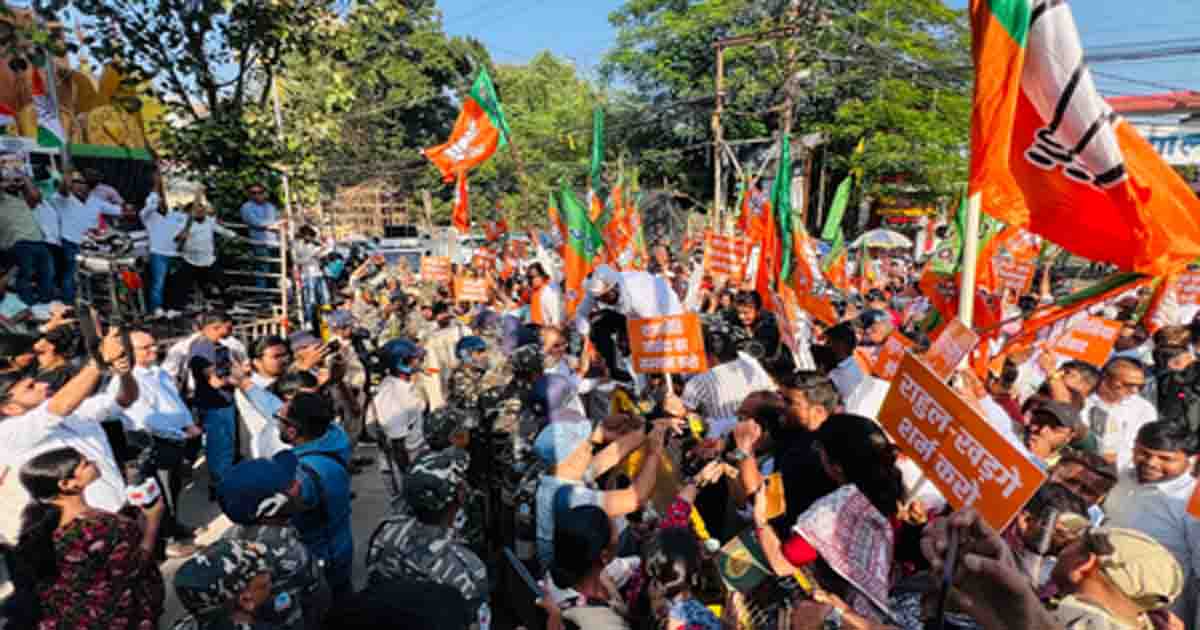
The Bharatiya Janata Party (BJP) on Monday staged a protest outside the Congress office in Ranchi against Congress President Mallikarjun Kharge’s alleged objectionable remark related to Prime Minister Narendra Modi’s father.
The demonstration was led by Jharkhand BJP chief Aditya Sahu and Leader of Opposition in the state Assembly, Babulal Marandi.
BJP workers marched to the Congress office and demanded an apology from Kharge. The situation turned tense for some time as workers of both the BJP and Congress came face-to-face outside the party office.
Anticipating unrest, the district administration had deployed heavy security in the area, with police personnel stationed in large numbers and barricades set up around the premises.
Protesters attempted to cross the barricades and move towards the Congress office, leading to heated arguments between the police and BJP workers.
Carrying party flags and placards, the protesters called for an end to what they described as disrespectful remarks against the Prime Minister and urged political leaders to maintain decorum in public discourse.
The protesters raised slogans against the Congress and Kharge, demanding an apology to the Prime Minister.
On the other hand, Congress workers present there also responded with slogans against the BJP. Some workers were seen climbing barricades to register their protest. Police promptly removed them from there, preventing any untoward incident.
Speaking during the protest, Babulal Marandi alleged that Congress leaders had repeatedly made objectionable statements against Prime Minister Modi and had now extended such comments to his parents.
He said political differences should be expressed within the bounds of decorum and civility.
The BJP has called for nationwide demonstrations and gheraos of Congress offices over the controversy. The Ranchi protest was part of that campaign.
Despite the heavy police deployment, workers from both parties remained steadfast in their respective demonstrations throughout the event.
National News
Declining standard of language in political discourse: Shiv Sena-UBT, RJD on Kharge’s ‘baap’ remarks

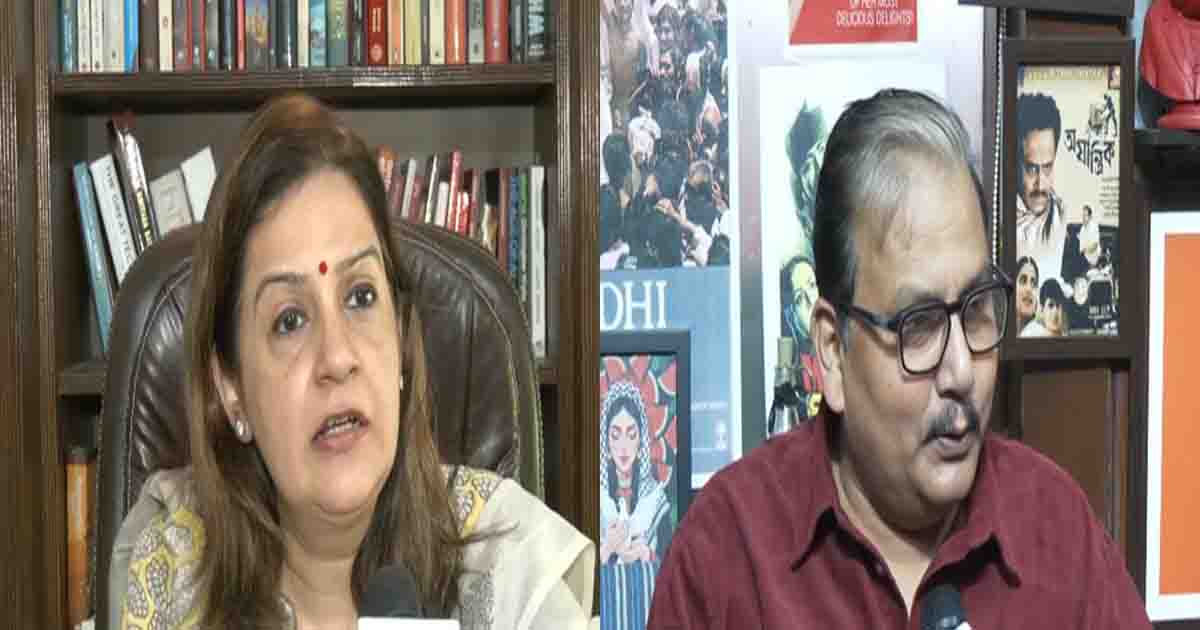
Shiv Sena-UBT and Rashtriya Janata Dal (RJD) leaders on Monday criticised the remarks made by Congress President Mallikarjun Kharge during a programme in Patna, even as they questioned the standards of political discourse and called for greater restraint in the language used by political leaders.
The controversy erupted following Kharge’s address at a Congress event in Patna on Sunday, organised to mark the birth anniversary of Bihar’s first Chief Minister, Sri Krishna Singh. During the programme, a person in the audience reportedly interrupted Kharge, saying that Prime Minister Narendra Modi would not leave power.
Responding to the interruption, Kharge said, “Modi ka baap bhi jayega” (Even Modi’s father will have to go). The Congress President reportedly repeated the remark several times, triggering a political controversy and drawing criticism over the language used while referring to the Prime Minister.
Reacting to the controversy, Shiv Sena-UBT leader Priyanka Chaturvedi said the continuously declining standard of language in political discourse was unfortunate.
Speaking to media, Chaturvedi said: “The continuously declining standard of language used by everyone in politics is unfortunate. But at the same time, what are the pressing issues in the country today? The country’s issues are inflation, corruption, vote theft, and many challenges faced by the youth that are being ignored. This is once again an issue meant to distract attention.”
She expressed hope that political parties would exercise restraint while making statements and expressing their views, stressing that family members who had no role in politics should not be dragged into political disputes.
“I would repeat that dragging mothers, fathers, sisters, daughters, or children, who have nothing to do with politics, into political matters is completely wrong,” she said.
Meanwhile, RJD MP Manoj Jha also criticised the use of such language but questioned what he described as selective outrage over controversial remarks made by political leaders.
Speaking to media, Jha said: “No one can support this kind of language. I am observing the outrage, but why is this outrage so selective? When remarks such as ‘Congress ki vidhwa’, ‘Jersey cow’, references to the ‘mangalsutra’, ‘they will take away your buffaloes’, and ‘they will perform mujra’ are made, should there not be outrage or anger then?”
Jha said he had already submitted a written request in Parliament for a discussion on the standards of language used by both the ruling party and the Opposition.
“I am saying it again today through you: there should be a two-day discussion in Parliament on what the dignity and standards of language used by both the ruling party and the Opposition should be. It cannot be that there is outrage today and silence tomorrow. That does not seem right,” he said.
Referring to what he described as a “pretence of purification” staged against Kharge himself in Uttarakhand’s Haldwani, he said he had not witnessed similar outrage on that occasion.
“When a pretence of purification was staged against Kharge himself, I did not see this outrage. This is not appropriate,” the RJD MP said.
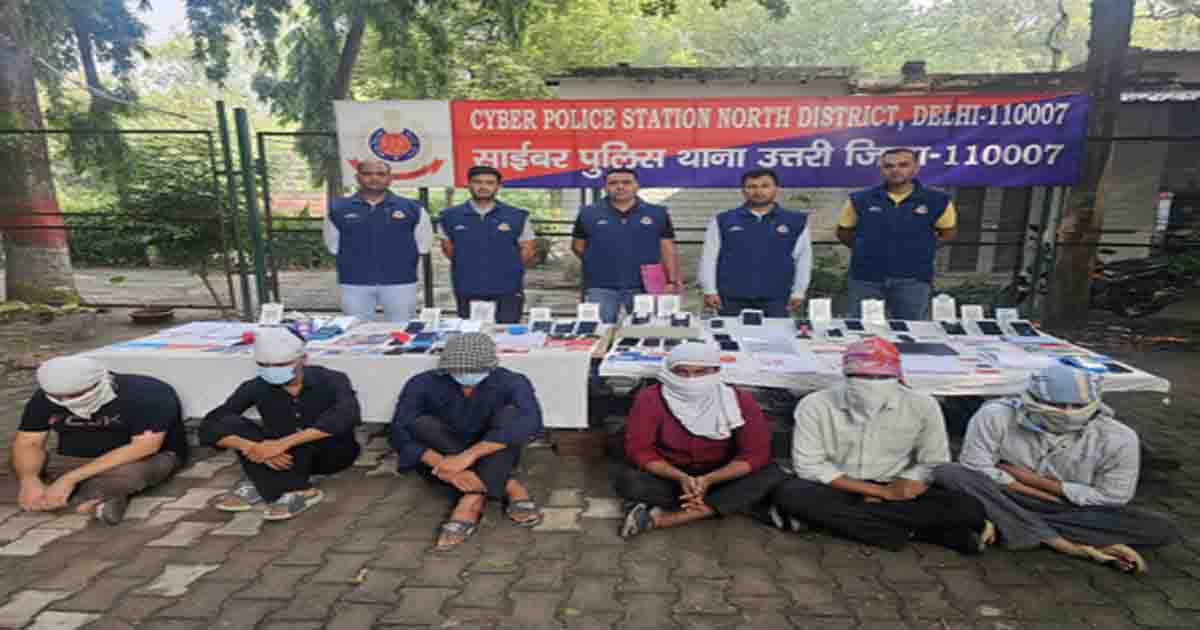
Delhi Police have busted a major cyber fraud network involved in transactions worth over Rs 30 crore as it arrested seven people in connection with an online shopping scam that came to light following a complaint by a Delhi University student, officials said on Monday.
The investigation began after Fatima, a student of Ramjas College at Delhi University and a resident of Uttar Pradesh’s Prayagraj, reported being cheated of Rs 6,450 through an Instagram shopping advertisement. The complaint was registered on the National Cybercrime Reporting Portal (NCRP), following which an FIR was registered at the Cyber Police Station, North District, on September 4.
According to the complaint, the student came across an advertisement for a kurti on an Instagram account named ‘Kavya_kurti_hub’. She was redirected to a WhatsApp number, where she placed an order worth Rs 799 and paid Rs 400 in advance through a QR code.
Subsequently, she received a call regarding parcel delivery and was asked to provide a passcode. The seller then induced her to make additional payments on the pretext of generating the code and processing a refundable charge. She transferred Rs 1,150, Rs 2,000, Rs 2,650 and Rs 650 in separate transactions. However, neither the parcel was delivered nor the money refunded.
During the investigation, police analysed nearly 200 mobile numbers, IMEI numbers, banking transactions, and digital records obtained from platforms and service providers, including Flipkart, Zomato and Blue Dart.
The investigation traced the cheated money through Pine Labs Merchant to a Canara Bank account linked to Kizentech Solutions Pvt. Ltd. in Greater Noida.
Following extensive technical surveillance, police conducted coordinated raids in Greater Noida on October 16 and arrested six accused: Aditya Mishra, Ayush Verma, Abhishek Pal, Himanshu Rana, Rahul Kumar, and Gaurav Pandey. Another accused, Udit Pratap Singh Bhadauriya, was arrested from Kanpur on October 21.
Police said the investigation had so far linked 27 cyber fraud complaints from different states to the network. Approximately 25 bank accounts allegedly opened in the names of fictitious firms and individuals were found to have been used to route the proceeds of cybercrime.
During interrogation, investigators found that the accused allegedly established firms and opened current bank accounts, which were subsequently supplied to other members of the syndicate for monthly payments and commissions. Pandey, an MBA graduate, allegedly played a key role in arranging and supplying bank accounts to cyber fraudsters.
Police also recovered 20 mobile phones, 45 SIM cards, 39 point-of-sale (POS) machines, 33 debit cards, 28 cheque books, 15 scanners, two laptops, five stamps, seven Aadhaar cards, five PAN cards and 21 bank-related documents.
The operation was conducted by a team led by SI Arvind Yadav under the supervision of senior North District police officers.
Police said further investigation was underway to identify additional members of the network and establish links with other cyber fraud cases.

BJP protests outside Congress office in Ranchi over Kharge’s remark on PM Modi

Maha CM assures cooperation with Telangana on Thummidihetty project

Declining standard of language in political discourse: Shiv Sena-UBT, RJD on Kharge’s ‘baap’ remarks

ED arrests Mumbai advocate linked to Rs 2.6 crore ‘digital arrest’ case of Goa couple

Delhi Police busts Rs 30 crore online shopping scam, arrests seven

Rahul, Cong ecosystem want to force regime change: BJP after Neha Bora praises B’desh Gen-Z protest

Attack on democratic rights: INDIA Bloc leaders on detentions of anti-ECI protestors

BJP pays tribute to ex-President Abdul Kalam, recalls his enduring influence on generations of India’s youth

INDIA bloc begins protest march against ECI

Maha Congress stages agitation against Gyanesh Kumar
-

 Crime4 years ago
Class 10 student jumps to death in Jaipur
-

 Maharashtra2 years ago
Mumbai Local Train Update: Central Railway’s New Timetable Comes Into Effect; Check Full List Of Revised Timings & Stations
-

 Maharashtra2 years ago
Mumbai To Go Toll-Free Tonight! Maharashtra Govt Announces Complete Toll Waiver For Light Motor Vehicles At All 5 Entry Points Of City
-

 Maharashtra2 years ago
False photo of Imtiaz Jaleel’s rally, exposing the fooling conspiracy
-

 National News2 years ago
Ministry of Railways rolls out Special Drive 4.0 with focus on digitisation, cleanliness, inclusiveness and grievance redressal
-

 Maharashtra2 years ago
Maharashtra Elections 2024: Mumbai Metro & BEST Services Extended Till Midnight On Voting Day
-

 National News2 years ago
J&K: 4 Jawans Killed, 28 Injured After Bus Carrying BSF Personnel For Poll Duty Falls Into Gorge In Budgam; Terrifying Visuals Surface
-

 Crime2 years ago
Baba Siddique Murder: Mumbai Police Unable To Get Lawrence Bishnoi Custody Due To Home Ministry Order, Says Report