
National News
It will be more impactful than anti-CAA movement, says AIMIM on AIMPLB’s Waqf Bill stir

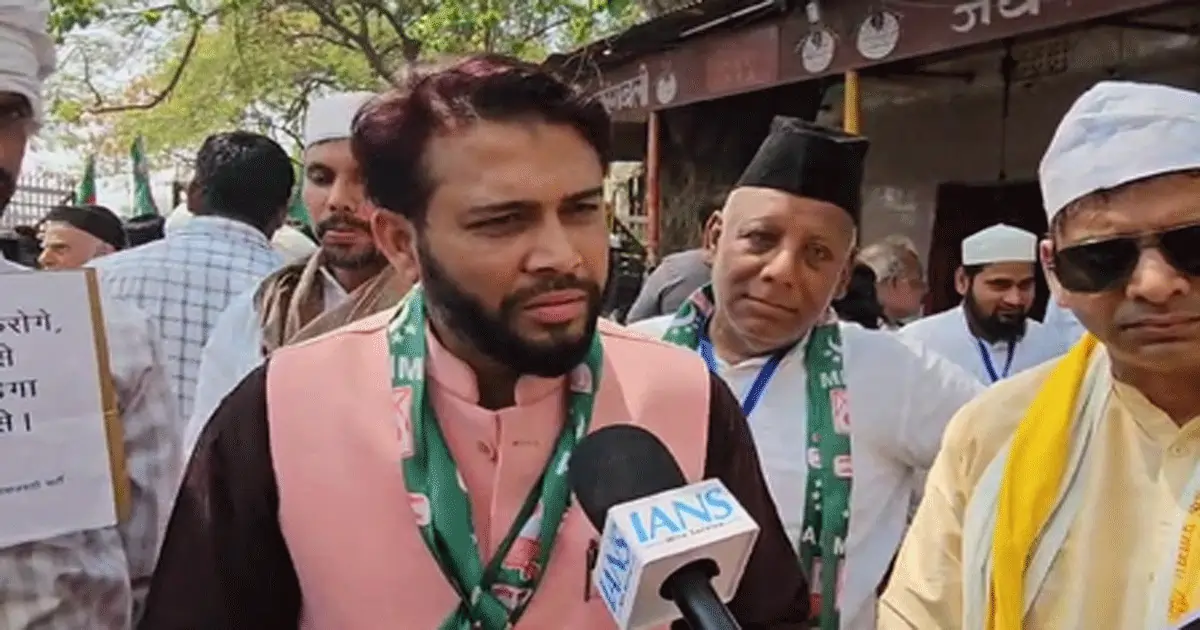
Patna, March 26: The protest launched by the All India Muslim Personal Law Board (AIMPLB) against the Waqf (Amendment) Bill in Bihar’s capital, Patna, on March 26 has sparked significant political discourse. Shamim Akhtar, the state Secretary of the All India Majlis-E-Ittehadul Muslimeen (AIMIM), declared that the protest against this Bill would become a bigger movement than the anti-CAA and NRC protests in Independent India.
Speaking to media, Shamim Akhtar emphasised the growing potential of the movement, asserting that it would eventually have a considerable impact on the government.
“So far, the government has not felt any major impact, but this protest will soon evolve into a mass movement. The CAA-NRC protests were a landmark moment for Muslims in Azaad Bharat, and it shook the government. But after that, the pandemic came, and the momentum slowed down. However, I believe this movement will be even more powerful than the anti-CAA/NRC protests in Independent India,” he remarked.
Akhtar further stated that the protest would galvanise a larger section of the population and bring the government’s policies into sharper scrutiny.
He also criticised Rahul Gandhi, Leader of the Opposition in Lok Sabha, for not participating in the protest.
“Rahul Gandhi is far away in Delhi, a thousand kilometres from Patna. When the protests were taking place at Jantar Mantar, he was absent. Even Sonia Gandhi, who is only three to four kilometres away from the protest site, did not attend,” Akhtar pointed out, questioning why the Congress was silent on such an important issue.
“The Muslims of the country, and SP chief Akhilesh Yadav, want to know why Congress is not showing any support. Why are they not opposing the Bill openly, and why aren’t they speaking up against it, considering it undermines both Muslims and the Constitution of India?” he added.
As the protest continues to gain traction, Akhtar further said that it would intensify over the coming weeks.
“I can’t predict the exact course of events, but I hope that after Ramzan and Eid, this movement will gain momentum. There is talk of a nationwide movement, with Gardani Bagh-style protests expected in every district of Bihar and across the country, similar to the indefinite sit-ins during the CAA-NRC protests,” Akhtar said.
Asked whether the protest could garner attention and support from Islamic countries, Akhtar emphasised the importance of focussing on the issue within India.
“I will speak about Islamic countries later. But as for the situation within our own home India, it is our responsibility to address the fire within before seeking help from outside,” he explained.
He further stated, “This country belongs to all its citizens, regardless of their religion, class, or community. There are people from various social organisations and political parties, including the Bhim Army, Jan Suraaj, RJD, and others, who are supporting us. This shows that the issue transcends just the Muslim community — it’s about protecting the Constitution and safeguarding the rights of all people.”
“The Modi government is trying to marginalise minorities. The Waqf Board issue is one that directly concerns Muslims. It is our right to manage our own Waqf properties and make decisions about them,” he said.
He used the analogy of a temple to illustrate his point, stating, “If I were to give the keys of a temple to someone from another community instead of a Hindu priest, how could I expect the temple’s interests to be protected? Similarly, the Waqf Board is a Muslim matter, and we have the right to decide on it.”
Akhtar also criticised the introduction of the triple talaq Bill, accusing the Modi government of interfering with Muslim personal law.
“When the triple talaq Bill was passed, Modi Ji didn’t tell us how to maintain our marriage, but he wanted to dictate how we should divorce. Our Shariat already provides a clear framework for marriage, divorce, and other personal matters. Now, with the Waqf Bill, the government is trying to interfere in our community’s affairs, and this attempt will fail,” Akhtar claimed.
He concluded by stressing that the Waqf Bill was a larger conspiracy to undermine the Constitution, which would be resisted by people across India.
Meanwhile, the RJD chief Lalu Prasad Yadav and Leader of Opposition in the Bihar Assembly, Tejashwi Yadav, joined the AIMPLB’s demonstration against the Waqf (Amendment) Bill.



At least four people were killed and two others seriously injured after a car went out of control following a tyre burst and plunged into a deep roadside ditch near Raisar on Rajasthan’s Dausa-Manoharpur National Highway (NH-148) early Friday morning.
According to officials, all six occupants were pilgrims returning to Agra after visiting Khatu Shyamji.
The accident occurred at around 6 a.m. when the car’s tyre burst while the vehicle was travelling within the jurisdiction of the Raisar police station. The driver lost control, causing the car to plunge into the ditch. After receiving information, police reached the spot and, with the assistance of local residents, rescued those trapped inside the vehicle.
The injured were rushed to a hospital by ambulance, while the bodies of the deceased were shifted to the mortuary of a government hospital.
Raisar Station House Officer Rajpal Singh said the accident occurred due to a tyre burst.
The deceased have been identified as Atul, Mukul, Rupesh and Shiva, all residents of Agra. Two other occupants, Rahul and Arpit, sustained serious injuries and were admitted to a private hospital for treatment.
The accident triggered a traffic jam on the Dausa-Manoharpur National Highway. Long queues of vehicles formed on both sides of the road, causing inconvenience to commuters for nearly an hour.
After ensuring that the injured were taken to the hospital, police personnel managed traffic movement. The damaged car was subsequently removed from the ditch with the help of a crane.
In a separate accident in Rajasthan’s Dausa district, a loading tempo travelling from Delhi to Kota veered off the Delhi-Mumbai Expressway and overturned into a roadside ditch early Friday morning, leaving five people injured.
The injured have been identified as Noorjahan, Zyakat Ali, Kunal, Ajay and the driver, Vijaypal.
All five are residents of Kota and work in setting up amusement rides at fairs. They were taken to Dausa District Hospital, where they are undergoing treatment. According to police, the accident occurred after the driver reportedly dozed off at the wheel.
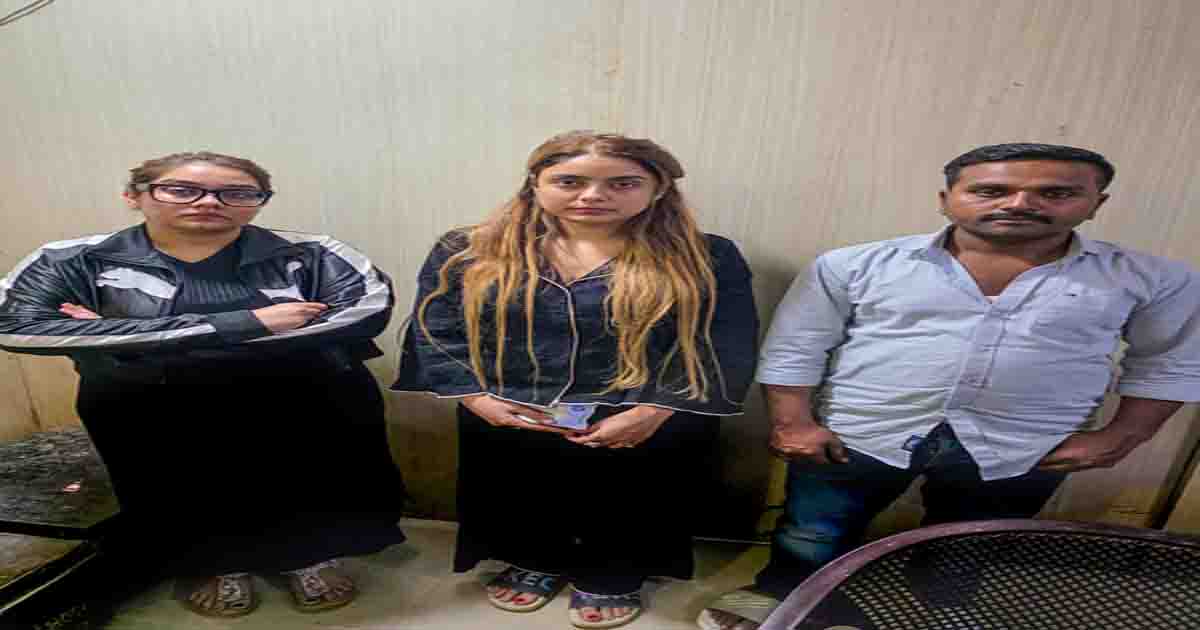
Model Shraddha Dubey, the prime accused in the murder of Shiva Sharma, has revealed details of her escape route and admitted that her boyfriend, Amir, had helped her evade the police, according to officials.
During hours of interrogation, Dubey disclosed several details but remained silent on certain aspects of the case. She was subsequently sent to jail. Investigators suspect that she kept her driver, Danish, with her to prevent him from revealing her secrets. She used him as a shield and a means of facilitating her escape.
In her statement to the police, Dubey admitted to travelling to Kanpur and Agra. On October 18, she reportedly visited a hotel in Kanpur to book a room. However, when the hotel staff asked her to produce identification, she left without completing the booking.
Dubey feared that if her photograph went viral following the murder case, the hotel staff might recognise her and inform the police. She subsequently booked a car and left for Nagpur without staying at the hotel.
She managed to evade the police for 11 days. Although she was fond of staying in large, luxurious hotels, she reportedly chose smaller hotels and lounges where identification documents were not required to avoid disclosing her identity.
Dubey also travelled to Rae Bareli but could not reach her home. Fearing that she might flee abroad, the Deputy Commissioner of Police (DCP) issued a lookout circular.
During interrogation, Dubey reportedly admitted that Amir had been accompanying her since Lucknow and had helped her enter Nepal through Bahraich. Following her statement, the police are likely to add Amir’s name to the First Information Report (FIR). Preparations are also underway to announce a reward for information leading to his arrest.
According to the DCP (Central), investigators are identifying people who allegedly helped Dubey and the other accused evade the police. Strict action will be taken against those found assisting them.
Investigators have also learnt that Dubey remained in contact with several people at the locations she visited. Police suspect that someone was continuously guiding her and helping her avoid arrest.
The DCP personally interrogated Dubey for hours. During questioning, she reportedly refrained from naming anyone and repeatedly complained of difficulty in breathing and speaking.
Meanwhile, Dubey was arrested in Nagpur by the Uttar Pradesh Special Task Force (STF) and Lucknow Police, officials said on Tuesday.
She had been on the run since October 9, when Sharma allegedly fell from the balcony of an apartment in Lucknow’s Hazratganj area. His death was initially treated as an accidental fall, but later became a suspected murder case after his family alleged that he had been assaulted and tortured before being thrown from the building.
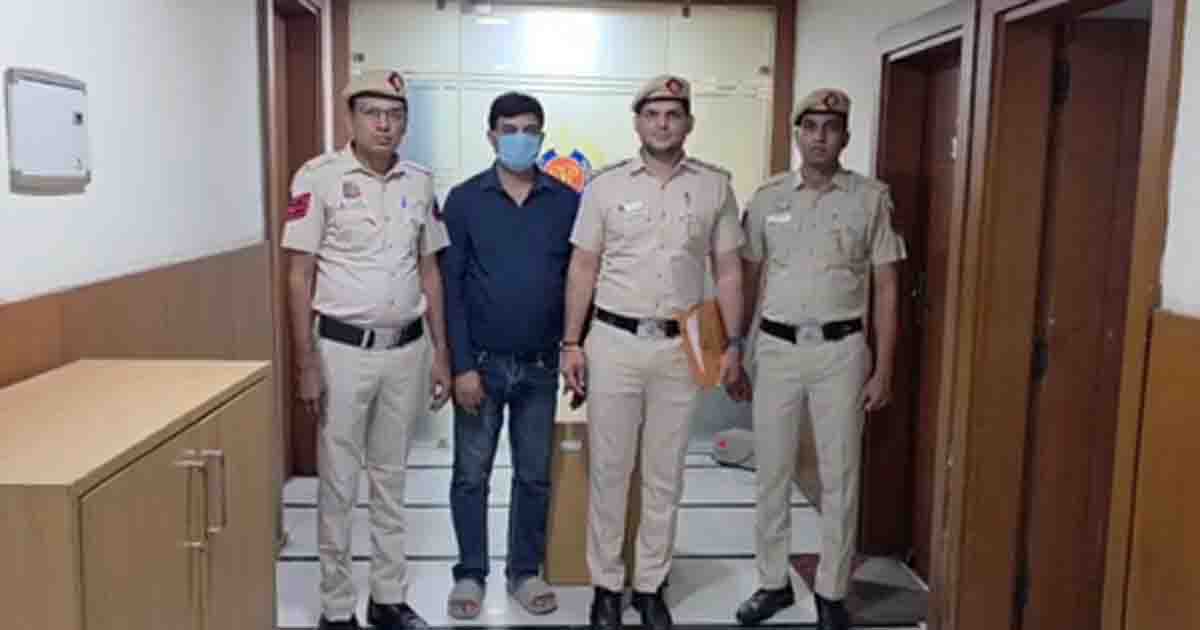
Delhi Police have arrested a 41-year-old man for cheating a garment manufacturer of approximately Rs 2 lakh on the pretext of supplying ready-made garments and sewing machine materials, officials said on Friday.
The accused, identified as Pawan Kumar Dugar, a resident of Badarpur in Delhi, was apprehended by the Cyber Police Station of Shahdara district following a technical investigation. Police also recovered a mobile phone used to contact the complainant.
According to the police, the case was registered following a complaint by Neeraj Kumar Jain, who is engaged in manufacturing ready-made garments and dealing in garment-related materials.
The complainant said that on July 6, he was contacted by Dugar, who posed as a supplier of ready-made garments and sewing machine materials. The accused persuaded him to place an order by claiming that the required goods were available for delivery.
To gain the complainant’s confidence, the accused shared catalogues, invoices and transport-related documents. He also repeatedly assured the complainant that the ordered goods would be dispatched and delivered on time.
Relying on these representations, Jain transferred approximately Rs 2 lakh through multiple transactions. However, the promised goods were never delivered, and the money was not refunded, leading to the registration of a cyber fraud case.
During the investigation, technical analysis helped the police establish leads regarding the accused’s whereabouts in Badarpur. A dedicated team from Shahdara’s Cyber Police Station subsequently conducted a raid and apprehended him.
The team comprised Sub-Inspector Sunil Dev Sihag, Head Constable Ravi Malik and Head Constable Sandeep. The operation was conducted under the leadership of Inspector Vijay Kumar, Station House Officer of the Cyber Police Station, and the overall supervision of the Assistant Commissioner of Police (Operations), Shahdara.
During the operation, the police recovered a mobile phone associated with a number allegedly used to contact the complainant.
Further financial scrutiny revealed that bank accounts linked to the accused had surfaced in six cybercrime complaints involving multiple victims and suspected fraudulent transactions worth lakhs of rupees.
According to the police, the investigation indicated that the accused allegedly acted as the caller and was directly involved in the fraudulent dealings.
Further investigation is underway to trace the complete money trail, identify additional victims and establish the full extent of the alleged fraud.

Four killed as car plunges into ditch on Dausa-Manoharpur Highway in Rajasthan

Ananya Panday enjoys muffins with Akshay Kumar son Aarav, shares picture from their outing

Shraddha Dubey reveals escape route, admits Amir role in Shiva Sharma murder case

Tiger Shroff firing case: Women network emerges, 3rd taken into custody by Mumbai Crime Branch

Delhi Police arrest man in readymade garment supply cyber fraud case

Rahul, Cong ecosystem want to force regime change: BJP after Neha Bora praises B’desh Gen-Z protest

BJP pays tribute to ex-President Abdul Kalam, recalls his enduring influence on generations of India’s youth

Attack on democratic rights: INDIA Bloc leaders on detentions of anti-ECI protestors

INDIA bloc begins protest march against ECI

Maha Congress stages agitation against Gyanesh Kumar
-

 Crime4 years ago
Class 10 student jumps to death in Jaipur
-

 Maharashtra2 years ago
Mumbai Local Train Update: Central Railway’s New Timetable Comes Into Effect; Check Full List Of Revised Timings & Stations
-

 Maharashtra2 years ago
Mumbai To Go Toll-Free Tonight! Maharashtra Govt Announces Complete Toll Waiver For Light Motor Vehicles At All 5 Entry Points Of City
-

 Maharashtra2 years ago
False photo of Imtiaz Jaleel’s rally, exposing the fooling conspiracy
-

 National News2 years ago
Ministry of Railways rolls out Special Drive 4.0 with focus on digitisation, cleanliness, inclusiveness and grievance redressal
-

 Maharashtra2 years ago
Maharashtra Elections 2024: Mumbai Metro & BEST Services Extended Till Midnight On Voting Day
-

 National News2 years ago
J&K: 4 Jawans Killed, 28 Injured After Bus Carrying BSF Personnel For Poll Duty Falls Into Gorge In Budgam; Terrifying Visuals Surface
-

 Crime2 years ago
Baba Siddique Murder: Mumbai Police Unable To Get Lawrence Bishnoi Custody Due To Home Ministry Order, Says Report