
Mumbai Press Exclusive News
Is the New Waqf Bill Beneficial for the Muslim Community? Report: Qamar Ansari

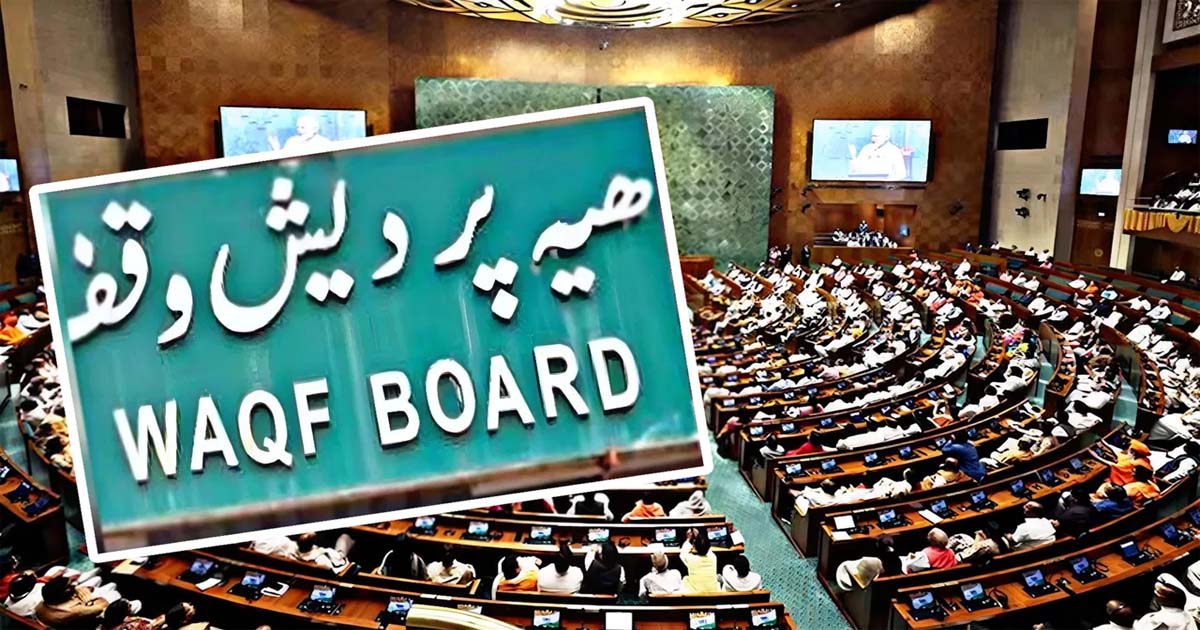
The recently introduced Waqf Bill by the government has once again sparked debate within the Muslim community. The bill is being presented as a step towards better management, transparency, and protection of Waqf properties across the country. However, differing opinions have emerged over whether it truly serves the interests of the Muslim community.
The new bill includes several key provisions, such as enhancing the powers of Waqf Boards, introducing a digital registry of Waqf properties, and initiating strict action against illegal encroachments. The government claims that the bill will ensure the protection of Waqf assets and that the revenue generated from them can be effectively used for education, healthcare, and welfare projects.
However, some religious and social organizations have expressed concerns. They argue that Waqf properties are inherently linked to religious purposes, and direct government interference could compromise religious autonomy. Some fear that the bill may hinder the freedom and original purpose of Waqf properties.
On the other hand, legal experts and reformist voices believe that if implemented honestly, the bill could be a positive step for the Muslim community. With better administration of Waqf assets—many of which have been mismanaged or encroached upon—the community could benefit in significant ways.
What’s the Difference Between the Old and the New Waqf Bill?
Old Waqf Law:
The earlier Waqf law, enacted under the “Waqf Act 1995,” aimed to regulate and safeguard thousands of Waqf properties across India. Key features included:
- Establishment of State Waqf Boards.
- Responsibility for property management vested in the Boards.
- Mandatory registration of Waqf properties.
- Appointment of Mutawallis (caretakers) with board approval.
Over time, however, the law revealed weaknesses in its implementation. Problems such as illegal encroachments, corruption, and ineffective oversight continued to rise.
New Waqf Bill:
The new Waqf Bill introduces several major changes, aiming to modernize the system, enhance transparency, and incorporate technology. Key provisions include:
- Digital Registry: All Waqf properties to be registered and monitored online.
- Central Database: A national Waqf portal to provide public access to information.
- Action Against Encroachments: Legal powers to swiftly remove illegal occupants.
- Administrative Transparency: Stronger audit mechanisms and transparent functioning of Waqf Boards.
- Grievance Redressal System: A responsive complaint cell to address corruption and misuse.
Summary of Differences:
| Aspect | Waqf Act 1995 (Old Law) | Waqf Bill 2025 (New Bill) |
|---|---|---|
| Registration | Manual registry | Digital registry with a national portal |
| Oversight | State-level monitoring | Centralized oversight and national database |
| Transparency | Limited | Enhanced transparency and robust auditing system |
| Action Against Encroachment | Lengthy legal process | Swift legal action provision |
| Public Participation | Weak grievance mechanism | Active grievance redressal system |
The use of modern technology, improved transparency, and administrative reforms in the new Waqf Bill are promising aspects. However, some scholars and religious groups worry that increasing government involvement may infringe upon religious autonomy. The actual impact of the bill will largely depend on its execution and the extent to which the Muslim community is consulted and included in the process.
For now, it remains too early to say whether the bill will prove to be entirely beneficial for the Muslim community. Its success hinges on fair implementation and inclusive governance.

Maharashtra
Four more arrested in Tiger Shroff firing case; two women accused of supplying weapons, accused remanded to police custody till October 26.


The Mumbai Crime Branch has arrested four additional suspects—two women and two men—in connection with the firing incident involving Tiger Shroff. The arrested individuals include two women, Beeta and Radha, as well as two men, Kunal and Vijender. All four were presented before the Killa Court today, amid tight security arrangements. The police requested police custody (remand) for the suspects to facilitate further interrogation; the court granted this request and ordered that they be held in police custody until October 26. The two women are accused of supplying weapons to the shooters and assisting the other suspects. The police sought this remand to conduct further investigations, including determining whether the suspects have any links to the Bishnoi gang. So far, a total of 10 suspects have been arrested in this case. Previously, the police had arrested the shooters—Phool Singh, Rehan, and Ritik (alias Roshan)—who carried out the firing; they were apprehended by the Kota Police while traveling by train from Mumbai toward Delhi, acting on information provided by the Mumbai Police. Additionally, the Delhi Special Cell arrested six other suspects from Haryana and Delhi, including women and individuals involved in supplying weapons. The police are continuing their investigation into the matter.

Mumbai: A woman has been arrested by a team from Crime Branch Unit 7 in connection with an extortion case. The accused allegedly extorted approximately 40 million rupees (4 crore rupees) from a resident of Ghatkopar by threatening to defame her using an obscene video and threatening her with death. She was also demanding further payments.
The complainant works as a manager at a jewelry store. Between December 2024 and January 2025, an acquaintance—a woman—engaged the complainant in an obscene video chat via WhatsApp. The accused then threatened to circulate this footage to the police, the courts, and the CBI, claiming that the complainant would be summoned for investigation. Fearing public disgrace, the complainant paid a total of 40 million rupees to the accused. The woman continued to demand more money and threatened that if further payments were not made, she would break the complainant’s limbs and kill her. Taking into account the gravity of the matter, Crime Branch Unit 7 (Ghatkopar, Mumbai) laid a trap for the woman who had been demanding extortion money. On October 19, she was caught red-handed at RK Restaurant, LBS Road, Ghatkopar West, Mumbai, while accepting a sum of 5 lakh rupees from the complainant. Following the complainant’s report, a case was registered at the Ghatkopar Police Station under Sections 308(2) and 308(7) of the Bharatiya Nyaya Sanhita (BNS). The Crime Branch has taken over the investigation, and the woman has been arrested; further inquiries are being conducted by Unit 7, Ghatkopar.
This operation was carried out by a team comprising Mumbai Police Commissioner Deven Bharti, Joint Police Commissioner Anil Kumbhare, Additional Commissioner Krishnakant Upadhyay, and DCP Nanath, along with the personnel of Unit 7.
Maharashtra
Major crackdown by Mumbai Crime Branch, 2 kg heroin worth ₹10 crore seized, three accused arrested.
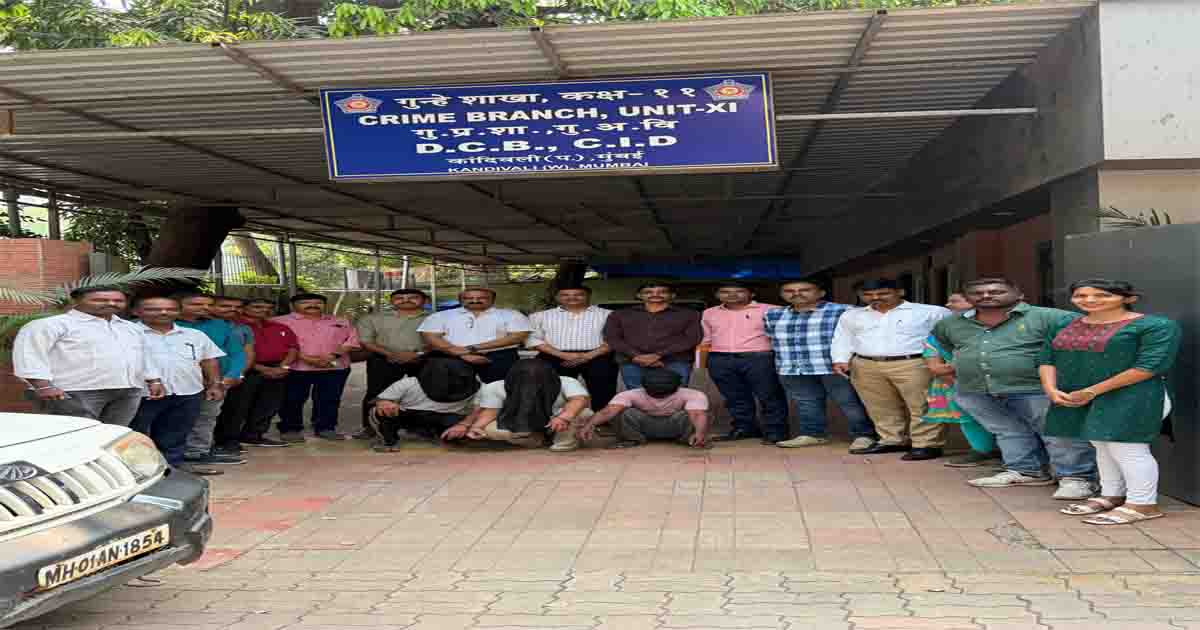
The Mumbai Crime Branch has intensified its operations against drug peddlers, and in the process, the police have reported the arrest of a drug smuggler.
A case has been registered at the Borivali Police Station under Sections 8(c), 21(c), and 29 of the NDPS Act, 1985.
On October 14, the Crime Branch conducted a raid in Borivali West. So far, three suspects have been arrested in connection with this case. The seized items include: 1) 2,032 grams of heroin, valued at 10,16,00,000 rupees; and 2) three mobile phones, valued at 30,000 rupees. Acting on the directives of Mumbai Police Commissioner Deven Bharti, the Mumbai Crime Branch has launched a special campaign to identify and take strict action against individuals involved in the smuggling, purchase, and sale of narcotics across Mumbai. During the aforementioned operation, acting on secret information, a police team conducted a swift and effective raid in Kandivali (West), Mumbai, on October 14. They seized 758 grams of heroin—estimated to be worth 37,900,000 rupees—from the possession of two individuals.
Subsequently, on October 17, based on information obtained during the interrogation of the arrested suspects, the police carried out another prompt and effective operation, seizing 1,274 grams of heroin—valued at approximately 63,700,000 rupees—from a third suspect. In total, 2,032 grams of heroin, with an estimated value of 101,600,000 rupees, have been seized from the three suspects.
A case has been registered under Sections 8(c) and 21(c) of the NDPS Act, 1985 (at the Borivali Police Station), as the suspects were found to be in possession of and smuggling heroin. The suspects are believed to be part of an inter-state drug trafficking syndicate. Further investigation is underway to identify and apprehend those responsible for supplying, buying, and selling the narcotics.
This successful operation was carried out by the Kandivali unit under the supervision of Police Commissioner Deven Bharti, Joint Police Commissioner Anil Kumbhare, Additional Commissioner Krishnakant Upadhyay, and DCP Nanath Dhole.

‘Fearing freedom’: Shiv Sena(UBT) criticises Centre over CJP activists’ arrest in ‘Saamana’

Four killed as car plunges into ditch on Dausa-Manoharpur Highway in Rajasthan

Ananya Panday enjoys muffins with Akshay Kumar son Aarav, shares picture from their outing

Shraddha Dubey reveals escape route, admits Amir role in Shiva Sharma murder case

Tiger Shroff firing case: Women network emerges, 3rd taken into custody by Mumbai Crime Branch

Rahul, Cong ecosystem want to force regime change: BJP after Neha Bora praises B’desh Gen-Z protest

BJP pays tribute to ex-President Abdul Kalam, recalls his enduring influence on generations of India’s youth

Attack on democratic rights: INDIA Bloc leaders on detentions of anti-ECI protestors

INDIA bloc begins protest march against ECI

Maha Congress stages agitation against Gyanesh Kumar
-

 Crime4 years ago
Class 10 student jumps to death in Jaipur
-

 Maharashtra2 years ago
Mumbai Local Train Update: Central Railway’s New Timetable Comes Into Effect; Check Full List Of Revised Timings & Stations
-

 Maharashtra2 years ago
Mumbai To Go Toll-Free Tonight! Maharashtra Govt Announces Complete Toll Waiver For Light Motor Vehicles At All 5 Entry Points Of City
-

 Maharashtra2 years ago
False photo of Imtiaz Jaleel’s rally, exposing the fooling conspiracy
-

 National News2 years ago
Ministry of Railways rolls out Special Drive 4.0 with focus on digitisation, cleanliness, inclusiveness and grievance redressal
-

 Maharashtra2 years ago
Maharashtra Elections 2024: Mumbai Metro & BEST Services Extended Till Midnight On Voting Day
-

 National News2 years ago
J&K: 4 Jawans Killed, 28 Injured After Bus Carrying BSF Personnel For Poll Duty Falls Into Gorge In Budgam; Terrifying Visuals Surface
-

 Crime2 years ago
Baba Siddique Murder: Mumbai Police Unable To Get Lawrence Bishnoi Custody Due To Home Ministry Order, Says Report