
Maharashtra
Iqbal Chagla Passes Away At 86: The Legal Luminary And Champion Of Human Rights


Senior advocate Iqbal Chagla, 86, passed away on Sunday afternoon after a period of ill health. The son of Mahommedali Currim Chagla, the first Chief Justice of the Bombay High Court of independent India, he leaves behind a remarkable legacy in the legal fraternity.
Chagla, father of sitting Bombay High Court judge, Justice Riyaz Chagla, served as the president of the Bombay Bar Association (BBA) three times.
Born in 1939, he earned an MA in History and Law from Cambridge University before beginning his practice at the Bombay High Court. He trained under the renowned Kharshedji Hormasji Bhabha and was designated a Senior Advocate in 1979. Between 1990 and 1999, he served as the BBA president and held other prominent roles, including as a Member of the Executive Committee of the Bar Association of India and the National Legal Services Authority (NLSA).
Despite being offered a judgeship thrice — twice by the Bombay High Court and once by the Supreme Court — Chagla declined, potentially forfeiting an opportunity to become the Chief Justice of India.
During his tenure as BBA president, Chagla played a pivotal role in calling for the resignation of four Bombay HC judges over allegations of impropriety. The BBA passed a resolution under his leadership, resulting in some judges resigning and others being transferred.
Chagla was highly regarded for his expertise in civil litigation, company law, and international arbitration. Known for his integrity and gentle demeanor, he was a sought-after counsel who often argued complex and high-profile cases.
BBA president Nitin Thakker described Chagla as a stalwart of the legal fraternity and a champion of human rights. “He has been an inspiration for so many young lawyers due to his court demeanor, his fairness and his integrity. He has been a champion of defending human rights and a fierce fighter for upholding rule of law. Above all he was a gentleman and a great human being. Bombay Bar Association has lost a stalwart and his loss is immense.”
Former BBA president Rajiv Chavan lauded Chagla’s legal brilliance and sportsmanship. “He was an outstanding lawyer, humane, and a cricket enthusiast. His loss will be deeply felt in the legal community and beyond. Despite his perfectionism, he was always kind and approachable.” Reminiscing how, Chagla had been kind to him, Chavan said the late senior advocate guided and inspired everyone to achieve greater things.
The BBA issued a statement mourning Chagla’s demise: “Mr. I.M. Chagla’s contributions to the legal field are immeasurable. His dedication, integrity, and excellence have inspired generations of legal professionals. We extend our condolences to his family in this difficult time.”
Chagla’s funeral will take place at 10:30 a.m. on Monday, January 13, 2025, at the Worli Crematorium in Mumbai.
Notable Cases
Chagla represented Nestlé India during the Food Safety and Standards Authority of India’s (FSSAI) ban on Maggi noodles, successfully arguing for the export of the product despite the ban in the Indian market.
He also handled the high-profile legal dispute between corporate lawyers Cyril and Shardul Shroff over their mother’s will, leading to the amicable division of their firm, Amarchand Mangaldas, into two entities.
In 2004, he represented Dr. Anahita Pandole in a pioneering Public Interest Litigation (PIL) against illegal hoardings in Mumbai.
After the 26/11 terror attacks, Chagla, representing the Society of Indian Law Firms, filed a PIL seeking the establishment of a Citizens Coordination Committee to monitor and advise on safety measures in Mumbai.
A towering figure in Indian law, Iqbal Chagla will be remembered for his legal acumen, unwavering integrity, and his dedication to upholding the rule of law.

Maharashtra
Akhilesh Yadav is fighting to save the country and protect the Constitution: Abu Asim Azmi


Mumbai: Samajwadi Party leader and MLA Abu Asim Azmi has congratulated SP President Akhilesh Yadav for his struggle to protect the nation and the Constitution. He stated that Akhilesh Yadav has the capacity to save the country, and the nation’s 1.4 billion citizens should recognize his efforts. Abu Asim Azmi emphasized that a strong alliance is essential to eradicate communalism and hatred from the country. He further added that the distribution of seats within such an alliance should be based on the strength of a party’s grassroots workers and its ability to secure the highest number of votes. Highlighting the political significance of Uttar Pradesh, he remarked that the path to Delhi runs through the state; therefore, a robust alliance must be formed to secure power in Uttar Pradesh and, in turn, halt those who propagate hatred.
Maharashtra
Major operation by Mumbai MIDC Police: Two suspects arrested for selling ‘hydro-ganja’ (cannabis) and other narcotics; 1 kg 896 grams of cannabis seized.

On October 29, Police Inspector Ranjit Gondkome of the Mumbai MIDC Police Station, along with the Anti-Narcotics Squad, was out on patrol as part of an operation targeting individuals involved in the consumption, purchase, and sale of narcotics. During this patrol, near the Industrial Estate on Paper Box Road, MIDC, Andheri (East), Mumbai, two individuals were observed moving about in a suspicious manner. Finding their behavior suspicious, Police Inspector Gondkome and his team moved to detain them. One of the individuals was carrying a red plastic bag. Both men attempted to flee the scene to evade the police, but they were successfully apprehended by the police team on the spot. When Police Inspector Gundkome questioned the two individuals regarding their presence at the location and their attempt to evade the police, they initially tried to mislead the officers. Upon further, more intensive questioning, ‘hydro-ganja’ (a potent form of cannabis) was discovered in their possession. Following the procedures mandated by the NDPS Act, 1985, a physical search of the individuals was conducted, along with a search of a red plastic bag held by Omkar Rajendra Pawar. This search yielded 1.896 kilograms of ‘hydro-ganja,’ with an estimated value of 6,636,000 rupees. The individuals—Omkar Rajendra Pawar (aged 28, resident of Bhakarwadi, Takoregaon, Satara District) and Piyush Madhukar Ghongde (aged 22, resident of Station area, Takoregaon, Satara District)—were found in possession of this substance, intended for sale, transport, and commercial purposes. Consequently, a case has been registered at the MIDC Police Station, Mumbai (Case No. 1244/2026), under Sections 8(c), 20(b), and 29 of the NDPS Act, 1985.
Investigations have revealed that the arrested suspects had traveled from Satara District to Mumbai city with the intent to sell this ‘hydro-ganja.’ Further investigation into the aforementioned crime is underway. This operation was carried out under the leadership of Mumbai Police Commissioner Deven Bharti, Joint Police Commissioner Manoj Kumar Sharma, Additional Police Commissioner Abhinav Deshmukh, DCP Datta Nalawade, and MIDC Senior Police Inspector Ghanshyam Nair.
Maharashtra
Sunetra Pawar calls meet on Nov 2 for ‘self introspection’ after Maha Council poll defeat
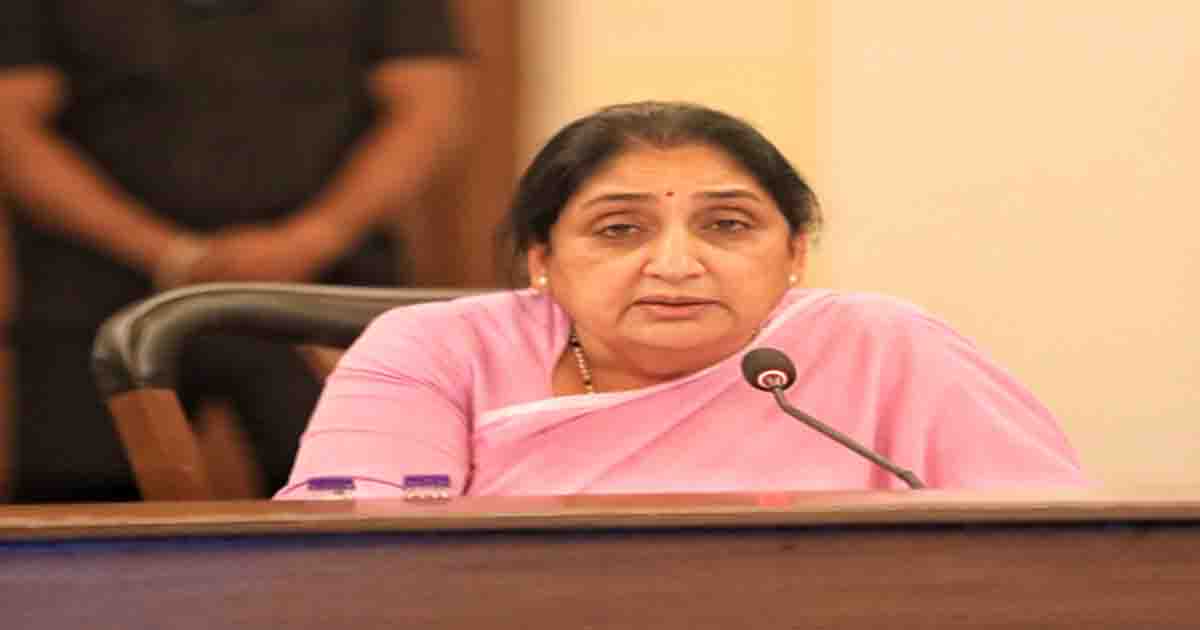
Amid humiliating defeat in the Chhatrapati Sambhajinagar Graduates’ constituency polls, the Nationalist Congress Party (NCP) President and Maharashtra Deputy Chief Minister Sunetra Pawar has convened a core committee meeting on Monday at her official residence Devgiri in Mumbai to self introspection and discuss future strategy especially for the local body elections.
The NCP had renominated a three-term legislator Satish Chavan in the Chhatrapati Sambhajinagar Graduates’ constituency but he was defeated by the NCP-SP nominee Pratapsinh Patil.
Chavan lost the poll due to internal friction among the MahaYuti allies and also because Gen Z and minority community voters deserted the NCP.
NCP’s decision comes a day after Deputy CM Sunetra Pawar on Thursday admitted that the Maharashtra Legislative Council election results call for self introspection.
She was reacting after the NCP nominee Satish Chavan lost to the NCP-SP candidate Pratapsinh Patil in the Chhatrapati Sambhajinagar Graduates’ seat.
As far as the MahaYuti alliance is concerned, it won Pune and Amravati Teacher’s seats while the Maha Vikas Aghadi has bagged three seats including Pune, Nagpur and Chhatrapati Sambhajinagar Graduates’ constituencies.
Speaking to reporters, Deputy CM Sunetra Pawar said, “In any election, there are victories and defeats. Even when the results come out, self-introspection is necessary, and we will do so. We will try to improve. I genuinely feel that this result calls for self-introspection on our part.”
Her reaction comes after the NCP Working President Praful Patel in his post on social media platform X on Wednesday said, “Today’s Vidhan Parishad election results serve as a definitive wake-up call. The time has come for urgent introspection to rebuild trust, realign our priorities, and fix our organisational structure.”
Earlier, Patel had also called for corrective steps to further strengthen the party organisation.
On the other hand, the Maharashtra NCP Chief Sunil Tatkare said, “We will sit together and analyse the outcome.”
Earlier, he emphasised that candidate selections and election outcomes reflect a collective failure and joint responsibility of the party leadership rather than individual missteps.
Deputy CM Sunetra Pawar’s comment comes after the Bharatiya Janata Party (BJP) and Shiv Sena engaged in a war of words over the Maharashtra Legislative Council polls.
MahaYuti leaders expressed their displeasure and blamed Shiv Sena for the defeat.
BJP placed the blame on Shiv Sena, saying that the loss occurred due to a lack of support from their ally.
BJP accused the Shiv Sena’s stance of undermining the MahaYuti’s strategy.
On the other hand, Shiv Sena said that the BJP, which claims to be the world’s largest party, should introspect on its own electoral strategy and internal discontent instead of shifting the blame of defeat onto its allies.
Monday’s core committee is taking place after the NCP had met on October 25 and gave explicit refusal to entertain any merger or share organisational control with the NCP-SP.
Beyond a mere denial of reconciliation, this decision codifies the permanent structural rift within the Pawar legacy and reshapes coalition dynamics across both sides of the state’s political divide.
The refusal to share control or merge signals that the era of tactical ambiguity between the two NCP factions is officially over.
Both outfits are now set on divergent trajectories, setting up a long-term electoral contest for the legacy of the party’s original mandate.
By firmly ruling out a merger or power-sharing agreement, the ruling NCP faction after its core committee meeting held on Sunday reinforces its commitment to the MahaYuti alliance alongside the Bharatiya Janata Party (BJP) and Shiv Sena.
Having secured official recognition and symbol rights from the Election Commission, the ruling NCP seeks to establish itself not as a temporary breakaway group, but as the sole legitimate vehicle of the party’s administrative future.
Retaining full structural autonomy allows the party to maintain its bargaining power within Cabinet portfolios and regional seat-sharing negotiations without the threat of internal ideological dilution.
Despite taking a firm stance against the merger, the Sunetra Pawar-led NCP however, faces crucial unaddressed internal challenges.
The conflict between the youth wing and seasoned veterans remains unmanaged, threatening cohesion.
The lack of alignment between party office-bearers and government representatives leaves the cadre without clear direction.

Akhilesh Yadav is fighting to save the country and protect the Constitution: Abu Asim Azmi

Major operation by Mumbai MIDC Police: Two suspects arrested for selling ‘hydro-ganja’ (cannabis) and other narcotics; 1 kg 896 grams of cannabis seized.

Priyanka Gandhi condoles loss of lives in Uttarakhand helicopter crash

UP Assembly polls: HM Amit Shah puts BJP’s ‘hat-trick mission’ in motion

PM Modi watches ‘Anand Math’ stage adaptation during Ekta Prakash Parv in Gujarat

Rahul, Cong ecosystem want to force regime change: BJP after Neha Bora praises B’desh Gen-Z protest

Attack on democratic rights: INDIA Bloc leaders on detentions of anti-ECI protestors

BJP pays tribute to ex-President Abdul Kalam, recalls his enduring influence on generations of India’s youth

INDIA bloc begins protest march against ECI

Gujarat govt to honour Flydubai captain Smit Machchhar with ‘Vishisht Gujarat Garima Award’, Rs 25 lakh reward
-

 Crime4 years ago
Class 10 student jumps to death in Jaipur
-

 Maharashtra2 years ago
Mumbai Local Train Update: Central Railway’s New Timetable Comes Into Effect; Check Full List Of Revised Timings & Stations
-

 Maharashtra2 years ago
Mumbai To Go Toll-Free Tonight! Maharashtra Govt Announces Complete Toll Waiver For Light Motor Vehicles At All 5 Entry Points Of City
-

 Maharashtra2 years ago
False photo of Imtiaz Jaleel’s rally, exposing the fooling conspiracy
-

 National News2 years ago
Ministry of Railways rolls out Special Drive 4.0 with focus on digitisation, cleanliness, inclusiveness and grievance redressal
-

 Maharashtra2 years ago
Maharashtra Elections 2024: Mumbai Metro & BEST Services Extended Till Midnight On Voting Day
-

 National News2 years ago
J&K: 4 Jawans Killed, 28 Injured After Bus Carrying BSF Personnel For Poll Duty Falls Into Gorge In Budgam; Terrifying Visuals Surface
-

 Crime2 years ago
Baba Siddique Murder: Mumbai Police Unable To Get Lawrence Bishnoi Custody Due To Home Ministry Order, Says Report