
National News
Government To Soon Launch Revamped National Urban Livelihoods Mission

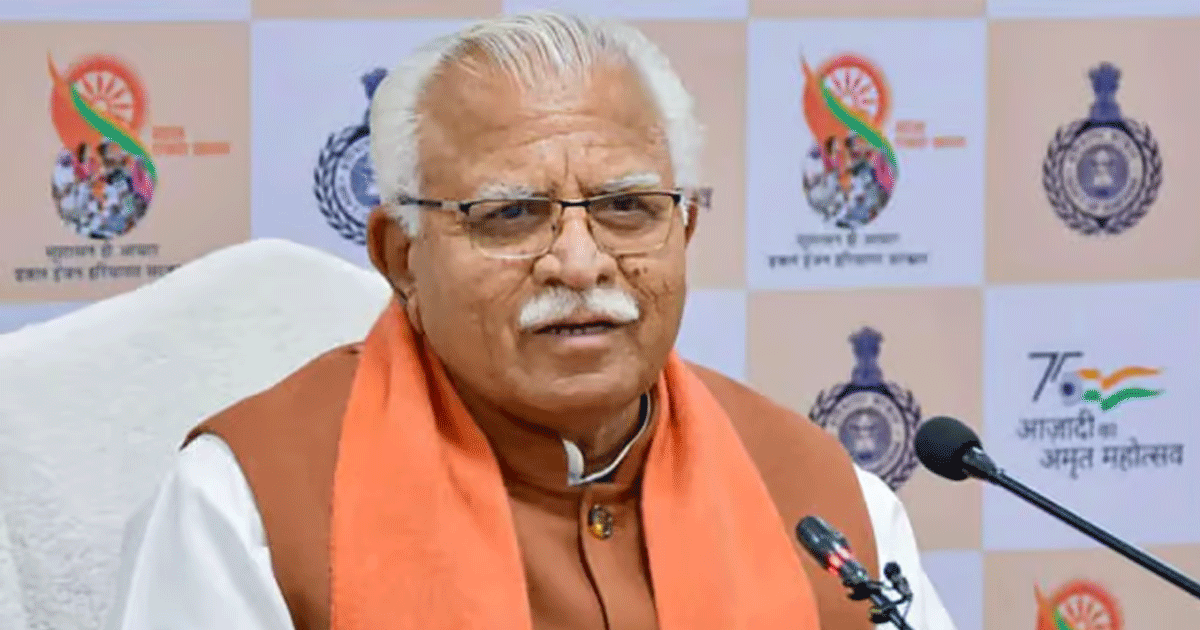
Union Minister for Housing and Urban Affairs and Power, Manohar Lal on Tuesday said that a revamped National Urban Livelihoods Mission (NULM) will be launched soon.
Interacting with media persons here, the union minister said that a pilot project is underway in 25 cities and its outcome will help shape the revamped National Urban Livelihoods Mission.
The minister reaffirmed the central government’s commitment to working in partnership with state governments by providing budgetary support, workforce training, and advanced technologies to foster urban development.
Rs 13,422 crore under PM Svanidhi Scheme
Under the PM Svanidhi Scheme, the total amount of loans disbursed amounts to Rs 13,422 crore, an official release said.
He said that investments in the urban sector have grown 16 times, from approximately Rs 1,78,053 crore between 2004 and 2014 to Rs 28,52,527 crore since 2014.
The Union Minister said that the increased investments underscore the government’s commitment to achieving the goal of Vikshit Bharat by 2047. He emphasised that the accelerating rate of urbanisation has made urban development a cornerstone of India’s growth strategy.
Over the past six months, urban development schemes have been expanded and implemented with greater speed and efficiency, the minister said.
Creation of 4,649 MLD water treatment capacity under AMRUT
Under the Atal Mission for Rejuvenation and Urban Transformation (AMRUT), the Union Minister listed several significant achievements, including the creation of 4,649 MLD of water treatment capacity and 4,429 MLD of sewage treatment capacity.
Under AMRUT 2.0, the government is prioritising stormwater drainage systems to address waterlogging challenges, alongside continuing efforts to enhance drinking water availability and sewerage systems.
Projects worth Rs 2.73 lakh crore under AMRUT mission
Under the AMRUT Mission, a total of Rs 2.73 lakh crores worth of projects have been sanctioned between 2014 and 2024 of which Rs 1.03 lakh crore is central assistance, as per the official figures.
The release said that overall works worth around Rs 96,970 crore have been physically completed.
Manohar Lal announced that the New Cities Scheme has been conceptualised to manage the pressures of rapid urbanisation. Under the Swachh Bharat Mission, since June 9 2024, the government has released more than Rs 1,123 crore.
Over the past six months since June 9, two major dumpsites in Ahmedabad and Hyderabad have been completely remediated, successfully addressing approximately 2.5 lakh metric tonnes of legacy waste, according to the release.

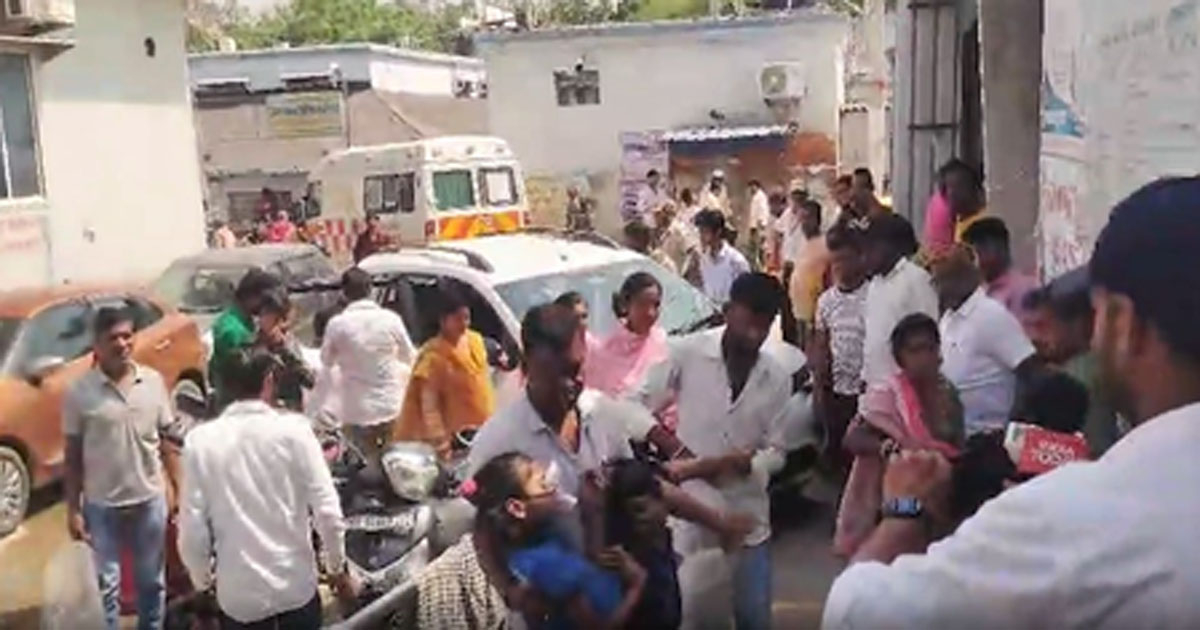
Patna, April 13: A nine-year-old girl was killed and over a dozen school children were injured after a school van overturned in Bihar Nawada district on Monday morning, police said.
The incident occurred on Kamlapur Road in the Govindpur block around 8.15 a.m. on Monday, where the vehicle reportedly lost control, plunged nearly 20 feet off the road, and overturned multiple times.
Eyewitnesses described a chaotic scene as the vehicle rolled repeatedly before coming to a halt. Local villagers — who were harvesting wheat in nearby fields — rushed to the spot upon hearing the crash. They played a crucial role in rescuing the children, pulling them out of the wreckage and transporting them to nearby hospitals.
According to the police, one student named Arohi Kumari (9) lost her life in this mishap, and two students have critical conditions at the moment. Other students are also under the close observation of doctors.
Preliminary findings suggest that the vehicle belonged to a private school. Local residents have alleged that the vehicle was overloaded beyond capacity. The vehicle has a capacity to transport 15 students, but it was carrying more than 25 at the time of the accident.
The eyewitnesses have also said that the driver of the vehicle was in an inebriated condition and travelling at high speed. These factors are believed to have contributed to the accident.
Police have reached the spot and initiated an investigation into the incident. Authorities are examining all aspects, including vehicle condition, driver’s conduct, and compliance with safety norms.
The Nawada police arrested the errant driver and lodged an FIR against him under the relevant sections of rash and negligent driving at the Govindpur police station. The district police will also conduct a medical check-up of the driver.
The incident has sparked widespread anger among villagers, who are demanding strict action against the school administration. Residents have emphasized the urgent need for enforcing safety regulations to prevent such tragedies in the future.
National News
‘Respected Modi ji, please save West Bengal’ poster at PM’s Asansol rally draws attention

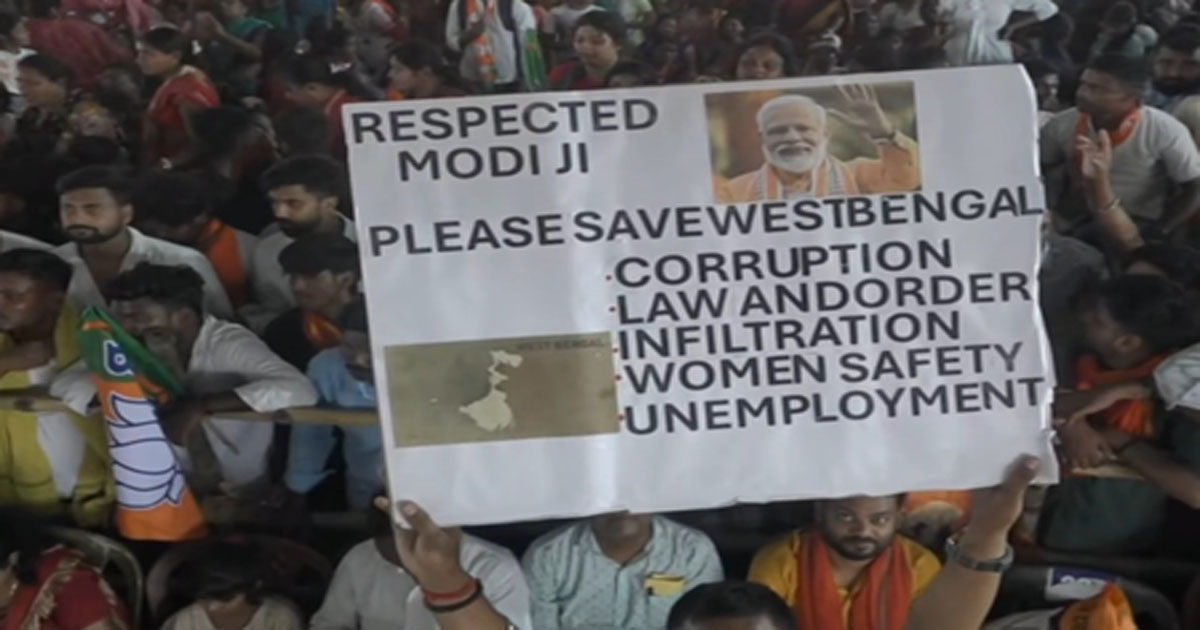
Kolkata, April 9: A striking visual emerged during Prime Minister Narendra Modi’s public rally in Asansol on Thursday, as a person in the crowd held up a poster appealing directly to the Prime Minister with the message, “Respected Modi ji, please save West Bengal.”
The moment came as the election campaign in West Bengal gathered momentum ahead of the upcoming Assembly polls.
The state is set to vote in two phases, scheduled for April 23 and April 29.
In the first phase, polling will take place across 152 Assembly constituencies, while the remaining 142 seats will go to the polls in the second phase.
The counting of votes is slated for May 4.
Amid loud cheers and slogans, the Prime Minister addressed a large and enthusiastic gathering in Asansol.
During his speech, attention briefly shifted to a person in the audience, who was seen holding up a poster featuring PM Modi’s portrait along with a map of West Bengal.
The poster prominently displayed the message, “Respected Modi ji, Please save West Bengal”, and also highlighted several issues faced by the public, including “Corruption, law and order, infiltration, women safety and unemployment”.
These concerns mirror the key themes on which the Bharatiya Janata Party (BJP) has been targeting the ruling Trinamool Congress government in the state.
The visual quickly stood out amid the rally, reflecting the charged political atmosphere as political parties intensify their campaigns in the run-up to the state elections.
Meanwhile, PM Modi launched a blistering attack on the Trinamool Congress government, claiming that the ruling-party-linked syndicate and mafia were looting the state’s resources and also warned that all those goons will be held accountable and answerable after the election results on May 4.
PM Modi, addressing his second election rally in Asansol, pinned the blame on previous dispensations from the Congress to Trinamool Congress for West Bengal’s “disgraceful decline from prosperity to deprivation” and said that the BJP’s good governance is the only solution for West Bengal’s burgeoning woes.
Accusing the Mamata Banerjee government of taking the state back to ‘dark ages’, the Prime Minister said that it is essential for West Bengal’s progress that the state is freed from Trinamool’s clutches.
“For Bengal’s progress, freedom from Trinamool is necessary, because while the entire country is moving ahead at a rapid pace, Trinamool is pushing Bengal backwards,” he added.
“Trinamool’s time is over. The next government will be a double-engine government of the BJP. After May 4, Bengal will enter a new era of development,” he said.
Making a fervent call to the electorate to choose their options wisely in the upcoming state polls, Prime Minister Modi said that the people of West Bengal won’t get fooled this time, as they want a “performing” government with a proven track record.
New Delhi, April 8: Global crude oil prices on Wednesday plunged sharply up to 20 per cent, after US President Donald Trump announced a two-week ceasefire with Iran that includes a pledge to restore navigation through the Strait of Hormuz — the narrow waterway at the heart of the world’s most acute energy crisis in decades.
The international benchmark Brent crude futures shed nearly 16 per cent or $17.39 to $91.88, hitting an intraday low, while US WTI crude declined almost 20 per cent or $21.90 to $91.05.
The Strait of Hormuz, through which roughly a fifth of global oil flows, has been at the centre of the conflict. Iran had restricted passage for several weeks, contributing to rising prices and supply concerns. Markets had been on edge ahead of Trump’s deadline for Iran to reach a deal, with traders fearing a major escalation could disrupt shipments across the Gulf and send prices sharply higher.
Oil prices had surged in recent weeks amid fears that the strait could be closed or severely restricted. The waterway handles shipments critical to global supply chains, including crude oil and liquefied natural gas.
The US-Israel-Iran conflict has been paused for two weeks after approximately 40 days of hostilities that began in February.
President Trump’s shift in stance came just ahead of his stated deadline for Iran to reopen the Strait of Hormuz or risk extensive strikes on its civilian infrastructure.
Meanwhile, Iran indicated it would halt its military operations provided attacks against it ceased simultaneously. Foreign Minister Abbas Araghchi, in a formal statement, confirmed that safe passage through the Strait of Hormuz would be ensured for two weeks in coordination with Iranian armed forces.
The conflict had triggered an unprecedented surge in oil prices in March, with gains exceeding 60 per cent during the period.
Additionally, Indian equity benchmarks also rallied sharply on the development, trading more than 3 per cent higher in early trade. The Sensex jumped nearly 4 per cent, while the Nifty surged 3.5 per cent to their respective intraday highs.

Textile industry exports affected due to war in West Asia, Raees Sheikh demands package from the state

Mumbai Shocker! Man Brutally Beaten To Death In Dadar Over Old Rivalry; 6 Arrested So Far

Crime Branch Arrests Milk Seller In Malad East For Adulterating Amul And Gokul Milk, Repackaging As Counterfeit Brands

Russian FM Lavrov arrives in China for two-day visit amid West Asia conflict

Maharashtra Police Honours Gondia & Thane Teams for Outstanding Investigation & Conviction

Dhurandhar 2 Box Office Collection Day 1: Ranveer Singh Starrer Takes An Exceptional Opening; Crosses ₹100 Crore Mark

Mumbai Police Busts Fake Apple Accessories Racket In Ghatkopar, ₹16.33 Lakh Goods Seized; Six Booked

Dhurandhar 2 Box Office Collection Day 9: Ranveer Singh Starrer Earns ₹41.55 Crore On Its Second Friday; Enters ₹700 Crore Club

Mumbai: 28-Year-Old Ghatkopar Woman Killed By Speeding Tanker While Crossing Road, Driver Arrested

Thane Horror: Man Slashed With Chopper In Naupada For Refusing ‘Vargani’, Caught On Camera
-

 Crime4 years ago
Class 10 student jumps to death in Jaipur
-

 Maharashtra2 years ago
Mumbai Local Train Update: Central Railway’s New Timetable Comes Into Effect; Check Full List Of Revised Timings & Stations
-

 Maharashtra1 year ago
Mumbai To Go Toll-Free Tonight! Maharashtra Govt Announces Complete Toll Waiver For Light Motor Vehicles At All 5 Entry Points Of City
-

 Maharashtra2 years ago
False photo of Imtiaz Jaleel’s rally, exposing the fooling conspiracy
-

 National News2 years ago
Ministry of Railways rolls out Special Drive 4.0 with focus on digitisation, cleanliness, inclusiveness and grievance redressal
-

 Maharashtra1 year ago
Maharashtra Elections 2024: Mumbai Metro & BEST Services Extended Till Midnight On Voting Day
-

 National News2 years ago
J&K: 4 Jawans Killed, 28 Injured After Bus Carrying BSF Personnel For Poll Duty Falls Into Gorge In Budgam; Terrifying Visuals Surface
-

 Crime1 year ago
Baba Siddique Murder: Mumbai Police Unable To Get Lawrence Bishnoi Custody Due To Home Ministry Order, Says Report