
Crime
Delhi Cyber Police bust mule bank account racket, arrest four in courier scam case


New Delhi, July 14: The Cyber Police Station of North-East District, Delhi, has busted a mule bank account racket and arrested four persons in connection with a fraud case involving cheating of Rs 2.47 lakh on the pretext of a courier delivery company.
The arrested accused have been identified as Md. Arbaz Daniyal alias Labbu (20), Jimmy Bathla (41), Abdul Wadood (27), and Aniket Verma (25). Police said the accused were allegedly involved in operating and supplying mule bank accounts used to receive and transfer money obtained through cyber fraud.
According to the police, a case vide e-FIR No. 00194/2026 dated 16.06.2026 under Section 318(4) of the Bharatiya Nyaya Sanhita (BNS) was registered at Cyber Police Station, North-East District, on the complaint of Satender, a resident of Babarpur, North-East Delhi, who works as Deputy General Manager (DGM) at Delhi Transco Limited (DTL).
Police said the complainant received a call from a fraudster impersonating a courier executive regarding the delivery of a parcel. The caller allegedly convinced him to dial a number and activate call and message forwarding on his mobile phone. As a result, incoming calls and SMSs, including banking OTPs, were diverted to numbers controlled by the fraudsters, allowing them to fraudulently withdraw Rs 2.47 lakh from his bank account.
During the investigation, police analysed financial transactions, technical evidence and field intelligence to trace the money trail. Investigators found that Rs 80,000 of the cheated amount had been transferred to a Nainital Bank account belonging to the accused Md. Arbaz Daniyal alias Labbu.
Police said further investigation revealed that the account was allegedly opened and operated as a mule account for receiving proceeds of cyber fraud. A dedicated team conducted raids in Udham Singh Nagar in Uttarakhand and Lucknow, Mirzapur and Sultanpur in Uttar Pradesh, leading to the arrest of all four accused.
“Investigation has exposed a well-organised network engaged in procuring and supplying mule bank accounts to cyber fraudsters for laundering cheated money,” Delhi Police said.
During interrogation, police said Md. Arbaz disclosed that he had opened the bank account on the instructions of Jimmy Bathla in exchange for Rs 50,000. Jimmy allegedly handed over the account to Abdul Wadood for Rs 1 lakh.
Police further said Abdul Wadood allegedly supplied the Nainital Bank account details to Aniket Verma, who then provided the account information to cyber fraudsters operating through Telegram for use in online financial frauds.
Four mobile phones, one from each accused, have been recovered during the investigation. Police said analysis of the seized devices revealed transaction details linked to the alleged cyber fraud network.
The arrests have provided important leads about the larger interstate cyber fraud syndicate, and efforts are underway to identify other members, trace additional fraudulent transactions and recover the remaining proceeds of crime.



A 66-year-old man from Pune’s Aundh area was allegedly kept under ‘Digital Arrest’ by fraudsters posing as Mumbai Anti-Terrorist Squad (ATS) officers and duped of Rs 5 lakh, police said on Saturday.
The scammers accused the victim of helping Pakistani terrorists and receiving Rs 500 crore for the same. They then intimidated him with the threat of a “digital arrest” and coerced him into transferring money.
According to the police, the complainant, Jaydev Sitaram Bhalshankar (66), received a phone call on October 31 from individuals claiming to be Mumbai ATS police inspectors. They alleged that he had assisted Pakistani terrorists and accepted Rs 500 crore in return.
The callers further claimed that a complaint had been registered against him.
The fraudsters then made a WhatsApp video call and began questioning him under the pretext of a digital arrest. They warned him not to disclose the investigation or interrogation to anyone.
After obtaining details of his bank account, they forced him to deposit Rs 5 lakh into a Bank of India account.
Realising that he had been deceived, the victim approached the police.
A case was registered on November 20 at the Chatushrungi Police Station under relevant provisions of the Bharatiya Nyaya Sanhita (BNS) and the Information Technology Act.
Officials said that no arrests have been made so far, as further investigation is underway.
This comes days after a Gujarat woman lost Rs 14.50 lakh in a similar digital arrest scam.
A 73-year-old retired woman from Gujarat’s Surat City was allegedly kept under ‘digital arrest’ for nearly two weeks by fraudsters posing as Maharashtra Police officers, who threatened to arrest her in a money laundering case and cheated her of Rs 14.50 lakh, officials said.
According to the FIR, the fraud took place between October 21 and November 4, 2026. The accused contacted the woman through WhatsApp voice and video calls, allegedly posing as Inspector Vajesinh Patil of Panchvati Police Station in Nashik district of Maharashtra.
The fraudsters allegedly told her that her name had surfaced in a money laundering and fraud case, an FIR had been registered, and an arrest warrant had been issued against her.
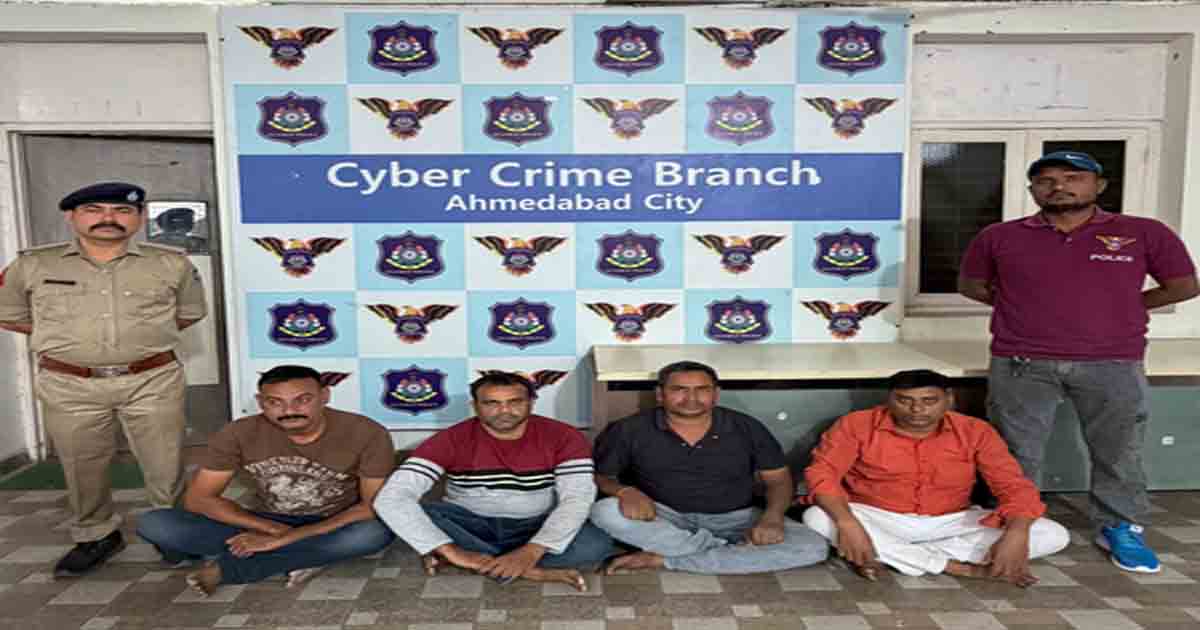
The Ahmedabad City Cyber Crime Branch of Gujarat has arrested four members of an alleged inter-state cyber fraud gang from Mumbai for diverting a business payment of Rs 6.55 lakh through email spoofing by impersonating the owner of a company and sending forged bank account details.
The accused allegedly hacked into email communications between Global Pantry Grocery Company and Maya Agrovet Limited, altered the email ID of the latter’s owner and sent a forged letter bearing Yes Bank’s letterhead, stamp and signature to divert a payment of Rs 6,55,111 into a fraudulent bank account.
According to the complaint, the fraud was committed before August 26, when the accused allegedly gained unauthorised access to the computer systems of one of the two companies and entered their email correspondence relating to business transactions.
They changed the email ID of Maya Agrovet Limited’s owner from ahgandhi.vishal@gmail.com to ahgandhi.vishal63@gmail.com and added two other email IDs, gatewayserv@yahoo.com and veertrdws@gmail.com, to the correspondence.
The accused then allegedly sent an email from the altered address containing a forged letter on Yes Bank letterhead.
The document mentioned the account personal name as MAYA AGROVET LIMITED and the registered account name as R K ENTERPRISES. It also carried a purported bank stamp and signature.
The complainant company was consequently induced to transfer Rs 6,55,111, which was due to Maya Agrovet Limited, into the account mentioned in the letter.
An FIR was registered on November 14 at the Cyber Crime Police Station under relevant provisions of the Bharatiya Nyaya Sanhita, 2023, and the Information Technology Act.
Police Inspector B N Patel and his team used technical analysis and human intelligence to identify the alleged perpetrators.
The team subsequently travelled to Mumbai and arrested four accused. Further investigation is underway to identify and trace other persons allegedly involved in the fraud.
The arrested accused have been identified as Ravindrakumar Kashyap, 42, Mohammad Riyaz Ansari, 38, Kamlesh Singh, 41, and Zulfikar Ali Siddiqui, 47. All four were residing in different localities of Nalasopara and Virar in Maharashtra’s Palghar district.
Kashyap is originally from Basti district and Singh from Prayagraj district in Uttar Pradesh. According to the police, Kashyap allegedly provided seven bank accounts to Riyaz, into which the fraud proceeds were deposited.
He withdrew the money and handed it over to Riyaz in return for a commission. Riyaz allegedly passed the bank accounts and withdrawn cash to Kamlesh, also receiving a commission.
Kamlesh allegedly arranged documents required to open the bank accounts, including shop-related papers, banners, firm registration documents and stamps, with the assistance of other accused.
He also allegedly supplied the accounts and cash to his associates in return for commissions. Siddiqui allegedly facilitated the depositing of the fraud proceeds into the bank accounts on the instructions of a co-accused and received a commission.
Police said he had previously been jailed in an NDPS case.
The four have been booked under Sections 54, 61(2)(a), 318(4), 319(2), 336(2), 336(3), 338 and 340(2) of the Bharatiya Nyaya Sanhita, along with Sections 43(a), 43(c), 43(i), 66, 66C and 66D of the Information Technology Act.

A specially designated Fast Track Court at the Rouse Avenue Courts Complex in Delhi on Saturday framed charges against all 14 accused in the National Eligibility-cum-Entrance Test (Undergraduate) (NEET-UG) 2026 question paper leak case, with all of them pleading not guilty and expressing their willingness to face trial.
The accused appeared before the Fast Track Court, constituted to deal with offences under the Public Examinations (Prevention of Unfair Means) Act, 2024, denied the charges framed against them and opted to contest the case on merits.
The court directed that the day-to-day trial proceedings against the accused will commence from November 25.
The accused against whom charges have been framed include Yash Yadav, Mangilal Biwal, Dinesh Biwal, Vikas Biwal, Shubham Khairnar, Dhananjay Lokhande, Prahlad Vithalrao Kulkarni, Tejas Harshad Kumar, Manoj Shirure, Shivraj Raghunath Motegaonkar, Manisha Waghmare, Manisha Mandhare and Manisha Sanjay Hawaldar.
The case relates to the alleged leakage of confidential question papers ahead of the NEET-UG 2026 examination, held on May 3 and subsequently cancelled following the paper leak controversy.
The Central Bureau of Investigation (CBI) filed a charge sheet against the 13 accused on July 28, alleging that the question papers were leaked through a network involving National Testing Agency (NTA) subject experts, intermediaries, coaching operators and others.
According to the probe agency, three NTA subject experts entrusted with translating, back-translating and proofreading the question papers allegedly took confidential examination questions out of the NTA’s office in Delhi by exploiting security lapses.
The CBI claimed that one of the accused, P.V. Kulkarni, wrote down all 135 Chemistry questions, along with their answer options, on small slips of paper and concealed them while leaving the confidential section.
The agency also flagged shortcomings in CCTV surveillance at the NTA office, saying that only 20-25 days of CCTV backup were available and that there was no dedicated control room to monitor the live feed from the confidential section.
The charge sheet against the 13 accused cited 360 witnesses, 422 documents and 43 material objects in support of the prosecution’s case.
The accused have been charged under various provisions of the Bharatiya Nyaya Sanhita (BNS), the Prevention of Corruption Act and the Public Examinations (Prevention of Unfair Means) Act, 2024.
The CBI subsequently filed a supplementary charge sheet against Sheshrao Bajrang Suryavanshi, the 14th accused arrested in the case, before the special court in October.
The probe agency claimed that Suryavanshi was linked to another accused, Shubham Khairnar, a career counsellor arrested in Maharashtra’s Nashik, for allegedly circulating the question paper on social media.
The CBI registered the case on May 12 following a complaint from the Department of Higher Education under the Union Ministry of Education over alleged irregularities and leakage of confidential NEET-UG question papers.
The original examination was cancelled, and a re-examination was conducted on June 21 under heightened security arrangements.

Elderly man in Pune loses Rs 5 lakh in digital arrest scam

Powai Police Hand Over 10-Year-Old Boy to His Parents; DCP Datta Nalawade Praises Police for Their Humanity and Efforts.

Shiv Sena Organises a Blood Donation Drive in Mumbai.

Gujarat Police bust inter-state ’email spoofing’ racket, arrest four in Mumbai

Saudi-led coalition intercepts Houthi ballistic missiles targeting Riyadh

Congress trying to protect 3 crore Bangladeshi infiltrators in voter list: HM Shah

Red Fort car blast probe exposes blueprint for spread of terror modules across India

Trump flags Iran targets as talks continue

‘Conspiracy, not accident’: NCP on Ajit Pawar death

BJP, Shiv Sena slam Mallikarjun Kharge for terming Diwali ‘Khushiyon ka Eid’
-

 Crime4 years ago
Class 10 student jumps to death in Jaipur
-

 Maharashtra2 years ago
Mumbai Local Train Update: Central Railway’s New Timetable Comes Into Effect; Check Full List Of Revised Timings & Stations
-

 Maharashtra2 years ago
Mumbai To Go Toll-Free Tonight! Maharashtra Govt Announces Complete Toll Waiver For Light Motor Vehicles At All 5 Entry Points Of City
-

 Maharashtra2 years ago
False photo of Imtiaz Jaleel’s rally, exposing the fooling conspiracy
-

 National News2 years ago
Ministry of Railways rolls out Special Drive 4.0 with focus on digitisation, cleanliness, inclusiveness and grievance redressal
-

 Maharashtra2 years ago
Maharashtra Elections 2024: Mumbai Metro & BEST Services Extended Till Midnight On Voting Day
-

 National News2 years ago
J&K: 4 Jawans Killed, 28 Injured After Bus Carrying BSF Personnel For Poll Duty Falls Into Gorge In Budgam; Terrifying Visuals Surface
-

 Crime2 years ago
Baba Siddique Murder: Mumbai Police Unable To Get Lawrence Bishnoi Custody Due To Home Ministry Order, Says Report