
Maharashtra
Concreting of roads, cleaning of drains should be continuously inspected till monsoon works are completed properly: Mayor Ritu Tawde

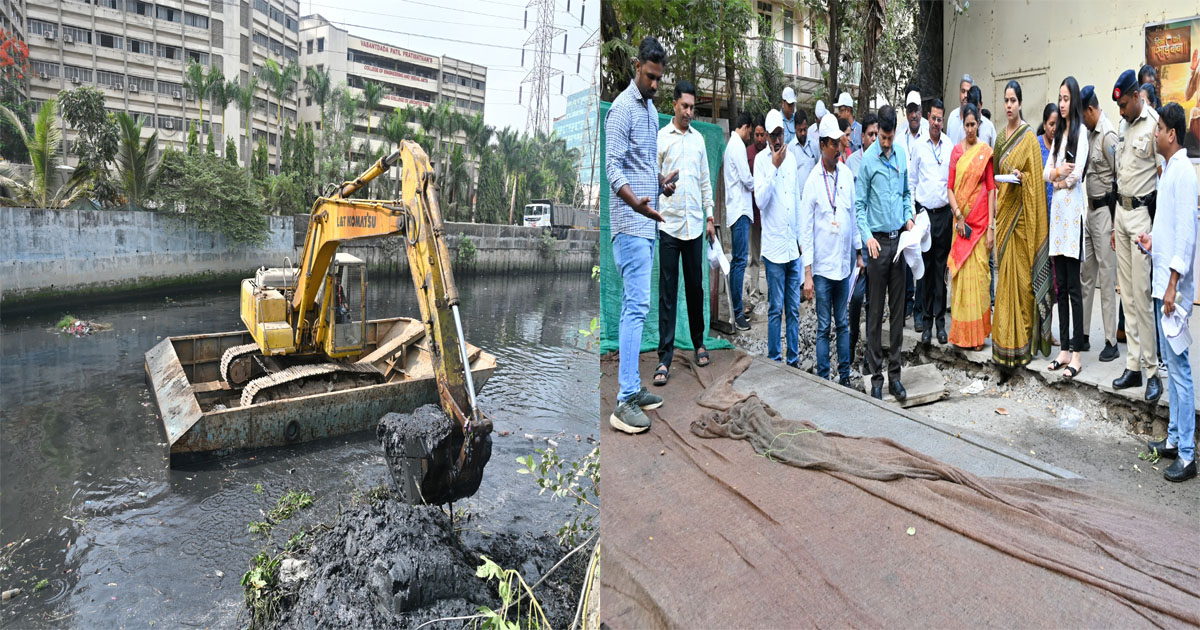
Mumbai: Pre-monsoon works are in full swing in Mumbai (Mumbai city and suburbs). However, until these works are completed properly and on time, we will continue to inspect concreting of roads, removal of silt from drains and other works, said Mumbai Mayor Ritu Tawde. At the same time, Mayor Tawde has directed the administration to work very diligently in relation to roads, drains and water. Along with the roads of Chembur, Mayor Ritu Tawde inspected the silt removal works in the drain and Mithi river this morning (May 2, 2026). M-West Ward Committee President Asha Marathe, L-Ward Committee President Vijayendra Shinde, F-South and F-North Ward Committee President Mansi Satmkar, Corporator Mrs.
Sakshi Kanojia, Corporator Kshish Phulwaria, Deputy Commissioner (Zone 5) Mrs. Scindia Nanded, Assistant Commissioner West, B-West Commissioner Scindia Shankar, Sakshi Kanojia. (L Division) Dhanji Harlekar, Chief Engineer (Roads) Mantaya Swamy, Deputy Chief Engineer (Storm Water Channels) Sunil Russell, Sunil Karjatkar and concerned officers were present.
Mayor Ritu Tawde initially inspected the works. The Mayor inspected Road No. 21 and 11 in Babasaheb Ambedkar Udyan area. The quality of road work, condition of various utility channels, trees along the road and water drainage system were inspected very closely. Besides, to check the quality of footpath construction, he has arranged a basic test to check the cement, concreting, iron used in it, nets etc.
Talking to the media during the visit, Mayor Tawde said that the Municipal Corporation has implemented the cement concreting project of roads in Mumbai as a long-term initiative. The road work is going on at a fast pace. The administration has been instructed to complete these works before the monsoon.
However, there should be no delay in the construction and maintenance of the quality of roads while increasing the pace of work. The completed roads and their water drainage pipes should be cleaned thoroughly. So that water does not get mixed in the cement and the pipes do not get blocked. Water should not be allowed to accumulate on the roadside. Along with this, Tawde directed that care should be taken that no tree is affected by cement concrete.
Meanwhile, while inspecting the roads in Chembur, the Mayor also interacted with the local citizens. The citizens expressed satisfaction with the road work and thanked the Mayor, public representatives and the administration.
After inspecting the roads, Mayor Tawde inspected the sludge removal works at three places – Mahol Nallah in ‘L’ section, JK Chemical Nallah in ‘F North’ section and Methi Nadi. Regarding the cleaning of drains, Mayor Tawde said that the target is to remove 8.28 lakh metric tonnes of sludge from drains before the monsoon this year. Out of this, about 45% or 3.76 lakh metric tonnes of sludge has been removed by May 1, 2026. The garbage removal work should be expedited and it should be ensured that all drains are free from sludge before the monsoon. Where necessary, protective walls should be constructed along the drains. CCTV monitoring facilities should be provided so that the administration and local public representatives can also see the actual status of the drain cleaning work. It should be ensured that the wheels of vehicles carrying silt are washed before plying on the roads. Tawde also gave instructions so that the roads do not become unsafe due to mud.


Mumbai, Oct 9: The ED arrested two accused in fresh action against a trans-national organised narcotics trafficking syndicate operated by fugitive don Dawood Ibrahim’s aide Salim Ismail Dola and his associates, an official said on Friday.
The Enforcement Directorate (ED), Mumbai Zonal Office, arrested Pravin alias Nagesh Ramchandra Shinde and Brijesh Kanjibhai Moradiya under Section 19 of the Prevention of Money Laundering Act (PMLA), 2002.
The ED investigation was initiated based on multiple FIRs registered by various law enforcement agencies in Mumbai against Salim Dola and others for offences relating to illicit trafficking of narcotic drugs and psychotropic substances.
The investigation conducted so far has revealed the existence of a highly organised trans-national criminal network engaged in procurement of precursor chemicals, clandestine manufacture of Mephedrone (MD), interstate transportation and distribution of narcotic drugs, international trafficking of narcotic substances, collection and layering of proceeds of crime through hawala channels, and acquisition of movable and immovable assets in the names of associates and other persons, the ED said in a statement.
Investigation revealed that Pravin alias Nagesh Ramchandra Shinde was involved in the illegal clandestine manufacturing of MD and in activities connected with generation, handling, possession, utilisation and movement of proceeds derived from illicit sale of the said narcotic substance, the ED said.
Investigation has further revealed that the illicit proceeds were used to acquire immovable properties and other assets in the names of persons closely associated with him, it said.
The investigation also revealed that Brijesh Moradiya was involved in arranging the procurement and supply of the precursor chemical used for the illicit manufacture of MD.
The cash received from Salim Dola through the Angadiya channel for procuring the precursor chemical was deposited and routed through multiple third-party/family accounts and entities controlled/arranged by him and his associates, then transferred through the banking channel to various chemical companies/entities, thereby facilitating procurement of the precursor chemical.
Simultaneously, amounts involved in these transactions were received by Brijesh Moradiya and his associates/family accounts in the guise of commission from the sale of the chemical and the same were thereafter further transferred, layered and utilised.
The ED had earlier conducted search operations at 21 locations across Mumbai, Surat, Ankleshwar and Rajkot on June 2, 2026 and June 3, 2026 in this case and had covered the entire spectrum of the organised narcotics network of Salim Dola targeting end-to-end nodes of the syndicate including precursor chemical suppliers, chemical traders, manufacturers/distributors of the synthetic narcotic drug Mephedrone (MD), Hawala Operators and persons holding benami properties worth crores of rupees acquired from proceeds generated through the organised drug syndicate.
The searches resulted in the seizure and freezing of cash, foreign currency, gold bars, and bank balances valued at Rs 1.33 crore (approx.), along with $2,200. Additionally, documents relating to immovable properties worth several crores of rupees located in India and Dubai were recovered, indicating substantial investments made from the proceeds of the organised drug syndicate, the statement said.
Maharashtra
Fadnavis criticises Congress on SIR; releases parliamentary footage of Kapil Sibal defending process


Mumbai, Oct 9: Maharashtra Chief Minister, Devendra Fadnavis, on Friday delivered a scathing rebuttal to the Congress party as high-octane protests led by Leader of the Opposition in the Lok Sabha, Rahul Gandhi, and Congress MP Priyanka Gandhi against the Election Commission and the Special Intensive Revision (SIR) process brought central Delhi to a standstill.
Taking to social media, CM Fadnavis released archival parliamentary footage of former Union Law Minister Kapil Sibal speaking in official support of the SIR framework during the Congress-led UPA tenure.
The clip—which has rapidly gone viral—directly counters the Opposition’s current claims that the voter roll revision is a “conspiracy” or an unconstitutional procedure. The Opposition parties have alleged that over 13 crore names have allegedly been left out in the draft poll rolls and has been protesting against it.
In his direct hit at the Congress leadership, CM Fadnavis highlighted the stark contrast between the party’s historic stance and its current street demonstrations.
“Congress is busy shouting against SIR from every possible stage, only to have its own former Law Minister Kapil Sibal’s words come back to expose the drama. The Parliament record doesn’t change with political convenience. Perhaps Congress should first check their own history before manufacturing new conspiracy theories. Sometimes, the best rebuttal comes from your own party’s past!”
CM Fadnavis captioned the video as ‘Congress’ double standards’, urging citizens to listen to official parliamentary proceedings from the UPA era and judge who is telling the truth.
The video shared by the Chief Minister shows then-Law Minister Kapil Sibal explaining the three precise categories under which the SIR process removes or updates names on the voter list. “Deletion of duplicate entries take place when a voter shifts from one constituency to another, followed by seamless re-registration at the new address. Also during updating old electoral rolls during boundary reorganisations. There will be routine deletion of names of deceased individuals upon verification,” said the former law minister in the video.
In the footage, Sibal emphasised that no legitimate voter could be barred by registration officers, noting that millions of citizens routinely applied for inclusion under established statutory provisions.
The video comes at a sensitive moment as Congress leaders Rahul Gandhi and Priyanka Gandhi Vadra lead sustained street demonstrations demanding the halting of the SIR process and the resignation of Chief Election Commissioner Gyanesh Kumar over what they claim is the disenfranchisement of 13 crore people during the recent SIR process.
The protests near Jantar Mantar and Election Commission headquarters have seen tense scuffles with law enforcement, leading to police complaints and political trade-offs.
BJP leaders have rallied around CM Fadnavis’s statement, asserting that the Opposition is attempting to manufacture a non-existent controversy over a standard voter roll hygiene drive that their own government previously endorsed and defended on the floor of Parliament.
The CM’s comments come a day after the Office of the Chief Electoral Officer (CEO), Maharashtra, in a major push to ensure maximum voter participation and clean electoral rolls, has launched targeted registration drives and door-to-door verification campaigns across the state.
Operating under the guidelines of the ECI, election authorities have committed to ensuring that no eligible citizen is left off the electoral roll and no ineligible entries remain. The extensive outreach forms a crucial leg of the ongoing SIR process.
Special voter registration camps have been conducted across all colleges and universities in Maharashtra from October 5 to October 9. Booth Level Officers (BLOs) are deployed at campus sites to assist eligible students with completing application forms and to resolve queries regarding the SIR workflow, said the Office of the Chief Electoral Officer (CEO), Maharashtra release.
BLOs are conducting home visits to identify eligible citizens missing from the Draft Electoral Roll and collect Form 6 following verification. For residents unavailable during home visits, special voter registration camps will be held at all designated polling stations on October 10 and October 11, 2026.
Citizens whose names appear on the list of absent or migrated voters (compiled during house-to-house enumeration) can apply for re-enrolment or correction. The official list of absent/shifted voters has been published online at ceoelection.maharashtra.gov.in for public verification.
Mumbai, Oct 8: The Enforcement Directorate (ED) attached immovable properties in Mumbai, Pune and Raigad (Maharashtra) worth Rs 567.45 crore in connection with a Rs 48,000 crore collective investment scheme operated by Pearls Agrotech Corporation Limited (PACL) for development of farm land, an official said on Thursday.
The PACL’s properties were attached by ED’s Delhi Zonal Office under the provisions of the Prevention of Money Laundering Act (PMLA), 2002.
The ED has attached 48 immovable properties held in the names of Prateek Kumar, Ansh Prateek Kumar, and entities namely Beaming Infradevelopers, Ganraj Properties, and Greenfield Estates Limited, having a current market value of Rs 567.45 crore.
With this attachment, the ED has so far attached movable and immovable properties worth around Rs 30,235.21 crore, including assets located in India and abroad.
The ED’s investigation was initiated on the basis of an FIR registered by the Central Bureau of Investigation (CBI) in New Delhi under Sections 120-B and 420 of the Indian Penal Code, 1860, dealing with conspiracy and cheating.
Subsequently, the CBI filed a charge sheet and a supplementary charge sheet against 33 accused for their role in running an illegal investment scheme.
According to the charge sheets, the accused entities and individuals operated a massive illegal collective investment scheme, fraudulently mobilising more than Rs 48,000 crore from lakhs of investors across India under the pretext of sale and development of agricultural land.
Investors were induced to invest through cash down payment and instalment payment plans and were made to sign misleading documents such as agreements, powers of attorney and other instruments.
“In most cases, land was never delivered, resulting in unpaid investor dues of around Rs 48,000 crore,” the ED said.
The ED recorded an Enforcement Case Information Report (ECIR) in the case in 2016 and filed a charge sheet in 2018, followed by six supplementary charge sheets in 2022, 2025 and 2026 against the various accused.
“Prateek Kumar was arraigned as an accused (A-13) in the First Supplementary charge sheet dated August 20, 2022, filed in the case immediately, where cognisance was taken by the Special Court vide order dated September 19, 2022,” the ED added.
Subsequently, an open-ended Non-Bailable Warrant (NBW) was issued against Prateek Kumar by the Special Court on April 9, 2025.
These entities are beneficially owned and controlled by Prateek Kumar.
The investigation revealed that these immovable properties were purchased using funds diverted from PACL, which had originally collected money from gullible investors, thereby constituting proceeds of crime.

‘Mobocracy got a reply from democracy’, says BJP amid party’s resounding victory in bypolls

‘No one can stop the youth’: Chirag Paswan on train cancellations for CJP protest

Nepal: School bus plunges off road, kills five in Pokhara

As bypoll results largely favour ruling parties, BJP pulls a surprise in Bengal Rejinagar

Govt disconnects over 82 lakh fraudulent mobile connections via ASTR

Gift to President Putin part of PM Modi bid to globally display India’s heritage

PM Modi’s warm camaraderie with Putin, Xi on full display at BRICS Summit

INDIA bloc begins protest march against ECI

Complaint against Netflix & Mukesh Chhabra for inappropriate language on ‘India’s Got Latent 2’

Maha Congress stages agitation against Gyanesh Kumar
-

 Crime4 years ago
Class 10 student jumps to death in Jaipur
-

 Maharashtra2 years ago
Mumbai Local Train Update: Central Railway’s New Timetable Comes Into Effect; Check Full List Of Revised Timings & Stations
-

 Maharashtra2 years ago
Mumbai To Go Toll-Free Tonight! Maharashtra Govt Announces Complete Toll Waiver For Light Motor Vehicles At All 5 Entry Points Of City
-

 Maharashtra2 years ago
False photo of Imtiaz Jaleel’s rally, exposing the fooling conspiracy
-

 National News2 years ago
Ministry of Railways rolls out Special Drive 4.0 with focus on digitisation, cleanliness, inclusiveness and grievance redressal
-

 Maharashtra2 years ago
Maharashtra Elections 2024: Mumbai Metro & BEST Services Extended Till Midnight On Voting Day
-

 National News2 years ago
J&K: 4 Jawans Killed, 28 Injured After Bus Carrying BSF Personnel For Poll Duty Falls Into Gorge In Budgam; Terrifying Visuals Surface
-

 Crime2 years ago
Baba Siddique Murder: Mumbai Police Unable To Get Lawrence Bishnoi Custody Due To Home Ministry Order, Says Report