
Crime
Bihar: Fear grips Revenue Dept after Dy CM’s crackdown

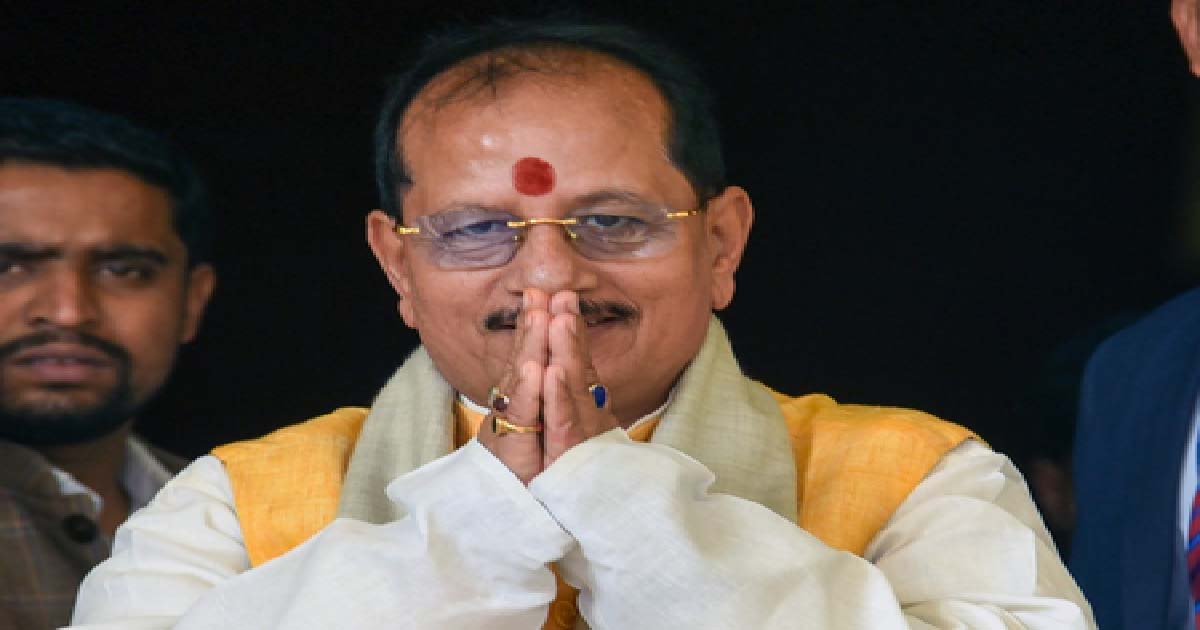
Patna, Dec 30: A stir has been created in the Bihar Revenue and Land Reforms Department following strict action initiated by Deputy Chief Minister and Revenue and Land Reforms Minister Vijay Kumar Sinha.
The situation has escalated to the extent that some officials, fearing action, have written to the Governor and Chief Minister Nitish Kumar, seeking intervention.
However, Vijay Kumar Sinha has categorically stated that he will not bow to any pressure.
Responding to the unrest and resentment among officials, the Deputy Chief Minister, on Tuesday, said that the government is working solely in the interest of the people and has no intention of hurting anyone.
“Our intentions are absolutely clear. The objective is to reform the Revenue and Land Reforms Department so that it serves the public better,” he said.
Referring to the Muzaffarpur land scam, Vijay Sinha said that agricultural land was illegally transferred with the connivance of officials.
He recalled that during his tenure as Agriculture Minister, he had ordered action against the Circle Officer (CO) involved and directed that an appeal be filed in court.
“I have now taken fresh cognisance of the matter as Revenue Minister, and those responsible for creating unnecessary disputes over undisputed government land will not be spared,” Sinha said.
On officials going on leave during public interaction programs of the Revenue and Land Reforms Department in districts, Vijay Sinha said, “Once systemic reforms are implemented, the welfare of everyone—including honest officials—will be ensured.”
After assuming charge of the Revenue and Land Reforms Department, Vijay Kumar Sinha is in action mode.
He has been taking meetings of the department district-wise and making decisions on the spot.
Responding to a question on Naxalism, Deputy Chief Minister Vijay Kumar Sinha said that under the leadership of Union Home Minister Amit Shah, Naxalism has been almost completely eradicated from the country.
He added that if governance under such leadership is ensured across all states, the menace of Naxalism and extremism would be eliminated.



In a matter related to fugitive don Dawood Ibrahim’s brother, the Enforcement Directorate (ED) lodged an FIR seeking action against miscreants who trespassed a Thane flat that was attached earlier in connection with an extortion case registered against Iqbal Ibrahim Kaskar, an officials said on Friday.
The flat was attached by the ED in 2022 during money laundering investigation in a case relating to extortion by accused Iqbal Kaskar, younger brother of underworld don Dawood, who is suspected to be in Pakistan, the official said in a statement.
The FIR was filed as a deterrent action against miscreants for trespassing the “confirmed attached properties” in the possession of the ED’s Mumbai Zonal Office-I, it said.
“The FIR was lodged on October 15 after restoring the possession of a flat in Thane (West) under the provisions of the Prevention of Money Laundering Act (PMLA), 2002,” the ED said.
“In respect of the alleged unauthorised entry and interference with the attached property, an FIR dated October 15 has been registered at Kasarvadavali Police Station in Thane under Sections 329(4) and 223 of the Bharatiya Nyaya Sanhita, 2023, so that the matter is investigated and trespassers are punished,” the ED added.
The property was provisionally attached vide provisional attachment order dated April 8, 2022, during money laundering investigation in the extortion case against Iqbal Kaskar and others, it said.
The provisional attachment was subsequently confirmed by the Adjudicating Authority under Section 8(3) of the PMLA vide order dated September 29, 2022, and possession of the flat was also taken by the ED on December 17, 2024, under Section 8(4) of the PMLA, the statement said.
The ED investigation was initiated on the basis of FIR registered at Kasarvadavali Police Station in Thane, concerning allegations of extortion against, inter alia, Iqbal Kaskar, Mumtaz Azaz Sheikh alias Raju, Israr Ali Jamil Saiyad and others.
During investigation, it was revealed that pursuant to threats and extortion, flats were demanded to be registered in favour of or at the instance of the accused persons, the ED said.
In this context, Flat No. 405 was registered in the name of Mumtaz Azaz Sheikh on May 29, the ED said.
It came to notice that some people had entered the property, broken the lock and removed the ED’s possession notice, the statement said.
The ED conducted inspections and took necessary steps to safeguard the attached property.
The matter was also placed before the Special PMLA Court, which also directed the ED to restore the possession with police assistance, if required.
In compliance and also to safeguard the property, the lock of said flat was changed in presence of police personnel and witnesses and the possession of the said flat was restored, the ED said.
A fresh notice was also affixed on the premises clearly mentioning that any aggrieved person may either approach the office of the ED or the court where the trial of the case is being conducted, it added.
The Enforcement Directorate (ED) has provisionally attached an immovable property spread over approximately 14.51 acres in Kolkata valued at Rs 85.20 crore, in connection with a bank fraud and money laundering case involving M/s Unity Infraprojects Ltd. (UIL) and others, the agency said on Friday.
According to the ED, the attached land, located at Mouza Chakgaria in Kolkata, is held in the name of M/s Suburban Agriculture Dairy & Fisheries Pvt. Ltd. (SADAFPL). The attachment was made under the provisions of the Prevention of Money Laundering Act (PMLA), 2002.
The money laundering investigation stems from an FIR registered by the CBI’s Bank Securities & Fraud Branch in Mumbai on a complaint lodged by the State Bank of India.
The FIR alleges that UIL, in connivance with its promoters, directors and associated entities, defrauded a consortium of 23 banks by availing credit facilities of around Rs 3,200 crore. The total outstanding dues, including interest, are estimated at approximately Rs 3,800 crore.
According to investigators, the fraud involved fictitious transactions, round-tripping of funds, manipulation of financial records, and diversion of funds through shell entities.
The ED said its probe revealed that funds from UIL were routed through its wholly owned subsidiary, Unity Realty & Developers Ltd. (URDL), and subsequently used to acquire and hold assets through associated companies. SADAFPL was identified as a step-down subsidiary of UIL through URDL.
Further investigations established a trail linking the Chakgaria land parcel to funds originating from UIL and its group entities, indicating diversion and layering of proceeds generated from the scheduled offences. The property was attached under Section 5(1) of the PMLA to prevent its transfer or disposal pending confiscation proceedings.
The agency noted that in July 2025 it had conducted searches at residential and commercial premises, as well as bank lockers, linked to UIL, its former directors and their family members. During those operations, movable assets worth Rs 31.21 crore were seized or frozen.
The ED had also attached land parcels and flats valued at about Rs 1,493 crore through three separate provisional attachment orders, all of which were later confirmed by the Adjudicating Authority under the PMLA.
With the latest attachment, the total value of movable and immovable assets attached or frozen in the case has risen to about Rs 1,609 crore, the agency said.
The ED further informed that it filed a prosecution complaint before the Designated Special Court, City Civil and Sessions Court, Greater Bombay, Mumbai, on March 27, 2026.
Further investigation is underway.

The ED conducted search operations at half a dozen premises, including offices and residential properties, in Mumbai and Delhi and a farmhouse in Maharashtra in connection with the illegal receipt of foreign exchange from Dubai and Singapore by Mega Millennium Private Limited, an official said on Friday.
The Enforcement Directorate (ED) conducted the searches under the provisions of the Prevention of Money Laundering Act (PMLA), 2002, the official said in a statement.
Apart from inspecting digital devices and incriminating documents related to Mega Millennium Private Limited, the investigators also conducted searches at a farmhouse in Karjat, Maharashtra, the ED said.
Foreign currency, Indian currency and valuables worth several crores of rupees were also detected by the ED during the search operation, said an official.
The focus of the ED’s search operation was on Harish Dedhiya, a Mumbai-based consultant and director of the company, the statement said.
The company and its directors, including Dedhiya and his wife Dhara Dedhiya, have received large sums of foreign exchange from suspicious companies based in Dubai and Singapore, the ED said.
The ED investigation indicated that Dedhiya incorporated companies by appointing his own employees/dummies as Directors. Within a year of incorporation, these companies received hundreds of crores of rupees, which were layered through multiple shell entities, the ED said.
In a separate case in Maharashtra, the ED conducted search operations at 10 premises, including hospital/IVF centres, located in Thane, Baramati and Nashik and seized digital evidence and Rs 29 lakh in cash during the investigation in a human egg extraction racket, an official said.
The ED’s Mumbai Zonal Office-II conducted search operations on October 16 at the10 premises under the provisions of the Prevention of Money Laundering Act (PMLA), 2002.
The ED investigation was initiated based on an FIR and a subsequent chargesheet filed by Badlapur (East) Police Station, Thane, Maharashtra, alleging offences of cheating and forgery under the Bharatiya Nyaya Sanhita (BNS), 2023, and violations of the Assisted Reproductive Technology (Regulation) Act, 2021, and the Drugs and Cosmetics Act, 1940, by Manjusha Wankhede and 16 others, the ED said in a statement.
The case pertains to an organised network involved in recruiting financially vulnerable women for human egg donation and supplying them to various IVF centres and Assisted Reproductive Technology (ART) banks through donor-supply agents operating under different proprietorship concerns, the agency said.

Action under the ‘Pedestrian First’ initiative by the ‘G-North’ ward of the Mumbai Municipal Corporation

ED files FIR, foils bid to trespass flat attached in extortion case against Dawood’s brother

ED attaches Rs 85.2 crore Kolkata land linked to Unity Infraprojects bank fraud case

Left parties, student groups march towards EC HQ, demand Gyanesh Kumar resignation

Maha: Raj Thackeray demands impartial probe in Rs 500 crore audio clip row

Rahul, Cong ecosystem want to force regime change: BJP after Neha Bora praises B’desh Gen-Z protest

BJP pays tribute to ex-President Abdul Kalam, recalls his enduring influence on generations of India’s youth

Attack on democratic rights: INDIA Bloc leaders on detentions of anti-ECI protestors

INDIA bloc begins protest march against ECI

Maha Congress stages agitation against Gyanesh Kumar
-

 Crime4 years ago
Class 10 student jumps to death in Jaipur
-

 Maharashtra2 years ago
Mumbai Local Train Update: Central Railway’s New Timetable Comes Into Effect; Check Full List Of Revised Timings & Stations
-

 Maharashtra2 years ago
Mumbai To Go Toll-Free Tonight! Maharashtra Govt Announces Complete Toll Waiver For Light Motor Vehicles At All 5 Entry Points Of City
-

 Maharashtra2 years ago
False photo of Imtiaz Jaleel’s rally, exposing the fooling conspiracy
-

 National News2 years ago
Ministry of Railways rolls out Special Drive 4.0 with focus on digitisation, cleanliness, inclusiveness and grievance redressal
-

 Maharashtra2 years ago
Maharashtra Elections 2024: Mumbai Metro & BEST Services Extended Till Midnight On Voting Day
-

 National News2 years ago
J&K: 4 Jawans Killed, 28 Injured After Bus Carrying BSF Personnel For Poll Duty Falls Into Gorge In Budgam; Terrifying Visuals Surface
-

 Crime2 years ago
Baba Siddique Murder: Mumbai Police Unable To Get Lawrence Bishnoi Custody Due To Home Ministry Order, Says Report