
Business
Attention Mumbaikars! Petrol, Diesel Prices Hiked By ₹3 Amid Global Oil Crisis Due To Iran War; Check New Rates Here


Mumbai: Ending days of intense speculation, the Centre on Friday announced an immediate Rs 3 per litre hike in petrol and diesel prices across the country, marking the first revision in retail fuel rates in nearly four years. The revised prices came into effect immediately from Friday without any transition window. Along with petrol and diesel, the price of CNG was also increased by Rs 2, a move expected to have a wider impact on transportation and household expenses.
In Mumbai, petrol prices climbed to Rs 106.68 per litre after a hike of Rs 3.14, while diesel rates rose by Rs 3.11 to Rs 93.14 per litre. The increase is likely to hit daily commuters, cab and autorickshaw operators, and logistics businesses in the city, where fuel costs directly affect transportation fares and commodity prices.
Among the four major metro cities, Mumbai recorded one of the steepest hikes in petrol prices. In Delhi, petrol prices rose to Rs 97.77 per litre and diesel to Rs 90.67 per litre. Kolkata saw petrol prices increase to Rs 108.74 and diesel to Rs 95.13, while in Chennai, petrol now costs Rs 103.67 and diesel Rs 95.25 per litre.
The hike comes amid mounting pressure on state-run oil marketing companies due to rising global crude oil prices. Earlier in March, Indian Oil Corporation Limited (IOCL), Bharat Petroleum Corporation Limited (BPCL) and Hindustan Petroleum Corporation Limited (HPCL) had raised the prices of premium petrol and diesel, but rates for regular retail consumers had remained unchanged until now.
According to reports, the three oil companies were collectively absorbing losses of nearly Rs 1,600 crore daily as they continued purchasing crude oil at elevated international prices while avoiding a retail hike. The Centre had reportedly delayed revising fuel prices in an attempt to keep inflation under control, since fuel costs have a cascading impact on transportation, food and essential commodities.
The pressure intensified after conflict in West Asia pushed crude oil prices sharply higher in the global market. India’s crude basket, which averaged around USD 69 per barrel before the Iran conflict escalated in February, later surged to nearly USD 113-114 per barrel in subsequent months.
Earlier, Prime Minister Narendra Modi urged citizens to conserve fuel and adopt work-from-home practices wherever possible to reduce fuel consumption and ease pressure on India’s foreign exchange reserves. Supporting the appeal, Delhi Chief Minister Rekha Gupta announced a 90-day fuel conservation campaign and two days of work-from-home for government offices.


New Delhi, Oct 9: India has disconnected over 82 lakh fraudulent mobile connections through the Artificial Intelligence and Facial Recognition powered Telecom SIM Subscriber Verification (ASTR) tool, Union Minister of State for Communications and Rural Development Dr Chandra Sekhar Pemmasani said on Friday.
Addressing the International Telecommunication Union (ITU) Roundtable on “Implementing ITU Standards to Combat Fraudulent Communications” on the sidelines of the India Mobile Congress (IMC) 2026 here, the minister said the country has built a robust and layered defence mechanism against telecom-related fraud and cybercrime.
He noted that organised fraud networks are becoming increasingly sophisticated, with scams involving impersonation, so-called digital arrests, AI-generated voice cloning and deepfakes posing significant challenges. According to the minister, Indians lost more than Rs 22,800 crore to such fraud in 2024.
Dr Pemmasani said India has adopted a five-layered approach to tackle fraudulent communications. This includes real-time blocking of spoofed international calls, identification and disconnection of suspicious mobile connections through the ASTR platform, citizen participation via the Sanchar Saathi initiative, intelligence sharing through the Digital Intelligence Platform (DIP), and targeted action against emerging fraud channels.
Highlighting the impact of these initiatives, he said the Sanchar Saathi app has been downloaded around 25 million times, enabling citizens to actively participate in reporting suspected fraud and misuse of telecom resources.
The minister added that the Digital Intelligence Platform currently connects more than 1,600 organisations, including telecom service providers, banks and law-enforcement agencies, facilitating real-time information sharing to detect and prevent fraudulent activities.
He further said that the Financial Fraud Risk Indicator has helped avert suspected financial losses exceeding Rs 5,000 crore over the past 15 months by enabling timely intervention against fraudulent transactions.
Emphasising the need for international collaboration, Dr Pemmasani said fraud has become a global problem that requires coordinated global solutions.
He underscored the importance of adopting international standards for digital verification of caller identities across networks to curb cross-border fraud.
Welcoming the ITU’s proposal for joint trials among governments, regulators, telecom operators and technology companies, he said India is ready to participate and contribute to the development of global frameworks for trusted communications.
Business
Skill training institutes no less than IITs, IIMs: PM Modi urges youth to champion skill development

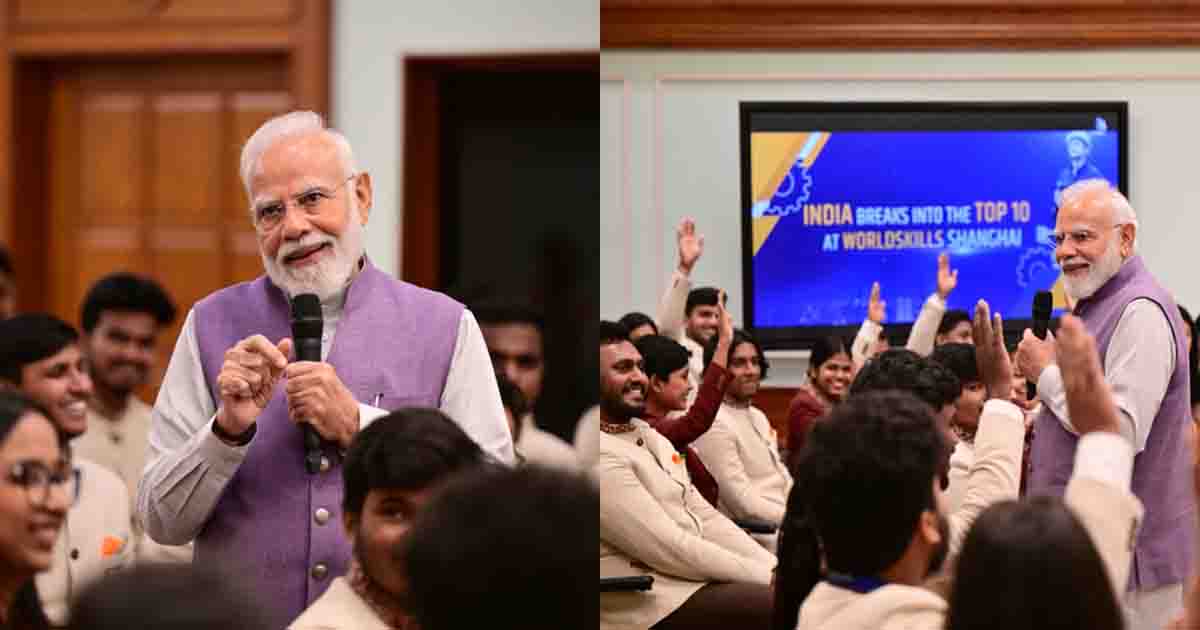
New Delhi, Oct 9: Prime Minister Narendra Modi on Friday met members of India’s contingent that delivered an impressive performance at the WorldSkills Competition Shanghai 2026, congratulating the young participants for showcasing their talent and skills on the global stage.
The interaction took place at the Prime Minister’s residence at 7, Lok Kalyan Marg, where PM Modi lauded the competitors for their achievements and encouraged them to continue excelling in their respective fields.
Sharing details of the meeting on social media, the Prime Minister praised the participants for their outstanding performance at the international skills competition and said it was a pleasure to interact with and motivate the young achievers.
The Prime Minister underlined the objective behind establishing a separate Ministry for Skill Development and said that the importance of skill training institutions is no less than that of IITs and IIMs. He encouraged the participants to share their experiences and suggestions with the government to help improve India’s skill training system.
India recorded its best-ever performance at the 48th WorldSkills Competition, held from September 22 to 27 at the National Exhibition and Convention Center (NECC) in Shanghai. The country secured six silver medals and 20 Medallions for Excellence, finishing 10th in the overall rankings.
The latest result marks a significant improvement from the previous edition of the competition held in France’s Lyon in 2024, where India finished 13th with four bronze medals and 12 Medallions for Excellence.
The improved ranking reflects the growing capabilities of India’s skilled workforce and its rising presence in global skills competitions.
According to the Ministry of Skill Development and Entrepreneurship, the six-day event brought together more than 1,400 young competitors from nearly 70 countries and regions.
India fielded its largest-ever contingent, comprising 70 competitors, who participated in 63 skill categories spanning emerging technologies, advanced manufacturing, engineering, creative industries and specialised services.
After four days of intense competition, winners were honoured during the closing ceremony held in Shanghai on September 27. The event celebrated excellence in technical expertise, innovation, precision and craftsmanship, drawing participants, industry leaders, experts and international delegations from across the world.
India’s participation in WorldSkills Shanghai 2026 was coordinated by the National Skill Development Corporation (NSDC) under the Ministry of Skill Development and Entrepreneurship, with support from Sector Skill Councils, industry partners, training institutions and technical experts.
New Delhi, Oct 9: PhonePe and the Digital Publisher Content Grievances Council (DPCGC), a self-regulatory body under the aegis of the Internet and Mobile Association of India (IAMAI), have announced the signing of a Memorandum of Understanding (MoU).
The partnership aims to facilitate seamless SRO certification for all merchants, champion regulatory compliance, and drive merchant education for all merchant partners onboarding on PhonePe’s Payment Gateway.
Under applicable Indian regulations, over-the-top (OTT) or Publishers of Online Curated Content (OCCPs) are legally required to be members of a recognised self-regulatory organisation (SRO) for grievance redressal.
Pioneering a compliance-first approach, PhonePe enforces this regulatory requirement as a mandatory prerequisite during its merchant onboarding process.
DPCGC is a Level II SRO formed under the IT Rules, 2021, which is registered with the Ministry of Information and Broadcasting.
Through the MoU, PhonePe and DPCGC aim to drive merchant education and awareness.
Recognising the limited awareness among OTT/OCCPs regarding SRO compliance, the joint initiative will educate both existing and prospective merchants on regulatory requirements and seamlessly facilitate their SRO certification through DPCGC.
The partnership further strengthens PhonePe’s position as a trusted, robust, and compliant payment partner tailored for the rapidly growing OTT ecosystem.
Dr. Subho Ray, President of IAMAI, said, “DPCGC, established under the IT Rules, is committed to efficiently addressing concerns and grievances related to OTT platforms through self-regulation.
This collaboration between DPCGC and PhonePe will foster greater alignment and adherence to the Code of Ethics, expanding the reach of self-regulation and strengthening its benefits for both the industry and its users.”
Deep Agrawal, Head of Payments at PhonePe, added, “At PhonePe, compliance and trust are at the core of everything we build. The OTT segment has exploded in terms of coverage and penetration over the last couple of years.
Agrawal further stated that our MoU with DPCGC will allow us to educate the OTT platforms to seamlessly drive higher awareness about customer grievance redressal, reinforcing PhonePe as the most trusted & compliant growth partner for India’s booming OTT ecosystem.”

‘No one can stop the youth’: Chirag Paswan on train cancellations for CJP protest

Nepal: School bus plunges off road, kills five in Pokhara

As bypoll results largely favour ruling parties, BJP pulls a surprise in Bengal Rejinagar

Govt disconnects over 82 lakh fraudulent mobile connections via ASTR

Demolition drive carried out in Delhi Seemapuri following building collapse

Gift to President Putin part of PM Modi bid to globally display India’s heritage

PM Modi’s warm camaraderie with Putin, Xi on full display at BRICS Summit

INDIA bloc begins protest march against ECI

Complaint against Netflix & Mukesh Chhabra for inappropriate language on ‘India’s Got Latent 2’

Maha Congress stages agitation against Gyanesh Kumar
-

 Crime4 years ago
Class 10 student jumps to death in Jaipur
-

 Maharashtra2 years ago
Mumbai Local Train Update: Central Railway’s New Timetable Comes Into Effect; Check Full List Of Revised Timings & Stations
-

 Maharashtra2 years ago
Mumbai To Go Toll-Free Tonight! Maharashtra Govt Announces Complete Toll Waiver For Light Motor Vehicles At All 5 Entry Points Of City
-

 Maharashtra2 years ago
False photo of Imtiaz Jaleel’s rally, exposing the fooling conspiracy
-

 National News2 years ago
Ministry of Railways rolls out Special Drive 4.0 with focus on digitisation, cleanliness, inclusiveness and grievance redressal
-

 Maharashtra2 years ago
Maharashtra Elections 2024: Mumbai Metro & BEST Services Extended Till Midnight On Voting Day
-

 National News2 years ago
J&K: 4 Jawans Killed, 28 Injured After Bus Carrying BSF Personnel For Poll Duty Falls Into Gorge In Budgam; Terrifying Visuals Surface
-

 Crime2 years ago
Baba Siddique Murder: Mumbai Police Unable To Get Lawrence Bishnoi Custody Due To Home Ministry Order, Says Report