
National News
2025 Delhi dangal: Congress vote share to determine AAP, BJP seat tally

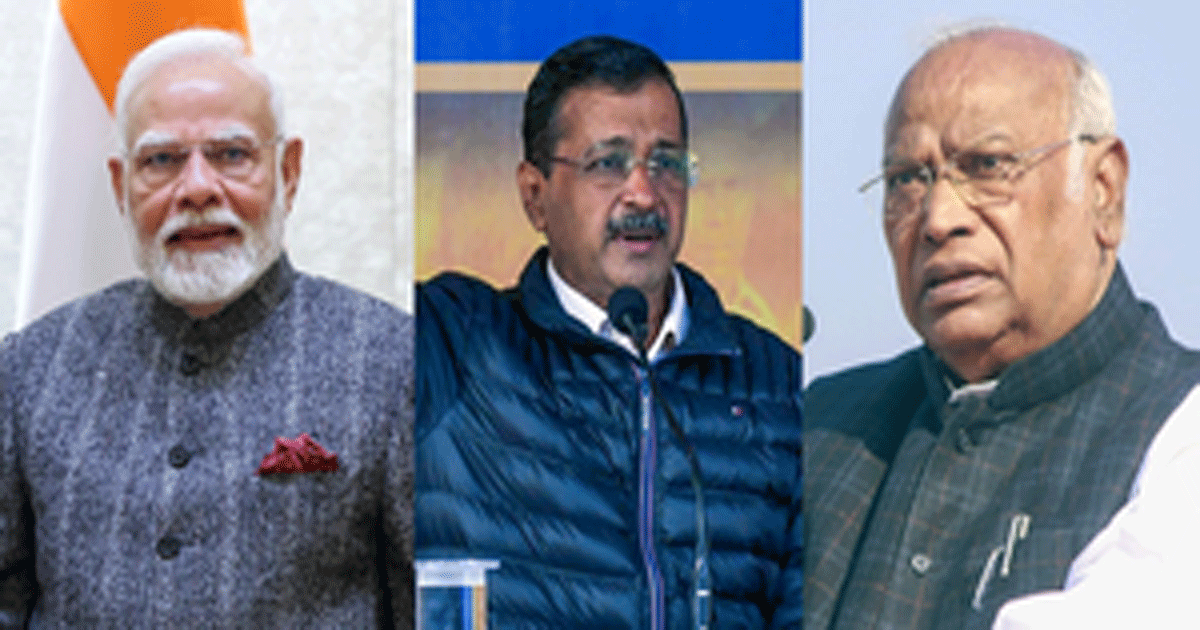
New Delhi, Jan 7: In the last two Assembly elections in Delhi in 2020 and 2015, voters overwhelmingly backed the AAP, giving it 53.6 per cent and 54.3 per cent vote share respectively, a comforting fact for the ruling party which is hoping to clock a decent number of seats even in the upcoming polls on February 5, despite the pressure mounted by the BJP and the Congress.
The belief in the AAP ranks is that even in the worst scenario, the drop in their vote share can never be so drastic that the party will be vanquished. They hope to continue being a force in Delhi politics.
As pollsters have indicated repeatedly, the BJP’s tally in Delhi Assembly elections, partially, depends on the Congress’ performance and its ability to cut into the AAP’s vote-bank that includes Muslims, slum dwellers, Purvanchalis and other residents of unauthorised colonies who vouch for former Delhi Chief Minister Arvind Kejriwal’s welfare schemes.
In 2020, the total turnout was 62.82 per cent and the AAP won 62 seats (vote share 53.6 per cent). The AAP won 67 seats in 2015.
The BJP won 8 seats in 2020 and 3 in 2015. The saffron party’s vote share in 2020 was 38.5 per cent. The Congress got a 4.26 per cent vote share in 2020.
In 2015, the total voter turnout was 67.47 per cent with the AAP’s vote share at 54.3 per cent, rising by 24.8 per cent from the previous outing in 2013, and its seats increased from 28 to 67, a gain of 39.
In the same election, the BJP’s vote share dipped by 0.8 per cent to 32.3 per cent and its seats reduced to 3 from 32 in 2013. The Congress vote share was 9.7 per cent, down 14.9 per cent, and it failed to open its tally – a loss of eight seats.
This election was a defining outing for the Congress which lost all its voters to the new outfit. The Congress’ loss of a vote share of 14.9 per cent was AAP’s gain.
The Modi Effect: Between 2015 and 2020 elections, the BJP’s vote share increased from 32.3 per cent to 38.5 per cent. The 2020 Assembly election was the first time that the BJP supporters, along with other voters in Delhi, were voting after seeing the performance of the Narendra Modi government at the Centre after a full tenure of five years.
Ahead of the 2015 elections, the Modi government was just one-year-old and Delhiites hadn’t seen his performance over a long period.
If previous results are any indication, the BJP support and vote share in the upcoming elections are likely to rise as voters are now aware of the ‘Modi Magic’ and his reputation to deliver on guarantees.
The possibility of Delhiites voting on Modi’s face value, just as voters did in Haryana and Maharashtra, is very high, especially, after the Prime Minister has guaranteed the continuation of all free welfare schemes being offered in the national Capital by the AAP and promising to make Delhi a global-level Capital.
Pollsters believe that if the AAP and the BJP promise the same free welfare services, the differentiating factor that might impact the voter decision could be the clean image of the top leaders of both the parties that is, Arvind Kejriwal for the AAP and PM Modi for the BJP.
“Such a Modi versus Kejriwal clash in Delhi could give an edge to the BJP due to the corruption allegations against the AAP leader,” said a political science teacher from Delhi University, cautioning that the BJP will have to counter Kejriwal’s ability to extract voter sympathy by claiming victimisation by the Centre and slapping of “false” corruption cases.
Voter turnout: A high voter turnout, a good performance by the Congress, in terms of vote share, and a restriction on bogus voting could still be the key factors that may influence the fate of both the AAP and the BJP in the upcoming elections.
An improved performance by the Congress may only keep the grand old party alive in the city where its identity is gradually getting eroded.
Among Delhi districts, the highest turnout in the 2015 Assembly elections was reported from North West at 68.58 per cent followed by Shahdara district at 65.81 per cent and 64.26 per cent in East district.
The high turnout in trans-Yamuna area, in a way, reflects the high expectations of the residents of unauthorised colonies and unplanned areas in terms of free water, power, health, sewer and roads – which the AAP has promised time and again.
The lowest turnout was in New Delhi district at 56.24 per cent, reflecting the voter apathy in more developed colonies whose residents already enjoy good infrastructure and, largely, are not eligible for free power and water. The district is home to constituencies like Patel Nagar, Delhi Cantonment, Rajender Nagar, New Delhi, R.K. Puram and Greater Kailash.


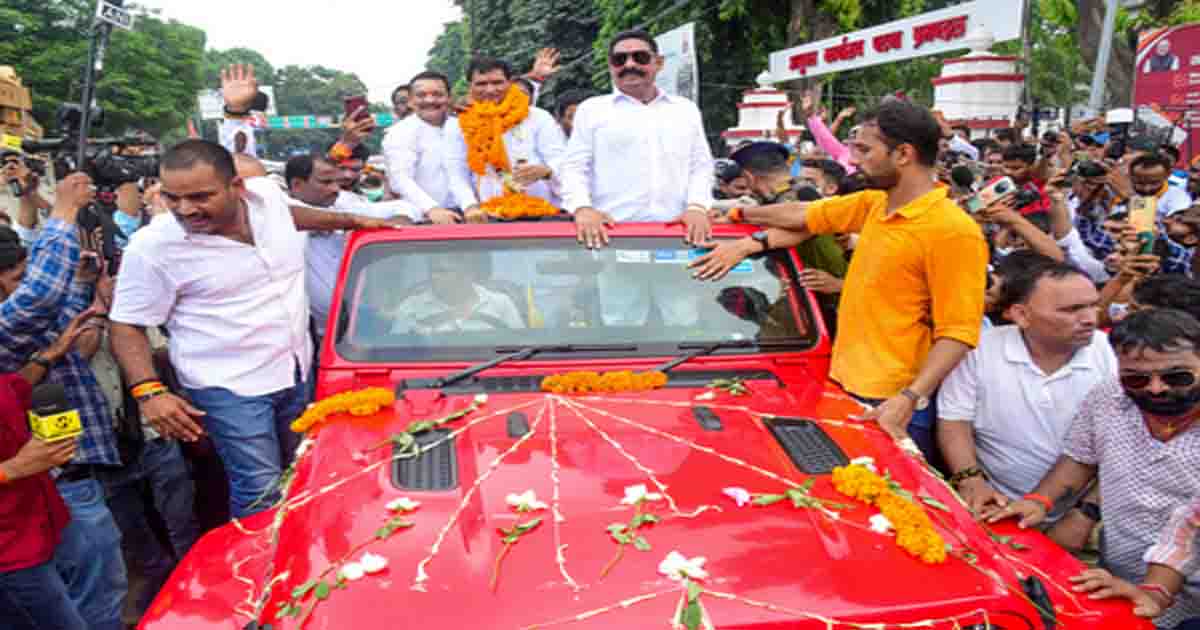
Amid campaigning for the biennial elections for eight MLC seats on October 23 in Bihar, police have registered three FIRs in connection with alleged violation of election rules during a roadshow in the Mokama Assembly constituency of Patna district.
The roadshow was held on Sunday. The cases have been registered against local MLA Anant Singh and Jan Suraaj candidate Anuj Singh, according to police sources.
Of the three cases, two were registered at Barh police station and one at Mokama police station in Patna district.
The police are investigating the alleged violations and examining the circumstances surrounding the roadshow.
According to police sources, the action followed complaints of violations of the Model Code of Conduct and other applicable regulations during the Member of Legislative Council (MLC) election-related event.
The allegations concern compliance with rules governing political roadshows and public campaigning.
However, the specific allegations against each leader and the legal sections invoked in the FIRs have not yet been independently confirmed.
The registration of the cases has triggered political discussions in the Mokama and Barh areas, where election-related activities have intensified.
During the MLC election period, candidates and political parties are required to comply with the Model Code of Conduct and applicable rules governing public meetings, roadshows, permissions and traffic management.
Authorities can initiate legal action when alleged violations are reported.
However, the filing of an FIR does not establish guilt. The allegations against Anant Singh and Anuj Singh will be subject to investigation and the due process of law.
Police said further action would be taken on the basis of the evidence collected and the findings of the investigation.
Additional details are awaited.
Anant Singh, the JD(U) MLA from Mokama in Patna district, has openly extended his support to Jan Suraaj candidate Anuj Singh and is campaigning against his own party’s official nominee, Neeraj Kumar, in the upcoming MLC election.
Anant Singh said his decision to support Anuj Singh stemmed from a personal dispute with Neeraj Kumar. He clarified that his move had nothing to do with his political relationship with the JD(U).
The election for eight Legislative Council seats is scheduled to be held on October 23, with counting of votes and announcement of results set for October 27.
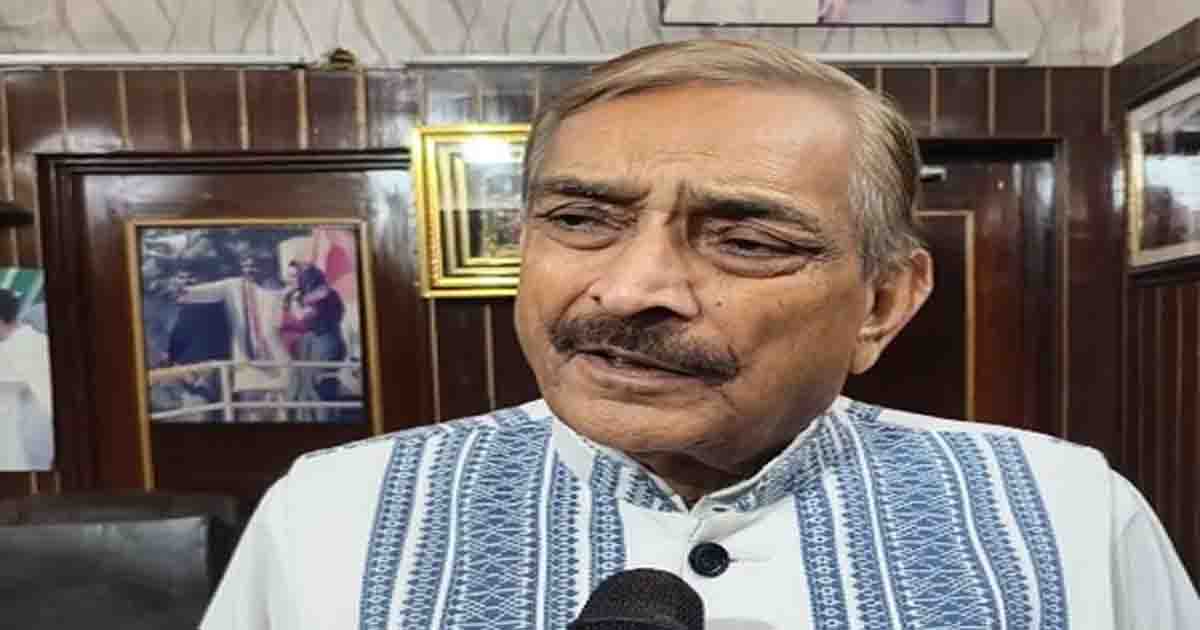
Congress MP Pramod Tiwari on Monday hit back at AIMIM chief Asaduddin Owaisi over his recent remarks, accusing him of acting as an agent of the Bharatiya Janata Party (BJP).
Tiwari claimed that election results demonstrated how Owaisi’s party had contributed to splitting minority votes, prompting him to describe the AIMIM chief and the BJP as “twin brothers”.
The exchange comes amid political preparations for the 2027 Assembly elections in Uttar Pradesh, with parties sharpening their positions and trading allegations ahead of the electoral contest.
Addressing a gathering in Uttar Pradesh’s Rampur, Owaisi had declared that he would “never make a Nehru, a Gandhi, or a Yadav” his leader. He also stressed the need to provide greater opportunities to young people from the Muslim community.
“Muslim youth have as much potential as people from other communities… However, they are not given a platform,” Owaisi had said, adding that the AIMIM would provide them with opportunities to move forward.
Responding to the AIMIM chief’s remarks, Congress MP Tiwari accused him of working to divide opposition votes in favour of the BJP.
Speaking to media, Tiwari said, “What standing does Owaisi have to even suggest someone like a Gandhi or a Nehru? His sole function, whether intentional or otherwise, is to divide the minority vote at the behest of the BJP. I can say with full confidence that this individual works for the BJP, as evidenced by election outcomes.”
Tiwari further cited electoral results in Maharashtra and Bihar to support his allegations, claiming that the AIMIM’s electoral performance had helped the BJP and its allies by splitting votes that could otherwise have benefited other candidates.
“In Maharashtra, while his party won four seats, it also caused other candidates to lose in 22 constituencies by splitting the vote, ultimately paving the way for a BJP-led government. He did something similar in Bihar … The results clearly show that he operates as an agent for the BJP. Owaisi and the BJP are twin brothers,” he added.
This comes as political parties begin gearing up for the 2027 Uttar Pradesh Assembly elections.
Tiwari also commented on the controversy surrounding the Special Intensive Revision (SIR) of electoral rolls being conducted by the Election Commission of India (ECI).
He argued that protecting citizens’ voting rights was essential and called for a change in government through the democratic process.
“The government in the country must be changed. The nation’s economic situation and foreign policy have both failed. The public wants relief from inflation and unemployment, and a change in government is essential to safeguard the right to vote. We want to change the government democratically through elections, and for that right to vote must be safeguarded,” Tiwari said.

The police on Monday apprehended a dreaded criminal following an exchange of fire in the Amdarah forest under the Orient police station area in Odisha Jharsuguda district, said a senior police official.
The Jharsuguda police also informed the media that the incident took place early Monday morning. The notorious criminal was identified as Bunty Prasad, a resident in the Hanuman Nagar area under the limits of the Orient Police Station of Jharsuguda.
Bunty has reportedly been evading law enforcement and is allegedly wanted in connection with 17 pending serious criminal cases, including attempted murder and Arms Act cases registered at Brajrajnagar and Orient police stations.
According to police, a special team from the Orient police station received reliable intelligence at around 6:00 a.m. indicating that the wanted criminal was hiding out in the dense cover of the Amdarah forest.
“Acting swiftly on the tip-off, the police personnel cordoned off the perimeter and launched a meticulous combing operation. Trapped and realising he was cornered, Bunty Prasad attempted to shoot his way out, opening sudden fire on the advancing police party,” the police official added.
Exercising restraint and acting strictly in self-defence, the police team returned controlled fire. During the exchange, a bullet struck Bunty in his left leg, causing him to fall to the ground. The police overpowered and arrested him immediately at the scene. An illegal firearm was also recovered from his possession, and his motorcycle was seized by the police.
Bunty was first rushed to the Khaliakani Community Health Centre for initial medical attention and was later shifted to the Jharsuguda District Headquarters Hospital (DHH) for further treatment.
In a separate case, the Brajarajnagar police of Jharsuguda district also arrested another notorious criminal and seized two country-made pistols and some ammunition following a raid on Monday.
Odisha Police have launched a special drive to arrest habitual offenders and criminals to avoid incidents of violence during the ongoing festive season.

Bihar MLC election: Three FIRs filed against Anant Singh, Jan Suraaj candidate Anuj Singh

‘Owaisi, BJP are twins’: Congress MP accuses AIMIM chief of splitting Oppn votes

Odisha: Jharsuguda police arrest wanted criminal after exchange of fire

‘Should face same punishment as adults’: Abu Azmi demands lowering of age of juvenile offenders to 14

Tiger Shroff firing case: 3 suspects held in Rajasthan’s Kota planned to flee to Nepal, say police

Rahul, Cong ecosystem want to force regime change: BJP after Neha Bora praises B’desh Gen-Z protest

BJP pays tribute to ex-President Abdul Kalam, recalls his enduring influence on generations of India’s youth

Attack on democratic rights: INDIA Bloc leaders on detentions of anti-ECI protestors

INDIA bloc begins protest march against ECI

Maha Congress stages agitation against Gyanesh Kumar
-

 Crime4 years ago
Class 10 student jumps to death in Jaipur
-

 Maharashtra2 years ago
Mumbai Local Train Update: Central Railway’s New Timetable Comes Into Effect; Check Full List Of Revised Timings & Stations
-

 Maharashtra2 years ago
Mumbai To Go Toll-Free Tonight! Maharashtra Govt Announces Complete Toll Waiver For Light Motor Vehicles At All 5 Entry Points Of City
-

 Maharashtra2 years ago
False photo of Imtiaz Jaleel’s rally, exposing the fooling conspiracy
-

 National News2 years ago
Ministry of Railways rolls out Special Drive 4.0 with focus on digitisation, cleanliness, inclusiveness and grievance redressal
-

 Maharashtra2 years ago
Maharashtra Elections 2024: Mumbai Metro & BEST Services Extended Till Midnight On Voting Day
-

 National News2 years ago
J&K: 4 Jawans Killed, 28 Injured After Bus Carrying BSF Personnel For Poll Duty Falls Into Gorge In Budgam; Terrifying Visuals Surface
-

 Crime2 years ago
Baba Siddique Murder: Mumbai Police Unable To Get Lawrence Bishnoi Custody Due To Home Ministry Order, Says Report